Facebook
 Google
 GitHub
 Linkedin
Boston Dynamics and Toyota Unite to Advance Humanoid Robotics
Boston Dynamics and Toyota Research Institute have embarked on a pioneering research agreement, integrating advanced AI algorithms into a general-purpose humanoid robot.
Robotics pioneer Boston Dynamics and Toyota Research Institute have entered into a joint research agreement to advance the field of humanoid robotics. The duo will leverage one another's industry and academic expertise, bringing together Boston Dynamics' humanoid Atlas robot and Toyota's large behavior models.
Boston Dynamics and Toyota Research Institute are combining their respective technologies to advance humanoid robot capabilities. Image used courtesy of Toyota
Making Science Fiction a Reality
In the summer of 2004, the film I, Robot, starring Will Smith, was released in the U.S. The film received mixed reviews concerning successful visual effects and a questionable plot. From another perspective, it was a fascinating glimpse into the future of what is now fast becoming a reality.
At the turn of the 21st century, robotics pioneers in academic institutions and industrial facilities have bolstered efforts in advancing the field of humanoid robotics for employment in healthcare services, manufacturing, retail, hospitality, and educational environments.
Humanoid robots do not tire, get ill, or require breaks like human workers. They can also lift heavy objects and undertake repetitive or labor-intensive tasks that detract from boosting operational efficiency and overall facility productivity.
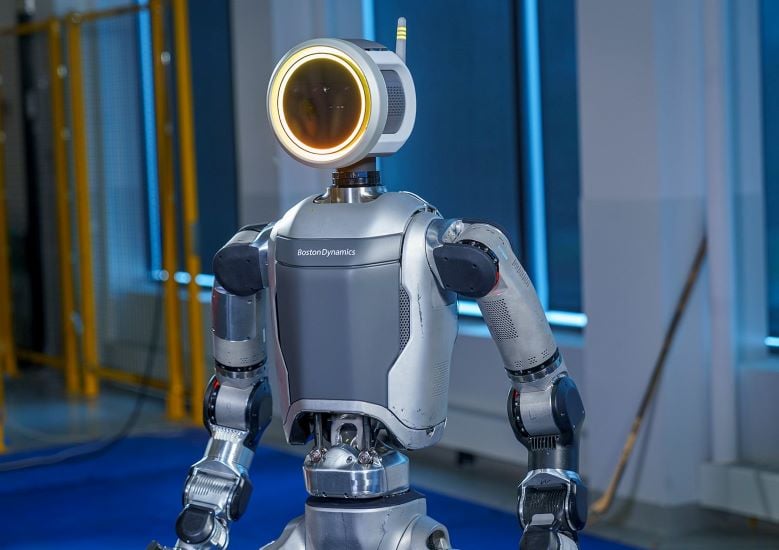
Boston Dynamics electric-powered Atlas robot is equipped to perform dynamic and dexterous tasks across manufacturing, healthcare, hospitality, and other industries. Image used courtesy of Boston Dynamics
Boston Dynamics’ Atlas Robot
Boston Dynamics' electric Atlas robot can run, jump, and traverse difficult terrain with dynamic and human-like motion. It utilizes integrated technologies including 3D vision and LiDAR, allowing for autonomous mapping and navigation, and 24 degrees of freedom for separate movement axes. The Atlas robot's articulated hands enable simple object manipulation. With its lightweight, energy-efficient design and real-time motion planning for flexibility, Atlas exhibits enhanced mobility and environmental interaction.
A demonstration of the motion capabilities and dexterity of the latest electric-powered Atlas humanoid robot. Video used courtesy of Boston Dynamics
Toyota's Large Behavior Models (LBMs)
The Toyota Research Institute is renowned for advancing LBMs for human-like robotics applications. LBMs are constructed and tailored using training-focused AI algorithms that filter through and process data (whether this be sensor, video, or motion), identify patterns, make predictions, and generate actions based on response to input data. With LBMs, robots can learn from human behavior and adjust to new jobs with less programming.
The goal of Toyota's LBM research is to increase the independence and context awareness of robots so they can interact with people in a secure and natural manner while carrying out complicated activities in dynamic settings like homes and workplaces. By doing this, Toyota hopes to increase the adaptability of robotics for useful, real-world support.
Boston Dynamics and Toyota
By combining their respective areas of expertise, the Boston Dynamics-Toyota alliance aims to improve the manipulation skills of an electric Atlas robot, enabling it to be teleoperated and configured for a variety of activities. The teams want to enhance LBMs for quick skill learning in challenging, whole-body tasks using data gathered on the robot's performance. Additionally, the research will explore basic issues related to humanoid robot training, utilizing whole-body sensing, and guaranteeing secure human-robot interactions.