Facebook
 Google
 GitHub
 Linkedin
New Partnerships Accelerate Humanoid Robotics Growth
From robotic hands to mobility spin-offs, global alliances are accelerating humanoid robotics, building design innovation, and industrial automation.
In this article, we will explore the latest initiatives and company spin-offs, focusing on advancing humanoid robotics and powering mobility. We will also cover industry partnerships that are forging ahead to revolutionize humanoid and assistive robotics in industrial and household environments, and to modify physical building architecture to enhance human-machine collaboration and independent work.
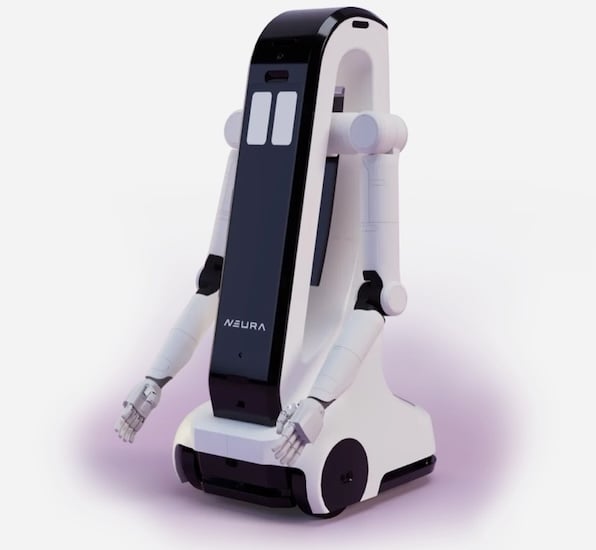
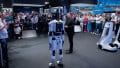
Neura’s workspace and household robotic assistant features smart navigation and collision-avoidance to keep occupants safe. Image used courtesy of Neura
Neura and Drees & Sommer Unite
Neura Robotics, based in Metzingen, Germany, is a pioneer of smart, autonomous “cognitive” robots for industrial or household environments. The company takes a “one-device” approach to the design of its robotics technologies. The company creates robots that take the concept of “everything at the tips of your fingers”, as you would expect of an iPhone, and embed it in the construction of a humanoid robot or robotic assistant. The result is a cognisant, independently operating robotic solution capable of human-machine interaction.
Neura is teaming up with the globally recognized consulting firm Drees & Sommer (DS) to redefine building design and enhance the interaction between human workers and robotic personnel. As part of a strategic partnership, Neura and DS intend to plan and operate buildings that serve as learning and interactive centers for humans and machines, optimizing collaboration and productivity.
The collaboration is also intended to produce building designs that substantially reduce human workload and enhance focus on high-level operations, including those that may involve implementing sustainability-minded practices. The Neura-DS partnership will first focus on high-demand areas with worker shortages, namely, sanitary facilities. Such facilities might include public and workspace toilet areas, as well as construction spaces that require a high standard of hygiene from the start of a project to its completion.
Schunk Gets Hands-on with Humanoid Robotics
Technology giant Schunk announced the spin-off of a new company, Schunk Humanoid Robotics, dedicated to advancing humanoid robotics for industrial applications. The company’s newly consolidated entity will focus on developing anthropomorphic robot hands (complete with arms, wrists, and five fingers) for various tasks in industrial operations.
The independent company draws on over 10 years of experience in robot gripping technologies, a well-established network of researchers and developers, innovative CoLab facilities, a global customer base, and access to the humanoid robotics market. A company dedicated to robotic hand technology can drive innovation and expedite testing and evaluation to bring products to market.
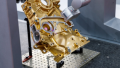
An example of combining machine vision, AI, and advanced robotics to fine-tune robotic gripping tasks. Video used courtesy of Schunk CoLab
Eaton’s Mobility Group Spin-off
Eaton intends to separate its eMobility and vehicle businesses into a new, publicly traded Mobility Group by the first quarter of 2027 (subject to legal and regulatory approvals). In addition to providing each business with a more defined strategic focus, customised resource allocation, and unique investment profiles, the split is expected to boost Eaton's organic growth and operational profits. The Mobility Group spin-off is intended to position Eaton to adjust and adapt to growing demand for power solutions across its electrical and aerospace businesses.
Mobility Group will be poised to provide safety and mission-critical solutions for managing and distributing power for commercial vehicles, light to heavy-duty trucks, and other vehicles and propulsion systems. Technological solutions include truck transmissions, clutches, valve actuation technologies, high-voltage electric vehicle fuses, and more.
As part of Eaton’s continued growth strategy, the completion of establishing Mobility will provide an avenue to enter utility, institutional, and data center markets.
Phoenix’s Technology Alliance Program
In another industry announcement, Phoenix Contact introduced the Technology Alliance Program (TAP), which comprises a global network of operational technology and cybersecurity partners. This expert network is part of a single platform, and each partner provides innovative applications covering security, data analytics, and automation for running on Phoenix’s switching and computing technologies.
TAP provides customers with the capacity to deploy third-party applications on Phoenix’s industrial PCs and EP Raptor industrial network switches. With TAP, industrial architecture is no longer diffuse, with standalone devices, but is brought together on a central, high-performance platform. Customers can benefit from vendor-agnostic tool selection, minimized points of failure, reduced cabling, reduced energy consumption, a smaller hardware footprint, and a cohesive deployment of automation and security processes.
The partner ecosystem includes OT and cybersecurity providers such as Xona, Industrial Defender, JPEmbedded, CyVault, EmberOT, PCItek, Forescout, Radiflow, and SyskeyOT.