Facebook
 Google
 GitHub
 Linkedin
Fenceless MR-1 Robot Sets New Benchmark for Human-Robot Safety
Mantis Robotics introduces the MR-1, a high-speed, safety-certified robot designed for fenceless human-robot collaboration in modern industrial environments.
Mantis Robotics has announced an industry benchmark in fast, fenceless human-robot collaboration with its ISO 10218 and ISO 13849-certified MR-1 flagship robot. The company’s main strategy is to enhance ‘collaboration’ through changing how robots and humans interact safely, preventing injury, and enhancing efficient movement and task execution.
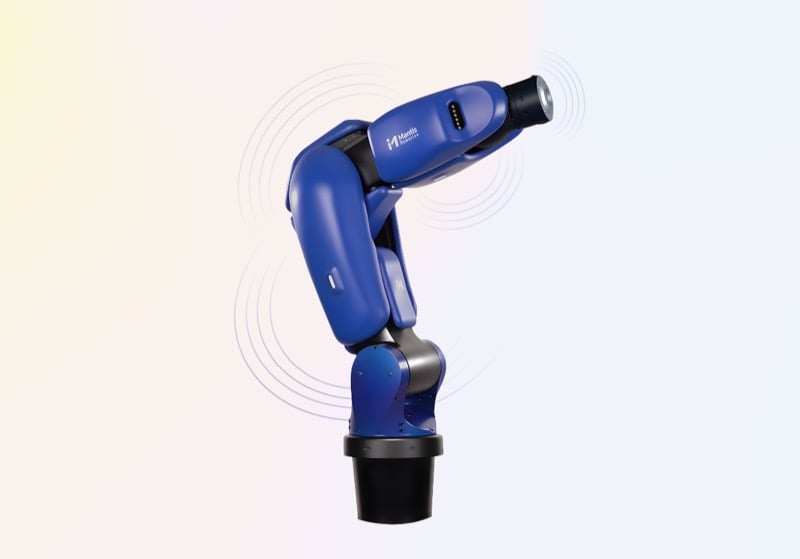
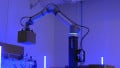
The Mantis MR-1 is a fenceless, 5 kg payload robot. Image used courtesy of Mantis Robotics
Limited, Traditional Safety Frameworks
In the early stages of human-robot collaboration, robots would be separated from human workers by monitored cages in dedicated workstations. The idea of this type of working environment is to isolate the specific work undertaken by the robot worker and keep human workers away from high-speed workflows that are not designed to accommodate flexible, changeable human work. The cages would typically use door interlocks, which, when triggered, cause the robot to execute a safety stop before a human worker enters. Entry sensors can take several forms, from LiDAR sensors (which define a safe perimeter) to curtains of infrared light (which trigger the safety stop when the film is broken). Pressure mats and proximity sensors that detect weight and proximity might also be used in a conventional caged workstation setup.
Fixed visual camera monitoring systems might also be used, with humans physically monitoring spaces. Other systems include safety-rated light mats/barriers, and/or RFID-tag-based setups for identifying tools and/or people approaching a robot interface area.
The problem with such systems is their rigidity, poor space use, workflow disruption caused by constantly paused robot movements, and human movement. Later innovations in safe human-robot collaborative work focus on intelligent robot design with embedded sensing and safety functions, so that robots respond dynamically in ways analogous to how humans do, but in a human-conscious, non-disruptive manner.
Research on human-robot collaborative work has also involved controlled collisions, which involve a gentle, or soft, collision in which the robots take in tactile force/pressure data to learn and adjust force and trajectory to avoid further collisions. While acceptable in a research laboratory setting for fine-tuning robot navigation and obstacle avoidance, this form of learning is unsafe for deployment in real-world settings.
Intelligent Sensor Inclusion
Mantis Robotics has actively researched how humans use a workspace to tailor its robotic technologies to learn, process, and respond dynamically to work most efficiently while enhancing safety.
The 5 kg payload Mantis MR-1 provides users with a 900 mm reach and a maximum speed of up to 10 m/s. The robot comes with a full (proprietary) sensor suite and employs the analytical and predictive capabilities of artificial intelligence to provide 3D spatial awareness of its surroundings. This enables detection and avoidance of objects, dynamic reaction to prevent collisions, and safe adaptation to human workers in real time. Mantis SafetyCore runs the range-based object detection ("STAR").
The MR-1 has the same footprint as a human worker, making it an attractive automation solution that fits into existing facility frameworks. Compared to other robots on the market (such as a 5 kg, 950 mm reach robot from ABB), the MR-1 features a maximum speed of 370°/sec for its first axis (ABB robot = 125°/sec). Customers can use the Mantis Studio no-code developer environment to build their robotic workflow solution with the MR-1, using a real-time 3D digital twin.
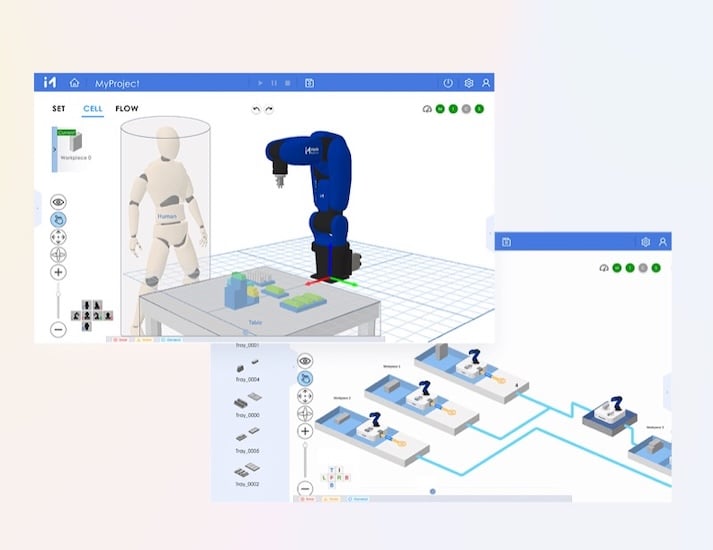
Customers can leverage Mantis’ no-code virtual developer environment to build robotic applications using auto-code generation, real-world modelling, and no CAD required. Image used courtesy of Mantis Robotics
The MR-1 has received formal safety approval under two key international standards: ISO 10218-1 (robot safety) and ISO 13849-1 (machine control system safety). Additionally, it bears a CE label, indicating that it complies with European Union equipment safety regulations. Therefore, ISO 13849-1 ensures that the robot's control system performs safeguarding functions reliably, whereas ISO 10218-1 ensures that the robot is properly designed, set up, used, and serviced.
Overall, MR’s MR-1 robot ensures speed and safety while providing the intelligent perception required to think dynamically and adapt to human workers, making the most of space and environmental parameters to boost productivity in human-robot collaborative work in industrial facilities.