Facebook
 Google
 GitHub
 Linkedin
Robot Competes in a Half Marathon — and Wins Against Humans
The race is not only for the swift, but for the smart. A humanoid robot raced past the half-marathon world record for humans at the Beijing E-Town Half Marathon.
Who remembers the creepy scene in Terminator 2: Judgment Day, where the T-1000 chases John Connor? Locked into its mission, the machine ran with perfect form to pursue a moving car. The robot moved with terrifying speed and determination. While this was science fiction in the 1990s, bipedal robots are beginning to learn to run with high levels of speed and agility.
Recently, the Beijing E-Town Half Marathon hosted a half marathon for robots. Competitors needed to be bipedal and humanoid in form. The 21.1-km course has been completed by countless humans, with the human world record for half marathons sitting at just over 57 minutes.
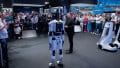
Chinese smartphone maker Honor developed a humanoid robot “Flash," which completed the half marathon in 50 minutes and 26 seconds. Video used courtesy of HONOR
Half-Marathon Results
This year’s fastest robot, “Flash,” completed the race in 50 minutes and 26 seconds. Flash, developed by Chinese smartphone maker Honor, was significantly faster than last year’s fastest robot (2 hours, 40 minutes, and 42 seconds), marking drastic improvements in technology over the past year. The robot was also faster than the world-record-holding human, and significantly faster than the author of this article could ever hope to run.
The Good, the Bad, and the Ugly
The human-robot half marathon showcased the technological prowess of multiple robotics companies. A fast, agile, and coordinated humanoid capable of competing in this foot race requires both advanced, high-speed hardware and efficient, intelligent software. Most of the robots in this race demonstrated both traits.
However, not every robot was a worthy opponent. At least one robot did what many humans would do at the thought of running a half marathon: it collapsed at the starting line. Another seemed to have no qualms about bumping into the walls and potentially other competitors. “Rubbin’ is racin',” as they say.
Most of the robots prioritized form over function. While a human marathon might demonstrate the athletic ability and the pleasing aesthetic of bodies in motion, these robots varied in appearance, from humanoid-looking to downright ugly.
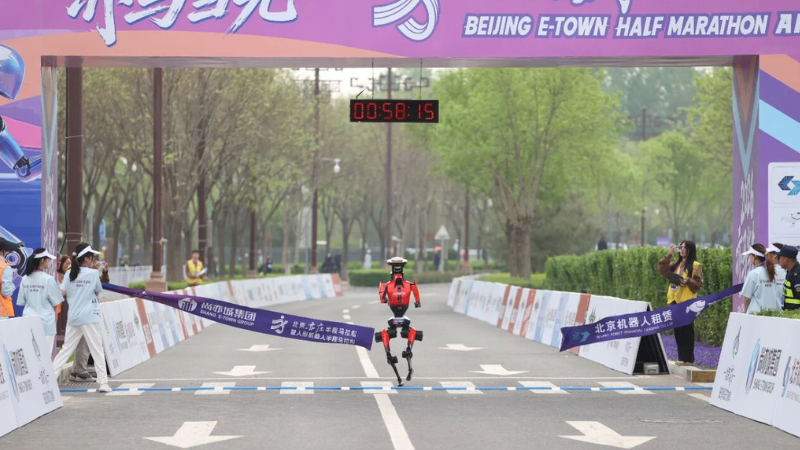
This body is built for running, not for looking at. Image used courtesy of english.beijing.gov.cn
The Future of Robot Marathons
One might incorrectly conclude that human participation in marathons will decrease thanks to the new robot competitors. However, organizers ran the robots in separate, parallel lanes rather than directly against humans, just as nobody expects a thoroughbred horse to compete in the Indianapolis 500.
Ultimately, this type of “robots only” race will fit a niche market; the human skill that is tested will be in the robot designers, not in the physical race itself. Crowds drawn to the technical event of battling robots will also be intrigued by robot foot races. Others, particularly those who found the Terminator creepy, will find robot marathons creepy as well. Televised robot foot races will not be for everyone.
Thankfully, unlike the T-1000, these robots are not chasing after humans. They are helping them. Many of the technologies are transferable to other applications. The winning robot won because its design mimicked the motion of the fastest athletes, featuring 95-centimeter-long legs.
The closer a robot can mimic human gait, the more doctors can learn about repairing bone and tissue after injury. Furthermore, the winning robot had a liquid cooling system that could optimize heat transfer in other systems.