Facebook
 Google
 GitHub
 Linkedin
KUKA Brings the Fleet: Mobile and Fixed Robots at MODEX
KUKA presented a compelling view of Physical AI at MODEX, integrating heavy-duty robots, mobile platforms, and software to address the gap between the supply chain's current capacity and growing demand.
Years ago, supply chain conversations focused on automating simple, consistent processes. With these challenges now solved, companies have shifted to presenting solutions for a landscape that is variable, uncertain, and ever-changing. KUKA lives right at the center of this evolution
In its MODEX display, KUKA captures the true nature of what the company calls Automation 2.0. This new term is called "Physical AI" by others. Whatever the name, it represents a shift to interpreting the intent of actions and tasks, rather than simply responding to consistent stimuli with pre-programmed motion paths.
The KUKA booth captured this vision of intent. It goes beyond simply assigning the robot to figure out HOW to do the task. They take a step back and translate WHAT is supposed to be accomplished in the first place.
Scaling Flexibility with an All-Payload AMR Portfolio
The standout of KUKA’s exhibit is autonomous handling with the KMP 250P, a compact mobile robot (AMR) designed for agile material handling with a high payload for its size. KUKA prides itself on being a rare robot manufacturer that presents a catalog of both fixed and mobile platforms.
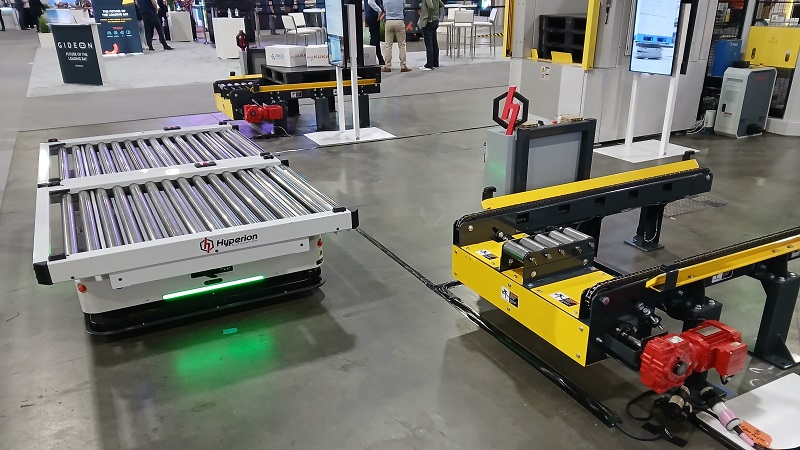
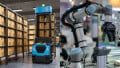
The AMP 3000, KUKA’s heaviest-payload AMR, in action.
Unlike traditional automated guided vehicles (AGVs) that follow fixed paths, AMRs use 3D mapping and vision technology to navigate environments without fixed paths or markers. These sensor packages can detect moving obstacles, like humans. This makes AMRs more practical for existing situations because they don’t require absolute isolation for safety.
Mobile Platforms + Robotic Palletizing
Every hand-off point in logistics is a possible introduction of inefficiency. We may be able to automate the palletizing, but can we feed the products as quickly as required? Can we transport and replace pallets as soon as they are full? If not, we have severely decreased our ROI. KUKA addressed this point by demonstrating synchronization between the palletizing robot and the AMR.
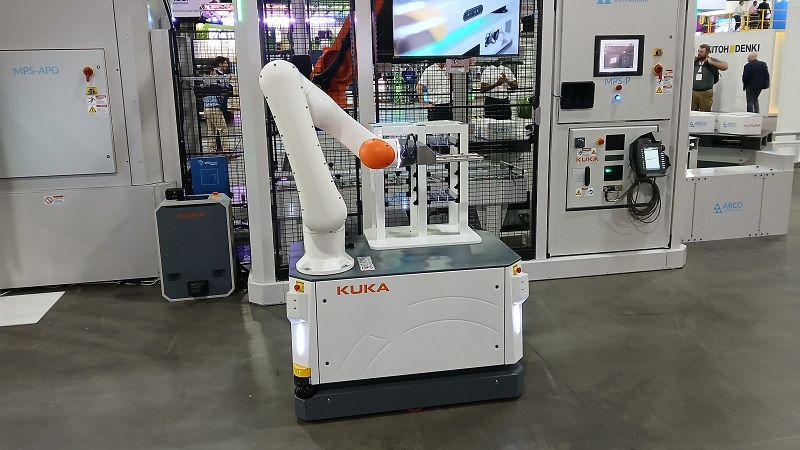
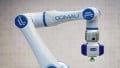
Mobility with collaboration: an LBR cobot mounted on an AMP mobile platform.
In this combined solution, AMRs serve as the warehouse's transport system, delivering goods directly to and from the palletizing cell. This reduces the need for fixed conveyance and forklift paths. By eliminating the need for fixtures, this integration reduces the hard physical footprint of automation. In turn, this can open the door to improvements for both large and small facilities.
AI Goes Physical With KUKA AMP
Physical AI, or Automation 2.0, is a concept intended to allow robots to perceive, decide, and act autonomously in unstructured environments. At the recent NVIDIA GTC in March, KUKA introduced the Automation Management Platform, or AMP. This software platform interacts with the robot hardware, providing a consistent location for AI applications to share data from the process and interact with the robots' motion.
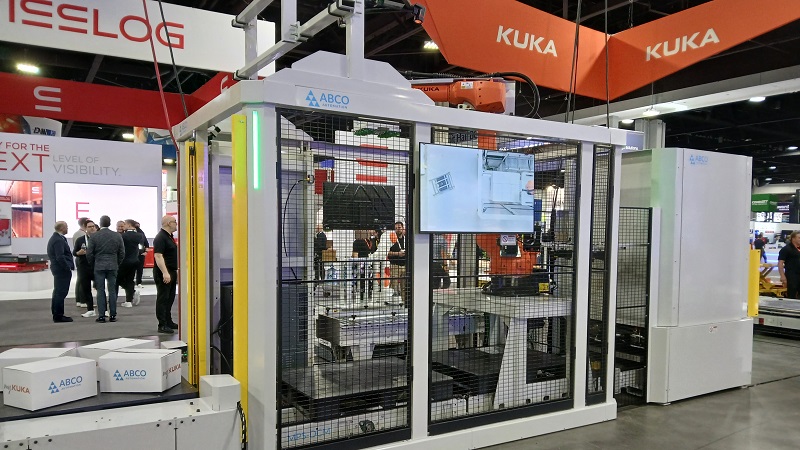
A palletizing cell with mobile robots underscores the importance of fleet management software and full manufacturer support.
With KUKA AMP, a facility’s entire fleet (including both mobile and fixed robots) can be managed via a single interface. In simplified terms, instead of programming a specific path for each variable condition, programmers can set a goal, such as “Palletize objects from this conveyor.”
The system can optimize all the pick points and navigation routes for multiple robots working together. This intent concept reduces the traditional barrier that required programming experience. Some knowledge will still be required, but it allows engineers to oversee complex robotic systems rather than focusing on programming each unique device in isolation.
A New Era for Logistics
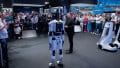
KUKA has a clear message for the world: robot programming is no longer done one piece at a time. The whole system acts like a body that needs bones, muscles, a nervous system, and a brain to complete complex tasks.
At the KUKA booth, attendees can experience each of these pieces: the robot muscles, the data-sharing network that provides the nervous system, and the brain, which is the new AMP platform.