Facebook
 Google
 GitHub
 Linkedin
Robotics Research Driving Workforce Diversity and Automation
Learn how new robotics research supports neurodivergent workers, advances soft robotics, and accelerates automation in marine manufacturing.
Autonomous mobile robots can improve the way humans work. For neurodivergent individuals who face barriers to integrating in industrial settings, advanced AMRs can serve as valuable work colleagues, encouraging neurodivergent workers to deliver their best performance. In this article, we will provide an overview of the latest robotics research and technologies facilitating workforce diversity, energy-saving soft robotics, and enhanced automation adoption.
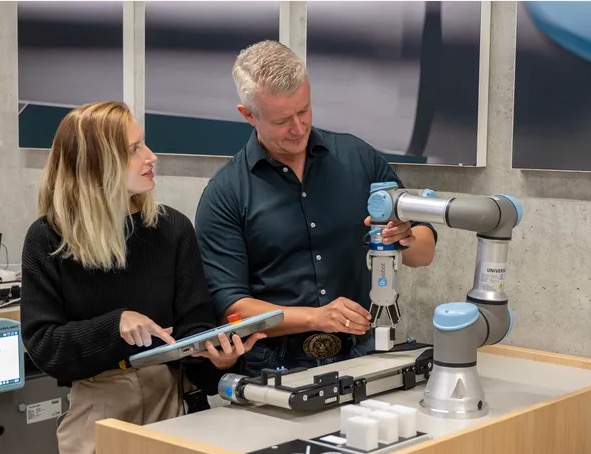
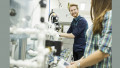
Robots could work alongside neurodivergent workers to enhance comfort, confidence, and competence in industrial factories of the future. Image used courtesy of UR
Barriers Facing a Neurodivergent Workforce
According to a report from the U.S. Centers for Disease Control and Prevention, around 1 in 31 children has been identified as having autism spectrum disorder. Some believe that as these children grow and eventually enter the workforce, they will bring a competitive edge by bringing unique skills and a novel way of working.
According to the Autism Society, 85% of autistic individuals holding a college degree are under- or unemployed. Apparently, only around 30% of individuals with autism express their neurodivergence to their employer. Barriers to employment for these neurodivergent individuals include communication challenges, difficulties with social interaction, and a lack of supportive tools and/or workspace offerings that enhance individual development. Employers might also lack knowledge and awareness of what exactly neurodivergent workers need to thrive.
AI-Powered Cobots for Supporting Neurodivergent Workers
Virginia Tech is working on developing collaborative robots to work alongside neurodivergent workers to help provide constructive feedback and support. It is leveraging the advancements in AI to create human-focused technologies that cater to the onboarding and development of individuals with autism. Diversifying the workforce and evolving businesses are dependent on the people and technologies employed.
The research relies upon self-determination theory, which is a principle from the field of psychology that proposes that people are at their best when three fundamental needs are met: relatedness, autonomy, and competence. Using advanced hardware and complex AI algorithms to embed safety functions will allow the researchers to develop cobots aligned with this theory.
The robots would be programmed to work safely, encourage worker autonomy and competency, and help build relationships. The researchers seek to use AI-supported robots in the industrial sector to improve autistic workers' participation and well-being. These robots would serve as an intermediary between neurotypical and autistic coworkers, as opposed to replacing human workers.
Air-Powered, Synchronized Soft Robots
Researchers from the University of Oxford have developed a novel kind of soft robotics technology, one that does away with complex control systems combining sensors, electrical components, and programming, relying on air pressure alone. The soft robots under study are tabletop models, although the researchers say that the underlying design is scale-independent. The researchers seek to expand their project, creating standalone energy-saving and cost-saving locomotors for use in harsh, otherwise energy-demanding environments such as industrial and manufacturing settings.
Soft robots developed by RADLab researchers move with self-autonomy; no programming or electronics, more like the movements of biological structures found in nature. Video used courtesy of Oxford Engineering
The research team created multi-functional fluidic units, each configured as a sensor (attuned to changes in air pressure), an actuator (pouch, responding to air pressure changes and generating a movement in response), and a soft-sleeve pneumatic valve (mediating air flow; either switching the unit on or off). These elements can work independently or together. When these three elements work together in an individual unit under constant pressure, they work synchronously and autonomously as one. When the team linked these units in particular configurations, the result was shaker and crawler tabletop bots that move autonomously, rhythmically, and entirely mechanically without the need for complex electronics.
The synchrony displayed by the bots was only apparent when multiple bots were linked together. The researchers employed the Kuramoto model, a mathematical model that explains the way oscillators synchronize when linked together. The resulting self-coordinated autonomy in response to environmental stimuli is a basic principle seen in biology, from a single cell to a whole organism.
Universal Robots and Viam
Universal Robots also announced its recent collaboration with Viam to advance marine manufacturing. The duo is combining their respective technologies and expertise to create a quick-to-deploy automated hardware system for sanding fiberglass, necessary in building yachts. By combining Viam's AI-powered software with UR's cobots, the partnership provides a solution that eases manual burden and addresses severe labor shortages.
The technology is highly adaptable; Viam's sophisticated software layer makes it easy to swap between various robot arm sizes and adjust particular components, enabling rapid adoption without requiring intricate redesigns. The platform is designed to support additional tasks such as decorating (namely painting) and polishing across wider industries. The system will have its European debut at Metstrade 2025.
Featured image used courtesy of UR