Facebook
 Google
 GitHub
 Linkedin
B&R Launches Fast, Open Codian SCARA Robots for Industry Automation
B&R’s new SCARA robots simplify deployment with open mechanics, mapp Robotics software, and platform-agnostic integration for rapid industrial automation.
B&R (a member of ABB Group) is promoting robotic system adoption with the introduction of control platform-agnostic, space-saving, development time-cutting, SCARA robots. The company has expanded its Codian robot line with the latest SR SCARA robot series in a way that reduces programming expertise, improves integration, and drives more rapid deployment.
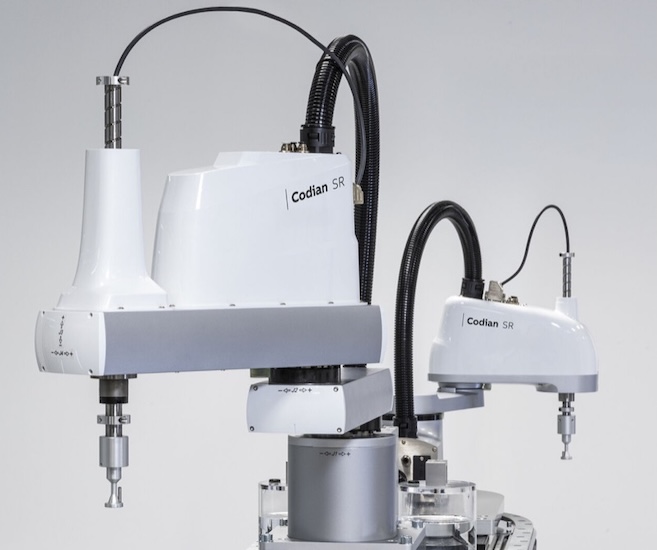
B&R's SCARA robots are designed to be modular and compatible, allowing for the reach, payload, and axis adjustment to meet the demands of particular applications. Image used courtesy of B&R
Codian Mechanics
B&R offers its customers more than 100 robot variants, catering to applications ranging from food and beverage to pharmaceutical packaging and pick-and-place. Bots from Codian Robotics’ HD/OS series feature a hygienic, corrosion-resistant design with an ingress protection rating of IP69K, providing complete protection against the intrusion of dust and resistance to high-pressure water jets. Made from US FDA-compliant materials, the HD/OS series bots can be used within the food and beverage industry, including within raw food processing.
The D2, D4, and D5 series bots from Codian Robotics (which integrate with B&R technologies) are made to satisfy a variety of automation requirements, with a primary focus on top-loading and high-speed applications. The Series D2 has a max payload of 125 kg and configurable rotational axes to accommodate vertical and two-dimensional movements. This makes it perfect for tertiary packaging, container loading, and product organization—even in locations with limited space or stainless steel. The TD4/TD5 is ideally suited to space-limited applications where an overlapping work area and the integration of two bots in half the space maximise picking rates.
Video used courtesy of B&R
The bots feature open robot mechanics (with no controllers or motors) for broad control system integration. The mapp Robotics open software platform provides developers and machine builders with pre-built software modules to expedite the development process. No experience with robotic programming languages is required. Features and functions include standard control and commissioning, workspace monitoring, compressor, and feed-forward. Users can benefit from other integrated functions, such as web visualization, alarm system, and user management.
The New Codian SCARA Series
B&R is adding to its Codian line-up with the new SCARA series, providing users with four degrees of freedom, rapid motion, and high-performance repeatability. The bots are compact with a payload capacity between 3 and 65 kg, and facilitate installation in clean room environments.
The latest SCARA robots uphold B&R’s open robot mechanics philosophy, which is adaptable and integration-friendly, allowing machine builders to deploy robotic systems without the constraints of a proprietary environment. This open approach side-steps integration barriers and facilitates setup across any control platform.
B&R’s Codian SCARA bots are compatible with third-party elements and take advantage of mapp Robotics, which combines HMI, control, and mobility in one environment. These robots are highly interoperable and designed to adjust to changing industrial needs, maximizing scalability and safeguarding long-term investments. They also embrace open communication standards.
While some customers may be attracted to the open robot mechanics approach, others might wish to take advantage of the machine-centric robotics approach, where the SCARA bots are native to the control (as part of B&R’s mapp technology and Automation Studio) and architecture and engineering system. Human machine interface, logic, motion, and safety are all accessible within a central, unified platform. Developers can employ the same logic and tools to program the robot and system.
Customers can synchronize SCARA bots with sensors, actuators, cameras, and conveyor systems in real time. This can help reduce the complexity of troubleshooting and diagnostics, which ultimately reduces downtime.
Related Content