 Facebook
 Google
 GitHub
 Linkedin
Deliveroo and Coco Robotics Pave the Way for Autonomous Robotic Delivery in the UK
Coco Robotics provides autonomous delivery in London and five other UK towns, and Deliveroo brings its customers its first robotic delivery service.
Automated robotic deliveries are expanding across the U.S. and the UK, with Coco Robotics (CR) and Deliveroo teaming up to introduce fully electric mobile robots that deliver short-distance goods to customers in London and five other UK towns. Deliveroo began in London in 2013, launched by founders Will Shu and Greg Orlowski. The London launch of Coco’s robot fleet and Deliveroo’s first autonomous robotics delivery service is intended to reduce pavement traffic and expand delivery capacity for local businesses.
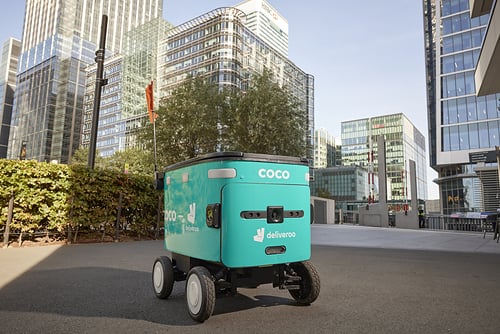
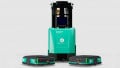
Deliveroo and Coco Robotics are taking to London's streets with smart, last-mile autonomous robotic delivery. Image used courtesy of CR
Perceived Benefits of Autonomous Delivery
Autonomous mobile robots that intelligently navigate busy urban streets at a walking pace (with built-in safety features) can reduce foot and road traffic while boosting local business growth. Businesses can scale while reducing the need for cars or motorbikes, which in turn lowers emissions and congestion. Using robots also means consistent operations that don't rely on biological needs.
While human riders may suffer from fatigue or illness, mobile delivery bots can operate 24/7 without needing to call in sick. That said, the UK rollout of Deliveroo's automated delivery service will begin alongside delivery fulfillment through Deliveroo’s broad rider network. The added autonomous mobile bots provide an extra perk to the service, intended to optimize delivery flexibility, reduce costs for merchants and customers, mitigate environmental impact, and enhance the customer experience.
For safety, CR mobile robots use onboard AI, cameras, and sensors to detect stationary and moving objects, including cyclists, pedestrians, and pets. Built-in programs allow the bots to slow down or stop completely to avoid objects and prevent unnecessary accidents. Remote human pilots step in when the robot encounters a tricky situation, such as a busy street crossing or construction zone, navigate the bot through or around the area, and hand control back to the bot to complete its delivery.
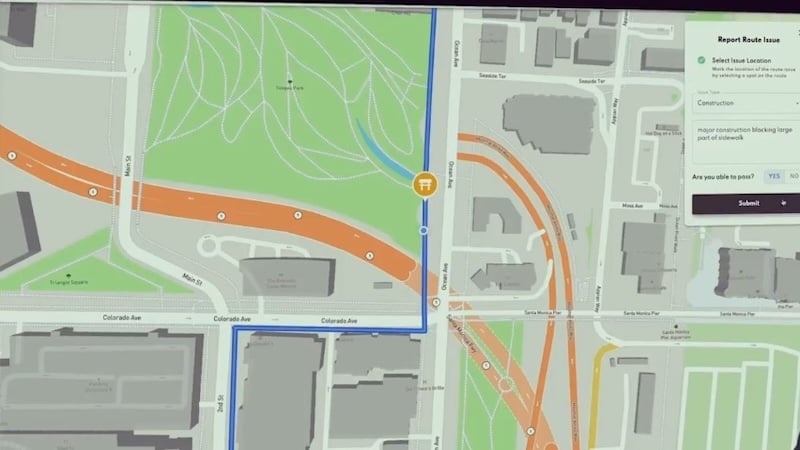
CR bots use advanced algorithms and real-time data analytics to navigate sidewalks safely and optimize delivery. Image used courtesy of CR
Growth Areas Across the UK and the U.S.
Before the UK rollout of CR Robots, the company sought to solve last-mile logistics challenges in busy, congested urban areas by starting with human-piloted systems and scaling capacity through onboard physical AI, hybrid sidewalk-and-road capabilities, and safety improvements. The CR mobile bots use a "human-in-the-loop" hybrid driving model to steer clear of potential accidents within bustling urban environments.
Los Angeles and San Jose, California, provided high-footfall proving grounds for CR’s pave-side bots. Coco also supports high-volume restaurant operations and customers in Chicago and Miami, where the robotics company operates in neighborhoods such as Miami Beach, Wynwood, Brickell, and Downtown Miami. CR also operates in Helsinki, Finland, partnering with Wolt and Uber Eats. Deliveroo and CR will launch the delivery service in Canary Wharf, London, this October, followed by expansion to Milton Keynes, Leeds, Stockton-on-Tees, and Nottingham in the coming weeks and months.
Other sidewalk delivery-style autonomous robot fleets operating across the U.S. include Starship Technologies and Serve Robotics. Serve Robotics uses four-wheel-powered robots with interactive digital eyes to deliver restaurant food via well-known third-party platforms like Uber Eats and Grubhub in densely populated urban areas. Starship Technologies is an industry pioneer that uses an extensive fleet of six-wheeled robots in partnership with leading supermarket chains, focusing mainly on regional grocery and retail delivery.