Facebook
 Google
 GitHub
 Linkedin
Emerson’s DeltaV Edge Environment 2.0: Now With Batch Data Processing
Version 2.0 of Emerson’s DeltaV Edge Environment incorporates batch data and eliminates data siloing.
Emerson has announced the latest update to their DeltaV Edge Environment for data analysis and process control. In the newest version, batch processing data can be evaluated, which is particularly valuable in life sciences research and production environments. Version 2.0 includes all of the tools that previous versions featured, such as the ability to integrate with various control structures and predict how system changes will impact production.
The Challenge with Batch Processing
The major challenge with batch processing data analysis is recognizing that data can still be compared between batches. Too often, batch processes are treated as one-time events, and the data is stashed away somewhere, with very little of it being used in future processing. This form of data siloing is less common in continuous processes but is often treated as a natural byproduct of batch processing. Trends can be hard to recognize through simple observation, and the conditions that created one batch can seem unrelated to another batch.
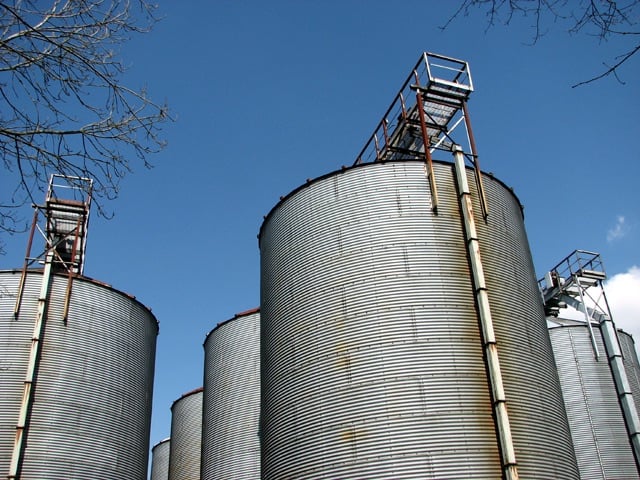
Don’t let batch data get trapped here! Image used courtesy of Evelyn Simak via Wikipedia Commons (CC BY-SA 2.0)
The data collected during these batch runs can be valuable for other batches or continuous processes if properly extracted and analyzed. If properly identified, small signals across multiple batches can also lead to more consistency between future batches.
DeltaV Edge Environment 2.0
Emerson’s DeltaV Edge Environment version 2.0 has been explicitly designed to incorporate batch data into analysis. The DeltaV environment already leverages AI and machine learning techniques to look for important trends in the data. Furthermore, it provided a bridge between the Operational Technology (OT) and the Information Technology (IT) meshing data and hardware. The real advantage of version 2.0 is the ability to detect trends in more types of data, such as batch processing and data silos that have been previously inaccessible or expensive to locate and process.
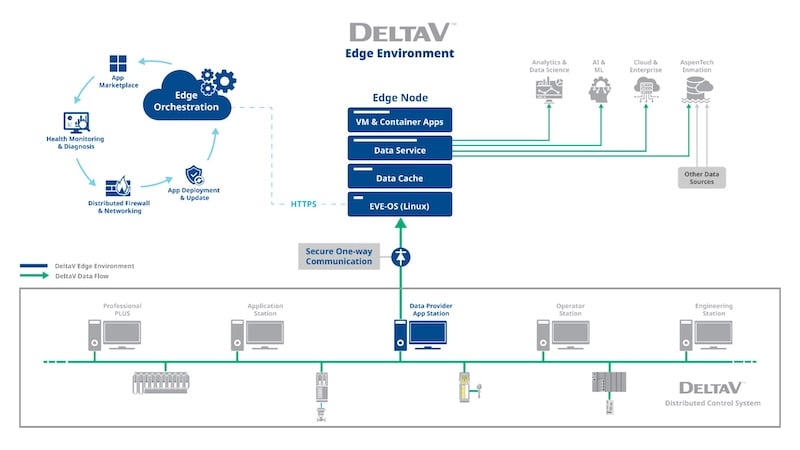
This schematic shows how the DeltaV Edge Environment connects various systems and processes to manage data and processes. Image used courtesy of Emerson
Regarding architecture, the DeltaV version 2.0 is similar to previous versions, leaving the end user with familiar interfaces. The data provider app station sends data to the edge node, which can then be accessed from a secure data service provided by the edge node. This information can be used directly, stored on the cloud, or combined with additional data to find more insights into production trends. From there, key process indicators can be predicted, even with changes to processing, and can also be applied to batch and continuous processes.
Targeted Industries
While Emerson specifically mentions life sciences, data silos exist in virtually any manufacturing environment. Anywhere batch data gets squirreled away, and every case treated as a “one-off” is a potential application for the newest version of the DeltaV Edge Environment 2.0. Small production runs of chemicals, such as dyes and paints, pharmaceuticals, and even some semiconductor processing applications, will benefit from the most recent upgrades. Overall, the Emerson DeltaV Edge Environment 2.0 makes data analysis, including that from batch processes, more useful for driving decisions.
Featured image used courtesy of Emerson