Facebook
 Google
 GitHub
 Linkedin
Inbolt Expands AI-Guided 3D Vision Robotics to U.S. and Japan
GuideNOW brings AI and 3D vision to robot guidance, helping manufacturers cut downtime, adapt faster, and reduce waste in dynamic workflows.
Balancing the production line while striving to meet consumer demand requires agility and intelligence. This is one of the reasons Inbolt is invigorating its existing and future customer base with a plug-and-play, AI-guided, vision-enhanced robotic solution, GuideNOW. Inbolt announced the expansion of its business across Japan and the U.S., through which the company seeks to strengthen its industry connections (including Beko Stellantis, Volkswagen, Ford, Renault, and Beko) and consolidate its position as a leading provider of robotic guidance systems.
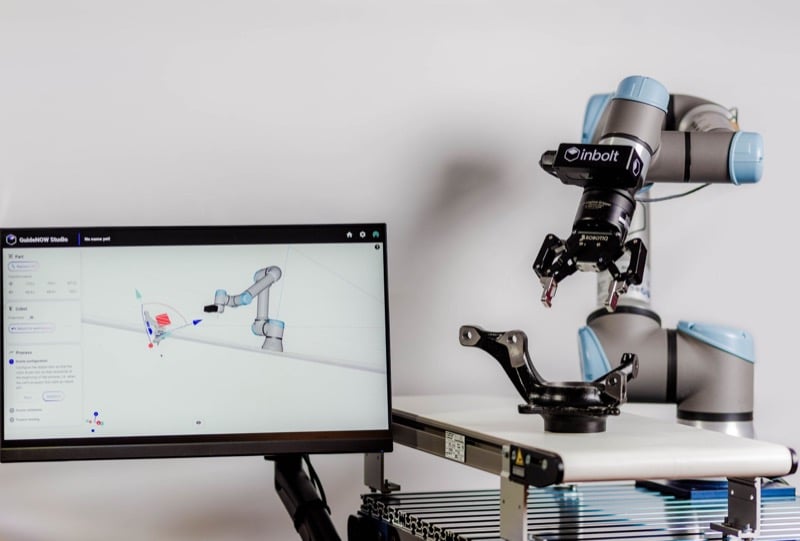
GuideNOW Studio provides a virtual space to add CAD models, train AI, optimize workflows, and do so within 30 minutes. Image used courtesy of Inbolt
Enhancing Agility Through AI and Machine Vision
Manufacturers are turning to intelligent automation to fast-track the production process and integrate flexibility into their workflows, avoiding rigid line production deficits such as costly retooling and machine re-programming. Any time spent retooling machines and modifying setups to accommodate new machine-learning models means wasted time, or technically, waiting waste, which negatively impacts uptime.
Manufacturers are finding new ways to harmonize Takt time and production time, where Takt time represents the rate at which goods/parts must be manufactured to meet consumer demand. Manufacturers are seeking innovations in AI and vision-backed automated robotic machinery to help adapt quickly to changes in consumer demand, and by extension, Takt time, to balance line production.
GuideNOW
Inbolt’s AI-backed, 3D machine vision-integrated GuideNOW real-time robot guidance solution allows users to connect using any hardware, localize parts, orient robots, change part models rapidly to suit varying production demands, and work in dark environments, promoting lights-out operations.
The GuideNOW solution includes a robot-mounted 3D camera, AI-guided part localization, and the GuideNOW Studio web application for training AI algorithms on computer-aided design (CAD) models or 3D scans. Inbolt says its software is 100 times faster than other current, advanced algorithms and that the complete GuideNOW solution is ideal for use across semistructured, structured, and unstructured environments.
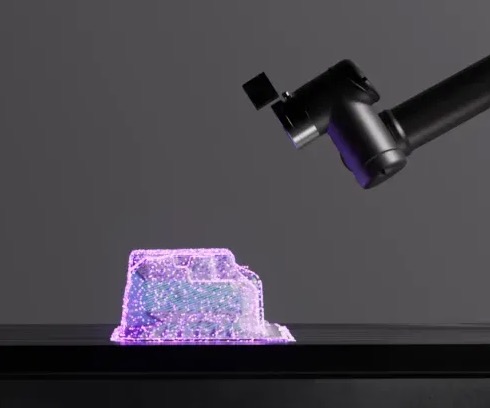
Vision sensor data combines CAD models/scans and AI to localize parts and adjust robot orientation. Image used courtesy of Inbolt
The plug-and-play nature of GuideNOW makes the solution approachable to more novice users, and CAD model training saves time, taking up to 30 minutes. Once the camera is mounted to the desired robot, the AI is configured and trained offline in GuideNOW Studio. CAD models are fed into the system, creating a digital twin, and elements of the surrounding environment are also included (such as a table, the working cell, and jigs). During operation, the 3D camera collects data, which the AI uses to inform the robot of the correct trajectory required to execute the workflow process in the right position.
In terms of aiding Takt time and production, the GuideNOW solution reduces programming time, makes real-time process modifications, and removes the costs associated with index tooling and custom jigs. The solution also ensures that robots and the parts they handle are not damaged by correcting and fine-tuning robot trajectories. These capabilities reduce inventory waste, material waste (from part damage), waiting waste, and part and equipment costs, and overall, they serve to maintain and even enhance productivity for manufacturers.
Promoting Intelligent Automation and Reshoring
Currently, factory robots made by ABB, FANUC, and Universal Robots are coupled with Inbolt's 3D vision and AI-backed technologies. Inbolt's technologies have been installed in over 50 facilities globally, minimizing downtime and part rejection rates, and by extension, supporting over 20 million robot cycles in the first half of 2025, maximizing operational efficiencies.
The company's $17 million Series A funding supports planned growth within the U.S. and Japan, which intends to serve businesses that require more intelligent, flexible, automated technology. Inbolt will set up shop in Detroit, emphasizing reshoring initiatives. The company will focus on Japan's consumer electronics and automotive sectors, in keeping with the nation's investments in automation and AI.
Dark Factories of the Future
Inbolt believes its enhanced 3D machine vision technology is moving the industrial sector closer to lights-out operations, where machines can run 24/7 at all hours, improving throughput and productivity.