Facebook
 Google
 GitHub
 Linkedin
Danfoss Brings a Bigger Toolbox to HVACR with the iC7 Series
The iC7 HVACR portfolio unifies motor control, harmonic mitigation, and predictive monitoring in a single platform for buildings.
At AHR 2026, Danfoss introduced the iC7-HVACR drive portfolio, a unified platform that combines variable-speed drives, ultra-low-harmonic drives, and bypass configurations for HVACR systems. The series is designed for direct integration into current building management systems and supports compliance with electrical performance standards. Each drive has embedded control, integrated sensing, onboard cybersecurity hardware, and harmonic mitigation within a single architecture intended for commercial HVACR infrastructure.
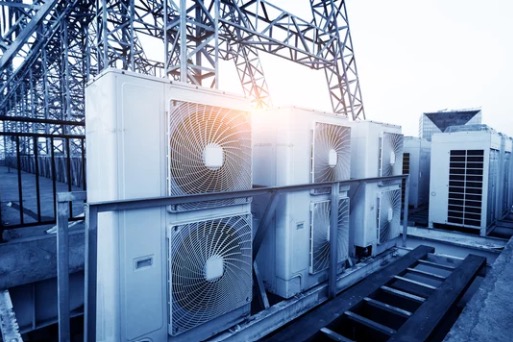
The iC7 HVACR drive portfolio features VSDs with ultra-low harmonic drives and bypass configurations that are easily adaptable to building management systems. Image used courtesy of Adobe Stock
Drive Platform and Embedded Control
All iC7-HVACR drives integrate onboard control functions intended to reduce dependence on external PLCs or dedicated HVAC controllers. Embedded sensors and HVACR-specific application software enable localized control, monitoring, and diagnostics within the drive itself, helping reduce panel components and simplifying integration with the user’s current Building Management Systems.
For cybersecurity, the platform also uses a hardware-based cryptographic chip to support device-level protection in networked environments. Thermal management is addressed through a back-channel cooling design that routes heat away from the enclosure. Danfoss indicates this approach can remove up to 90% of heat from electrical cabinets, reducing cooling requirements in mechanical rooms and supporting higher power densities in HVACR installations.
Ultra Low-Harmonic Variant
The ultra-low-harmonic versions of the iC7 incorporate an active rectifier front end to control input current distortion at the source. In this configuration, total harmonic current distortion is specified below 3%, supporting compliance with IEEE 519, and rather than relying on external passive filters or multi-pulse transformer arrangements, harmonic mitigation is handled inside the drive enclosure. That approach reduces the amount of additional equipment required in the electrical room and is typically specified in facilities where utility interaction and power quality are closely monitored, including healthcare environments, large commercial buildings, and data centers. In those settings, maintaining low distortion and predictable electrical behavior is often a design requirement rather than a performance upgrade.
Predictive Monitoring and Reliability.
The platform uses a closed-loop, edge-based condition monitoring designed to support predictive maintenance strategies. The drive continuously evaluates operating parameters to detect anomalies before faults occur.
Motor protection functions are built into the system to reduce wear and support uptime. Integrated power measurement and electronic overload functionality provide additional system-level protection.
iC7-HVACR Bypass Configuration
The iC7-HVACR Bypass uses the same control platform as the drive variants, eliminating the need for a separate add-on panel. It also provides monitoring, communication, and diagnostics in both drive and bypass modes, ensuring visibility to the Building Management System even when the motor is directly powered. The bypass assembly includes integrated sensing and centralized wiring and meets UL61800-5-1 safety standards for adjustable speed electrical power drive systems.
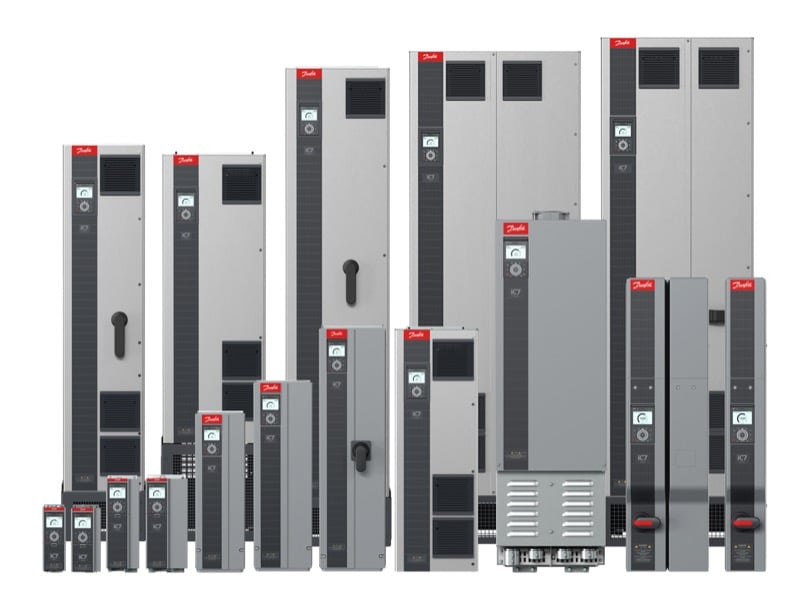
Danfoss has recently introduced the iC7HVACR drive portfolio. Image used courtesy of Danfoss
The iC7-HVACR family offers standard variable-speed drives, ultra-low-harmonic versions with active rectifiers, and coordinated bypass configurations. All models feature consistent control interfaces, communication options, and monitoring functions, simplifying specification and deployment in large commercial facilities. Instead of using separate drive families for harmonic mitigation, bypass, and standard applications, the iC7-HVACR series serves as a unified platform for HVACR motor control, power-quality management, and system monitoring.