Facebook
 Google
 GitHub
 Linkedin
Robotics Growth Drives FANUC’s Major Michigan Investment
FANUC will invest $90 million in a new Michigan facility to expand U.S. robotics production and support growing North American demand.
FANUC has announced a $90 million investment in a new 840,000-square-foot Michigan facility to expand robotics and automation production for North America. The project is expected to increase manufacturing capacity, improve customer response times, and support growing demand for industrial robots in the U.S. market. Alongside the production expansion, the company is also opening its FANUC Academy training center to help address workforce shortages and build future automation talent.
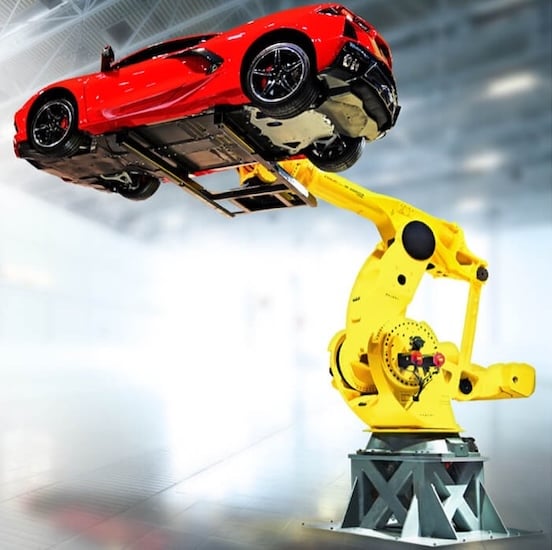
The global industrial robotics market is set to reach new heights as demand for faster goods production and delivery grows. Image used courtesy of FANUC
The Industrial Robotics Market
According to Grand View Research, the global industrial robotics market is expected to grow from around $34 million to nearly $61 million with a compound annual growth rate of 9.9% between 2025 and 2030.
Consumer demand for goods and products, particularly their fast delivery, is driving this exponential growth. Businesses are turning to the subscription-based robots-as-a-service (RaaS) model to eliminate the high upfront costs of onboarding robotics solutions, with RaaS providers helping orchestrate installation, upgrades, and maintenance to maintain business productivity. This model reduces inertia towards adopting robotic solutions and broadens accessibility.
Robotics technologies are helping businesses achieve sustainability goals and adopt eco-conscious practices in line with government policies and regulations, urging companies worldwide to lower their carbon footprints and energy use. Robotics and automation solution providers have designed their deliverables to consume less energy, reduce waste, reduce material use, and minimize their carbon footprint by adopting renewable energy sources, using less cabling, and leveraging AI to optimize performance.
AI and Machine Learning
The incorporation of AI and machine learning enables robotic machinery to collect and process large amounts of data and respond dynamically, with intelligence designed to enhance safety, optimize performance, and reduce downtime. In terms of software, machine learning uses robot data and historical maintenance data to execute predictive maintenance and keep operations on track.
North America received a 8% revenue share in 2024 and is currently experiencing growth in industrial robot adoption. There is a need for productivity-boosting tech and intelligent tech that can augment human workers' work. Robots can help tackle repetitive, mundane tasks, freeing up workers to focus on higher-value work. Robots can also take on more heavy-duty, high-risk tasks and enhance worker safety. Researchers and robotics experts are also incorporating large language models to interact verbally with human co-workers, which may enhance well-being.
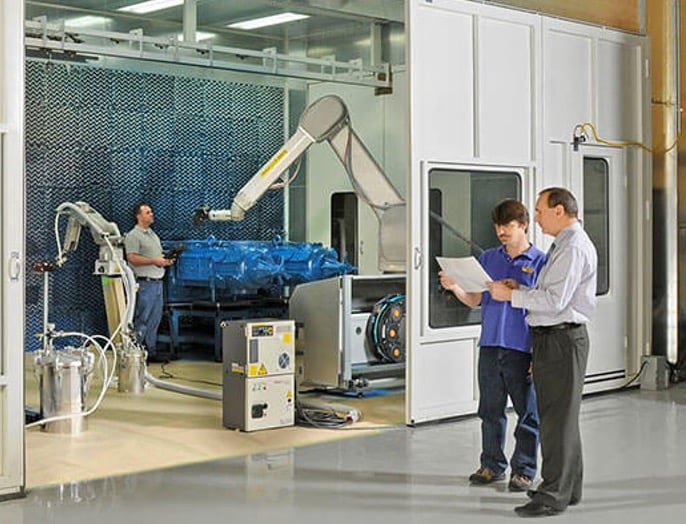
While FANUC strives to boost robotics production, the company’s focus also extends to upskilling the next generation of robotics and automation experts through its skills-development center, FANUC Academy. Image used courtesy of FANUC
Production Facility Expansion
FANUC has already invested $300 million to support the delivery of innovative robotics and automation technologies to customers across the U.S. The 840,000 sq. ft. facility is the latest investment, bringing the total footprint to 3 million sq. ft. and generating over 700 jobs in the U.S. since 2019.
Later this year, FANUC will open its recently built-out FANUC Academy, a dedicated, large-scale training center for advanced automation and robotics. This skills-development center is set to become the biggest of its kind in the U.S. Alongside FANUC’s growing manufacturing campus and the production of innovative robotics and automation technologies, the FANUC Academy is intended to bridge the manufacturing skills gap, garner new talent, and help the U.S. maintain a competitive edge in the global market.