Facebook
 Google
 GitHub
 Linkedin
Robotiq Extends Hand-E Stroke to 100 mm for Flexible Part Handling
The new 100-mm Hand-E Adaptive Gripper option gives manufacturers a wider gripping range while keeping the same payload, sealed design, precision, controls, and integration workflow.
Grippers are usually judged by what they can hold. In real production, however, the bigger issue is often how many different parts they can handle without forcing the line to stop. Robotiq addresses this challenge with its new 100 mm configuration of the Hand-E Adaptive Gripper.
The updated gripper gives manufacturers a wider stroke range while keeping the core platform the same. Same payload. Same sealed design. Same controls and firmware. The main change is reach.
Hand-E is now available in both 50 mm and 100 mm stroke options, giving manufacturers a way to match the gripper to a wider range of parts without changing the rest of the automation setup.
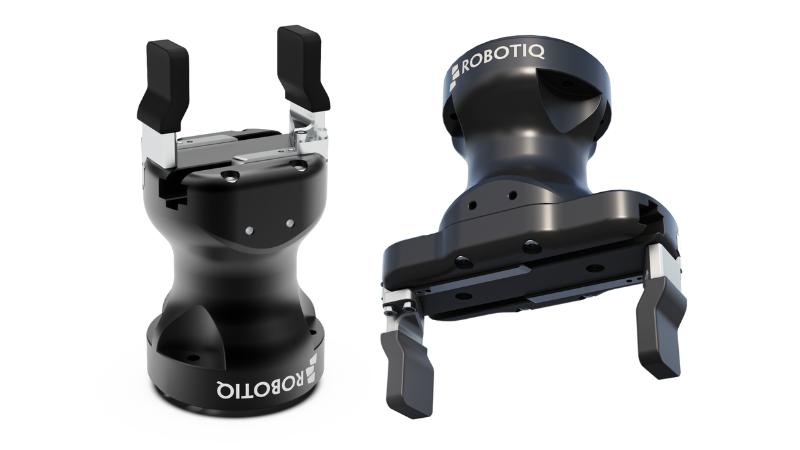
Robotiq’s Hand-E Adaptive Gripper is now available in a 100 mm stroke configuration, giving manufacturers more flexibility for handling different part sizes. Image courtesy of Robotiq
More Reach Without Changing the Platform
The new version extends Hand-E’s stroke to 100 mm. That matters most in high-mix production, where part sizes can shift throughout the day. Covering that range usually means swapping fingertips, adding extenders, or changing grippers. Each one of those steps adds downtime. It also adds another component that can wear out, loosen, or get misplaced. The 100 mm Hand-E configuration is meant to reduce that friction.
Just as importantly, Robotiq says the added stroke does not change the performance characteristics that made Hand-E useful in the first place. The gripper keeps its 7 kg payload, 0.025 mm repeatability, and IP67-sealed design.
Built for Tough Production Environments
Hand-E has always been engineered for precision and durability. The sealed IP67 body makes it suitable for dusty, wet, or coolant-heavy environments, including CNC machine tending.
Grippers are often exposed to chips, fluids, vibration, and debris in ways that other automation components are not, so this rating is always crucial.
For manufacturers already using Hand-E, the wider stroke requires no new programming, new integration work, or a different support workflow. This is arguably the most practical part of the update: the gripper changes enough to handle more parts, but not enough to disrupt existing users.
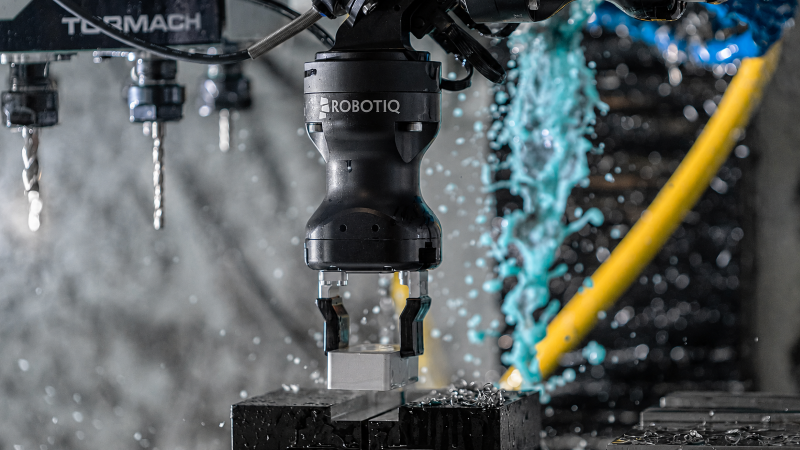
The Hand-E Adaptive Gripper’s IP67-sealed design supports machine-tending applications where coolant, dust, and debris are part of daily operation. Image courtesy of Robotiq
Where the Wider Stroke Helps
The new configuration fits best in applications where part variation creates extra work. Assembly and pick-and-place are obvious examples. A single production process may involve parts with different widths, and a wider stroke gives the robot more room to handle those changes.
CNC and machine tending applications are another fit. These environments need durable equipment, but they also benefit when one gripper can handle multiple part sizes without constant tooling changes. High-mix production is where the update may matter most. If a team is already swapping fingertips or adding extenders to keep up with changing parts, the 100 mm version gives them a cleaner way to cover that range.
Robotiq also points to physical AI applications. Its adaptive grippers are already used in contact-rich manipulation and experimentation, and a wider stroke gives those systems more flexibility when working with different objects.
A Small Change With Real Production Impact
Robotiq’s adaptive grippers are designed for plug-and-play deployment with Universal Robots, OMRON, and other major cobot brands. They also support broader robot integration through industrial communication protocols.
Programming is handled through a simple interface for position, speed, and force, and Robotiq says users can install the system in about five minutes. The company also supports ROS 2 packages and the NVIDIA Isaac Sim ecosystem for AI-driven manipulation work.
This is not a full redesign of Hand-E. It is a wider version of a gripper manufacturers already know. That is what makes the update useful. It adds flexibility without forcing a new learning curve.