Facebook
 Google
 GitHub
 Linkedin
Automate 2026: Opto 22 and the Full IT/OT Automation Adventure
Control isn’t a standalone hardware challenge these days. Check out the full journey on display at Automate in Chicago: from the ground floor up to the clouds!
At Automate 2026, there was a clear trend across many booths. Entire partner networks, each contributing a special solution that, when assembled, forms a comprehensive control system. The Inductive Automation booth hosted the foundational groov EPIC platform by Opto 22. When integrated together with multiple providers, a complete control system was on display.
Hardware at the Edge: groov EPIC
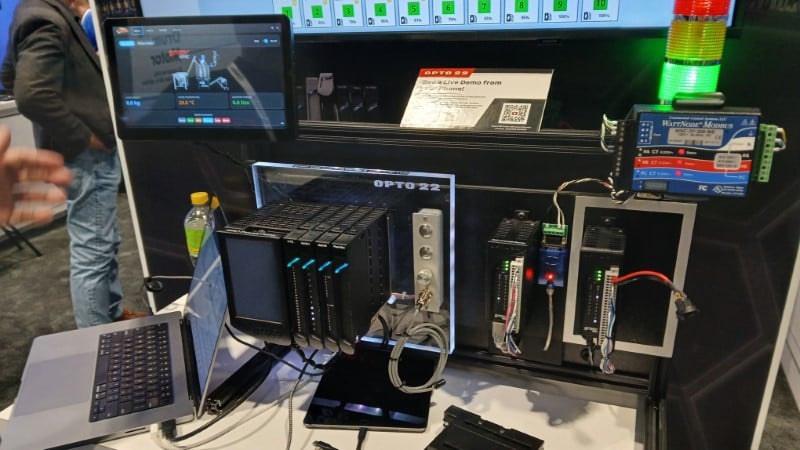
Opto 22’s groov EPIC edge programmable industrial controller on display in the Inductive Automation booth.
First things first, the hardware serves as the portal for the data to be accessed from the factory floor, and it’s the conduit for the control algorithms to provide instructions to the load devices. Without hardware, everything is simply theoretical.
Opto 22 provided the essential I/O access with the groov EPIC, a controller that provides an entire containerized operating system, adapting to all sorts of custom projects, but also seamlessly interacting with local and remote I/O. With an onboard OS, there are many applications that can be installed locally for simple data processing, but for most large-scale projects, handing data off to more capable machines is virtually guaranteed.
Data Transmission: Cirrus Link
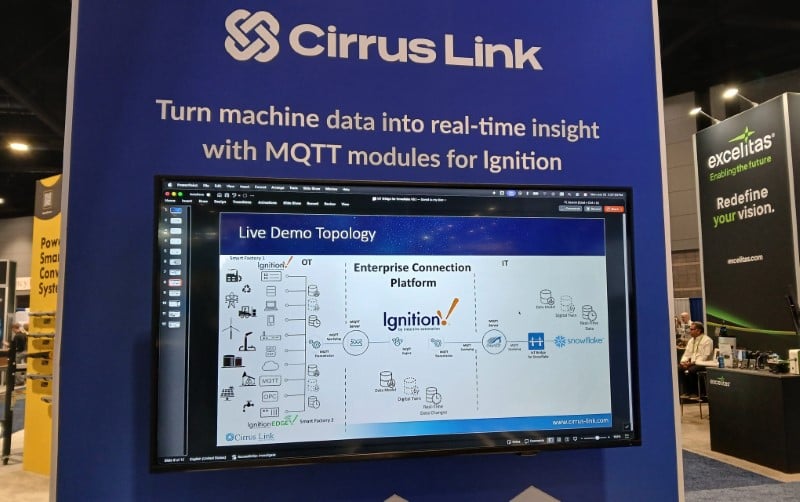
Overview of MQTT data flow from Cirrus Link.
The next natural step in the data journey must be a method of passing data back and forth between modules. Cirrus Link is that data layer, but it’s far more than simply handing variables between the PLC and the cloud. With the tremendous volume of data, there must be some context. Unified naming conventions, data types, associations with related data; all of this becomes vitally important to other machines.
Many control systems are built for a single point in time, but little thought is given to future expansion. Providing the right data layer is a strategy that extends far beyond the needs of the system as it exists on the day of commissioning.
SCADA and Visualization: 4IR Solutions
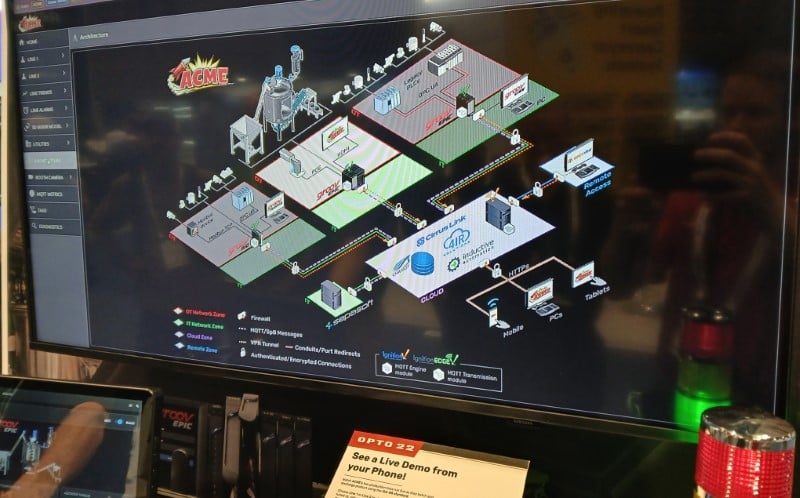
A live look at 4IR’s architecture of the “Acme Dynamite Company” invented for the Automate show.
The SCADA system is where the concepts can become more vague. SCADA, under formal definition, pulls data and provides control, but these days, it’s more often a complex platform of modular components stored either on a local server or in the cloud, with a secure connection between plant floor and processing. The SCADA system may perform the control and acquisition tasks, but visualization is also a major component.
At the booth, the FactoryStack platform by 4IR Solutions showed an example system that received data from the groov Epic via the MQTT broker and provided services like database storage, program backup, visualization, as well as secure links with AWS and Azure for AI and ML applications.
Finally, the MES Level: Sepasoft
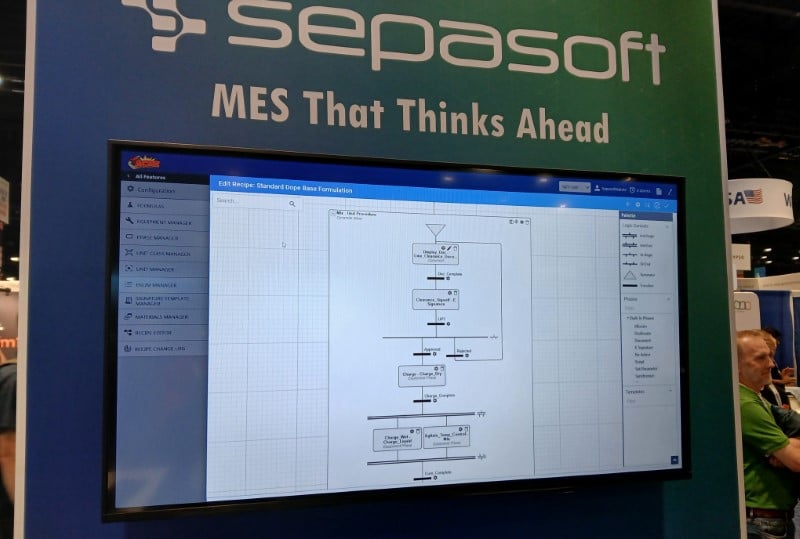
The manufacturing execution system (MES) is the access point for the actual physical production taking place on the shop floor. Batch recipes are stored, and production data is logged according to ISA-95 standards. Sepasoft MES ensures quality, effectiveness, product traceability, and efficiency across the entire plant. As systems grow in scale, the importance of an MES that grows along with the facility is critical.
The Inductive Automation booth wrapped a lot of skills into one booth, proving that the best solutions are a combination of the unique talents of multiple expert companies. But at the end of the day, those that survive are those that can orchestrate the solution, provide ease of integration for the customer, and understand the role of each partner so that the system runs reliably for the entire product life.