Facebook
 Google
 GitHub
 Linkedin
ABB PickMaster Lite Picks Up the Pace of Automation
ABB’s PickMaster Lite simplifies and speeds up the deployment of vision-guided robotic picking systems for packaging and automation applications.
ABB Robotics has announced the release of a new, pared-down version of its Pickmaster software to help original equipment manufacturers build picking cells and workflows faster, with minimal engineering effort, without compromising on industry standards or overall performance. PickMaster Lite provides operators with a no-code pick-and-place application setup, predefined process blueprints for faster setup, and control-system flexibility.
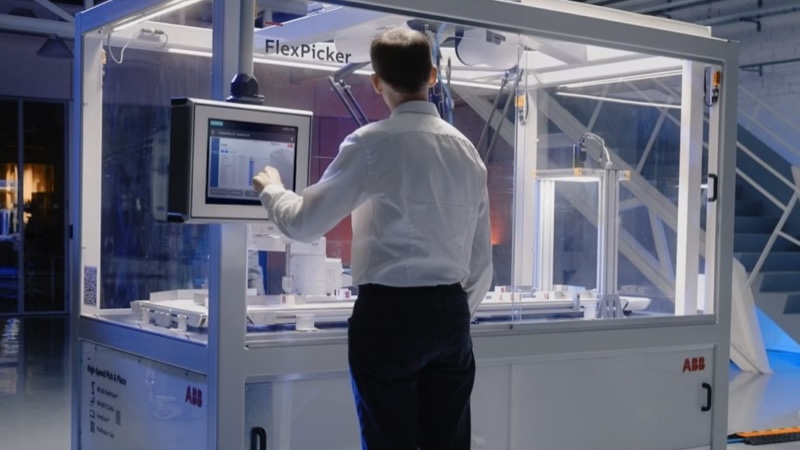
Intuitive user interfaces are built on ABB’s Ability Zenon data management software and delivered to customers via the new PickMaster Operator. Image used courtesy of ABB
A “Double Shortage”
According to the U.S. Bureau of Labor Statistics, job openings in manufacturing stood at 462,000 in March 2026. While this number is down from a peak of 1,025,000 unfilled jobs reported in April 2022, the shortage remains palpable. Manufacturers are struggling to onboard and retain workers, both for roles involving labor-intensive, repetitive tasks and for roles requiring advanced robotics skills.
The PickMaster Lite software enables the integration of intelligent, autonomous pick-and-place applications into existing manufacturing workflows without the need for repetitive manual labor or in-depth programming knowledge. This helps alleviate labor shortages, including skills gaps in manufacturing.
PickMaster Lite
The PickMaster Lite software upgrade enables manufacturers to scale and deploy picking solutions more rapidly to meet changes in production demand driven by consumer needs.
Pickmaster Lite links 2D and 3D vision systems to the pick-and-place robot, enabling it to process critical information about the features, orientation, and location of goods as they pass along the production line. The software also tracks conveyor belt speed, allowing the robot to pick up on the go without the belt needing to slow down or stop.
Rather than the time-consuming process of programming multiple lines of code to “teach” the pick-and-place robot to perform specific movements, PickMaster Lite uses predefined instructions to pick and maneuver objects. The software’s engine translates the instructions into a trajectory or curved movement/path in 3D space. The software also integrates predefined rules for collision avoidance and optimal speed.
Operators benefit from an intuitive graphical user interface through the PickMaster Lite software, with the ability to select "pick" and "place" areas at the touch of a screen; no coding is required.
ABB’s PickMaster Lite simplifies and speeds up the deployment of vision-guided robotic picking systems for packaging and automation applications. Video used courtesy of ABB Robotics
PickMaster Lite employs common fieldbus protocols, which are supported by the Omnicore Controller (such as Modbus TCP, EtherNet/IP, EtherCAT, and PROFINET RT/IRT), to connect PLCs and HMIs, much like connecting a USB drive to a computer's USB port. This flexibility eliminates the need for complex wiring, buying new hardware, or lengthy programming.
Other Features and Benefits
PickMaster Lite also offers operators the capacity for up to 10 robots and cameras, and up to 6 linear or circular variable-speed conveyors for each bot. The software also features a conveyor speed of up to 100m/min, up to 25 indexing work areas per robot, and support for DSQC2000 and DCQC377B conveyor-tracking hardware. Users of PickMaster Lite can also leverage advanced sorting and mixing functions, recipe and robot status control, process load balancing of goods between bots, fast multiplication of standard cells, and camera result sharing between bots.
According to ABB, key benefits of the PickMaster Lite software include reduced commissioning time and engineering effort (by 25% and 30%, respectively) and increased throughput by up to 15%. Customers might also wish to pair Pickmaster Lite with ABB RobotStudio, which enables the creation of digital twins that mimic real-world pick-and-place application setups to test, evaluate, and optimize processes before deployment.