Facebook
 Google
 GitHub
 Linkedin
Introducing Sherpa Mecha, an AI-Powered Humanoid Engineered for Manufacturing
Ati Motors’ Sherpa Mecha is a customizable humanoid robot on wheels, capable of a wide range of manufacturing tasks, including machine tending, bin handling, and part inspection.
Ati Motors has developed a mobile, AI-driven humanoid robot designed to meet the needs of operators and workers in manufacturing environments. The robot, Sherpa Mecha, is built to adapt and integrate into existing workflows and features customizable software and hardware to fit a broad range of industrial applications.
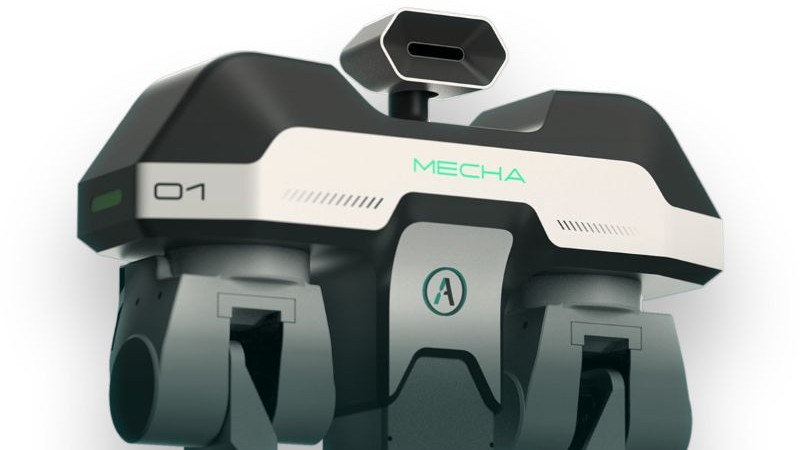
Sherpa Mecha is designed to handle various manufacturing tasks, including moving heavy bins, tending to industrial machinery, and conducting inspections. Image used courtesy of Ati Motors
Meet Sherpa Mecha
Ati Motors’ Sherpa Mecha is designed for practical industrial workspace applications and benefits manufacturers as an adaptable and versatile drop-in solution. Sherpa Mecha is designed to integrate into existing fleet management systems and factory line setups. Customers can adapt and update software, as well as tailor tooling to suit specific application requirements.
Sherpa Mecha is a humanoid robot poised to assist operators with a variety of seemingly small yet essential tasks, including part and tool fastening, changeovers, bin handling, part inspection, machine tending, pick-and-place, and more.
Unlike traditional humanoids with two legs, Sherpa Mecha rolls around on wheels to conduct its tasks. Video used courtesy of Ati Motors
This nifty humanoid’s mobility is not driven by a bipedal legged structure like how we move around day-to-day, but by mechanical wheels at the robot’s base. This design provides greater stability, lower risk, and a means of navigating unstable terrain on the factory floor.
Sherpa Mecha also employs 3D LiDAR for object detection, environment mapping, self-localization, and navigation in both structured and unstructured environments. The bot features a 28 lb payload capacity at full extension and modular AI-driven learning to provide adaptivity and responsiveness depending on changing task requirements.
Industrial Humanoid Robots
Another adaptable, though this time, two-legged humanoid is Digit from Agility Robotics. Digit is another helpful automation tool and collaborative human-machine coworker. An NVIDIA accelerator drives Digit's built-in computational capacity, and its architecture has evolved steadily.
The Digit system has recently progressed to the NVIDIA Jetson AGX Thor, a framework designed specifically for robots, replacing earlier models that relied on NVIDIA RTX hardware, which was initially created for graphics and AI applications. With this shift, conventional GPU technology is being modified in favor of specialized computing built to meet the intricate, real-time requirements of autonomous robots and other machinery.
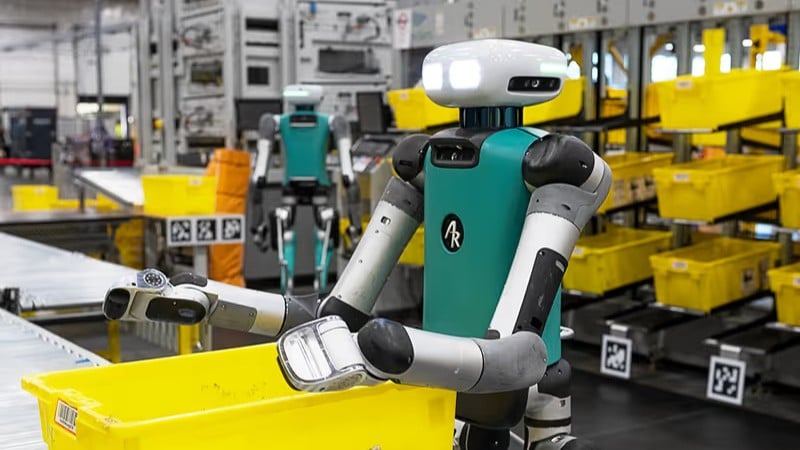
Digit, like Atlas, is a bipedal humanoid robot that employs AI to make decisions and complete a diverse range of industrial tasks. Image used courtesy of Agility Robotics
Digit features a 35 lb payload capacity, customizable end-effectors, an operating range of 5.5 ft, maintenance ports, e-stop, autonomous docking and charging, and stands at 5 ft 9 in. Customers can maintain the flow of operations by using a control pendant to move Digit between different work cells. Digit's skills are broad and varied, providing uses in application areas such as tote stacking, flow rack loading/unloading, tote destacking, tote nesting, AMR loading/unloading, conveyor loading/unloading, and tote palletizing/depalletizing.
Boston Dynamics’ Atlas is another humanoid robot. It bears two limbs and is designed for optimum agility, high-performance perception, and intelligent task assessment and execution. Atlas is capable of object recognition and manipulation, balancing, and workspace adaptation thanks to its sophisticated vision, depth, and force sensors. It has proven capable of accurately handling materials, loading and unloading bins, arranging parts on manufacturing lines, and identifying, transferring, and retrieving components. The bot enhances the safety of human coworkers by tackling repetitive or ergonomically demanding activities using AI-driven decision-making, movement, and control.
A Tireless, Assistive, Autonomous Workforce
Human workers can easily tire from a long day of repetitive tasks and handling heavy goods in manufacturing environments. Wouldn't it make sense to find a way to augment human worker capabilities to reduce repetitive and potentially hazardous tasks, free up time for higher-value tasks, and improve safety? This is where companies worldwide, seeking to automate their processes to drive operational efficiencies and alleviate the labor shortage problem, are looking to adopt AMRs and autonomous humanoid robots like Digit, Atlas, and now, Sherpa Mecha.
Related Content