Facebook
 Google
 GitHub
 Linkedin
Lam Research Introduces Dextro: A Cobot for Semiconductor Manufacturing
Dextro is a mobile collaborative robot designed to optimize equipment maintenance in semiconductor manufacturing. The new cobot performs critical tasks, including etch chamber cleaning and consumable part replacement.
Lam Research has developed a collaborative robot that performs maintenance tasks for semiconductor fabrication facilities. Dextro, Lam’s newest cobot, is equipped with a robotic arm and controller to perform some of these routine maintenance tasks. Controlled by a human operator, the tasks can be completed without needing to send a team of technicians into the fabrication equipment. Ultimately, the Dextro cobot reduces downtime and the potential for contamination.
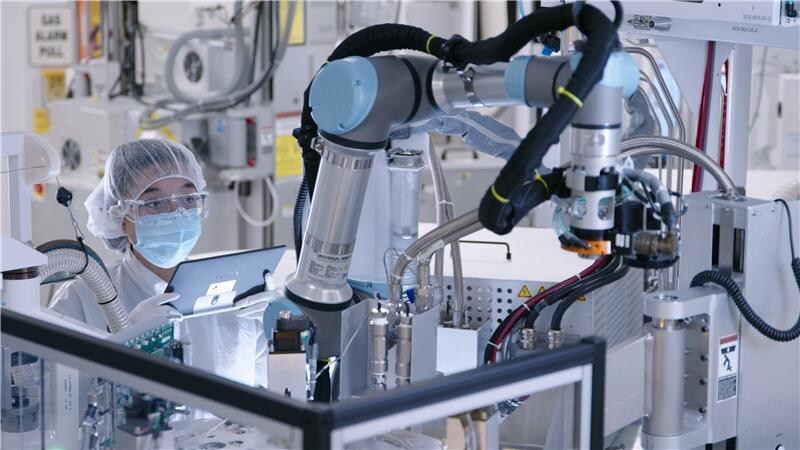
Lam Research’s Dextro cobot is designed to perform maintenance tasks on semiconductor manufacturing equipment. Image used courtesy of Lam Research
Semiconductor Manufacturing Maintenance
Maintaining a $300 million lithography scanner or plasma etcher is not as simple as maintaining a $20,000 car, though both require scheduled preventative maintenance. Depending on the specific piece of equipment, belts, chains, and drive motors must be replaced frequently. Water and air filters are also subject to replacement. Sensors must be routinely calibrated. Consumables, such as photoresists, sputtering targets, and others, need to be refreshed as well. Each of these tasks involves taking a machine out of production, sending in a maintenance team, performing the replacement, and then wiping down all of the surfaces to prevent particulate contamination of the wafers.
Unplanned maintenance tasks can be even more intense. Wafers that get stuck in process might need to be salvaged, reworked, or scrapped. Reticles for lithography are extremely expensive and can be damaged in the process under the wrong conditions. A small oil leak can cause millions of dollars of damage if not caught early in processing.
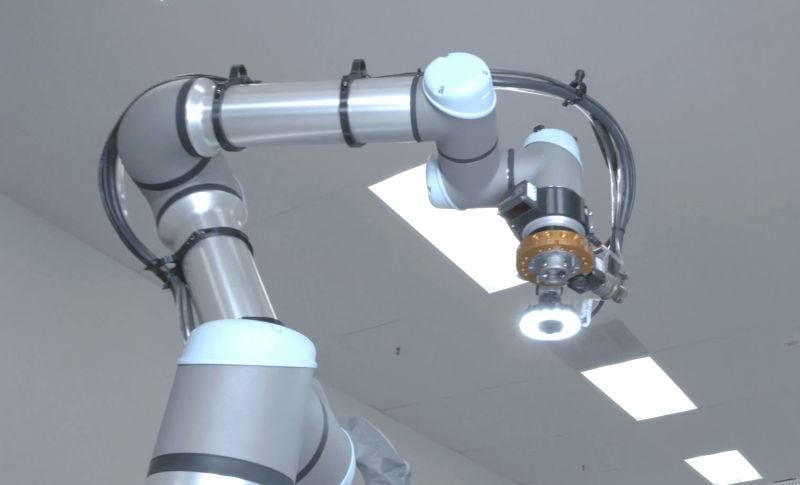
The Dextro cobot takes the place of human workers in semiconductor manufacturing equipment maintenance tasks, ensuring precision and safety. Image used courtesy of Lam Research
A Cobot for the Semiconductor Industry
Cobots have several distinct advantages over human operators in semiconductor manufacturing operations. First, one of the key metrics for semiconductor manufacturing is keeping the cleanroom, well, clean. Humans wear “bunny suits” that limit the hair and dead skin particles shed by humans in the cleanroom, but the bunny suits cannot stop all of the contamination. For particularly sensitive processes with exposed wafers, humans should not be in the space with the wafers at all. Instead, a cobot can be used to perform this level of wafer manipulation.
Consistency in procedure is another advantage of cobots. The cardinal rule in semiconductor manufacturing is to make the process repeatable. If there is a problem, there is an entire change of procedure process that must be followed across all tools, and often across all fabrication facilities in the company. Cobots can do this readily through programming. Humans tend to make their own subtle changes, person to person, shift to shift, and so on to procedures, which can lead to inconsistencies in the process.
Using different end-effectors, Dextro is suitable for various tasks, including etch chamber cleaning and replacing consumable parts. Video used courtesy of Lam Research
Dextro Cobots
Dextro is a cobot designed for just such a set of challenges. It has high-precision movements, which are an absolute necessity in the semiconductor manufacturing environment. Designed to work with humans, it can perform numerous maintenance tasks, from wiping down equipment to changing photoresist bags to removing stuck wafers. As a cobot, it will operate much more cleanly and have tightly controlled movements, all guided by a control technician.
Furthermore, the use of Dextro as a tool to perform maintenance tasks helps alleviate the skilled worker shortage. As semiconductor facilities become more complex, the demand for skilled technicians and engineers is outpacing the supply.
Autonomous Fabrication
Dextro has the ability to simplify certain maintenance tasks while reducing the potential for contamination on the wafers. This will ultimately reduce operating expenses, waste streams, and other common burdens in the semiconductor industry.
Related Content