Facebook
 Google
 GitHub
 Linkedin
No More Misses: Wide Beam Sensor Ensures Reliable Detection
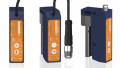
Banner’s B25 wide beam sensor enhances conveyor detection with a 25mm beam, ensuring reliable tracking of thin parts and preventing processing errors.
When parts are traveling down a conveyor belt, the control system needs to know where the parts are so that traffic jams do not occur. Through-beam sensors work great at detecting objects on a conveyor belt. They work by transmitting a laser beam to a reflector, and a lack of light returning to the sensor determines a detected object. The caveat with these sensors is the beam width. If the beam width is small, like a laser dot, thing parts travel underneath the laser, and the part will not be detected. A simple solution to this problem is to use a wide beam sensor, like the B25 from Banner Engineering.

Products moving down a conveyor belt need to be scanned and recognized to be properly processed. Image used courtesy of Unsplash
The B25 Wide Beam Sensor
The latest offering from Banner Engineering is the B25 wide beam retroreflective sensor. This sensor offers a 25 mm beam that can accurately detect objects down to 3 mm thick, making the B25 an excellent choice for detecting envelopes or poly bags. The B25 is designed for quick installation with a one-button teach feature that will filter out conveyor belt fluttering and provide more stable part detection. The sensor can be configured using the integrated teach button, a remote input wire, or through IO-Link. To facilitate different mounting configurations, the B25 has multiple wire channels built into the housing.
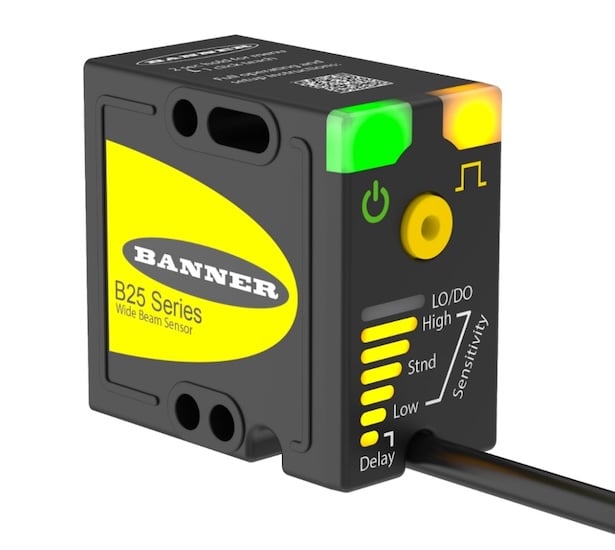
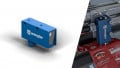
The B25 wide beam retroreflective sensor. Image used courtesy of Banner Engineering
The B25 comes standard with PNP outputs and IO-Link connectivity. An M12 pigtail is provided to connect the B25 to your control system. The sensing range is up to 2 m between the sensor and the reflector, and it operates on 10-30 VDC.
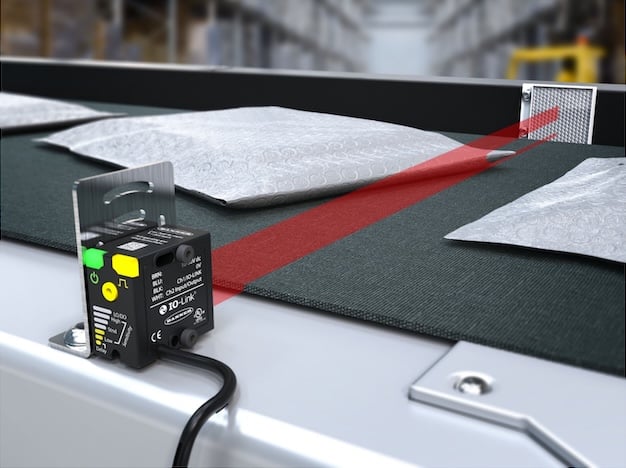
The B25 being used to detect thing parts traveling on a conveyor. Image used courtesy of Banner Engineering
Detecting Thin Parts
Conveyor systems are required to make decisions on where parts or objects should be directed or if they need to stop in place. The detection of these objects on the conveyor belt is crucial to making the right decision. If your object is not blocking enough light, you will have a hard time detecting the front edge of your object. Some of the situations you might see are inconsistent part positioning, flickering in the sensor output, or a threshold that is too close to the actual reading of the sensor. This can be a problem if you want to stop the part in a specific position on the conveyor. By using a wide beam sensor like the B25, the object has a great chance of blocking more of the laser light, thus making a more reliable detection.
Related Content