Facebook
 Google
 GitHub
 Linkedin
Pepperl+Fuchs Rolls Out Ethernet Motor Control Module for Conveyors
The new G20 Ethernet system targets both simple and complex conveyor systems, controlling up to 120 motor rollers via one IP address.
A conveyor system moves products and materials around a factory. In warehouses, conveyors are similar to highways, moving packaged goods throughout the facility. In some situations, conveyor systems are quite simple; they often consist of a straight section and possibly a sensor to detect a package. Other applications have a complex interconnected system of different conveyors going in different directions.
Recently, Pepperl+Fuchs released a conveyor motor controller that occupies only one IP address yet is capable of controlling up to 120 motor rollers.
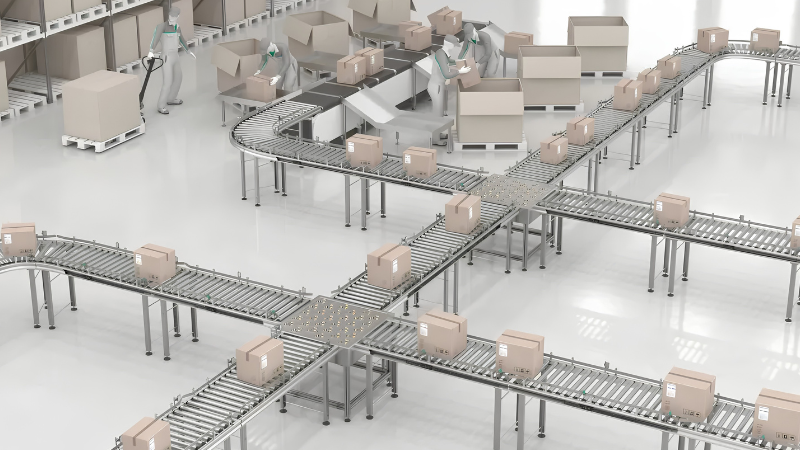
Pepperl+Fuchs has designed the G20 Ethernet system for simple and complex conveyor systems consisting of multiple controllers and sensors. Image used courtesy of Pepperl+Fuchs
G20 Ethernet Motor Control Module
Controlling roller conveyors is very application-specific, but Pepperl+Fuchs has made it simple with the new G20 Ethernet System. The system comprises a single controller connected to the machine network through EtherNet/IP or PROFINET and motor modules.
Each controller can support up to four networks of daisy-chained motor modules, and each network can have up to 15 modules. Each motor module can drive two motors, supporting either 24 V or 48 V DC motors. This configuration results in one IP address connecting up to 120 motor rollers.
Each module can also support up to two sensors that can be used to drive simple logic within the motor module and are fed back to the control system for further logic control.
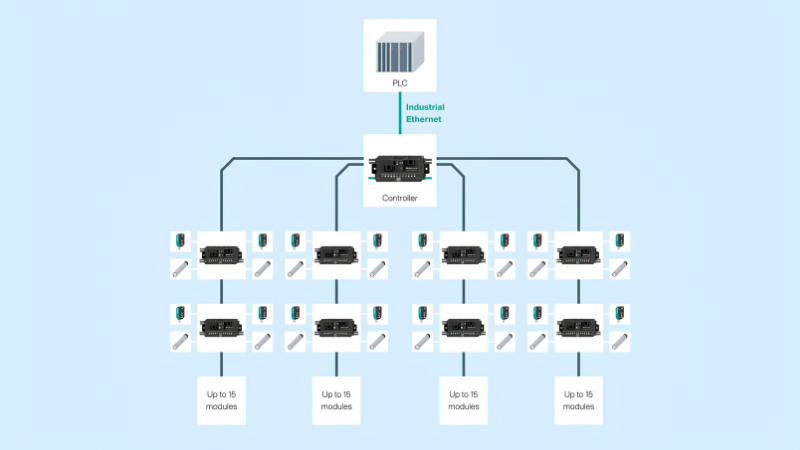
A topology map of the G20 system, illustrating the controller’s ability to control up to 120 motor drives through one IP address. Image used courtesy of Pepperl+Fuchs
ZPA and PLC-Controlled Operation
The G20 Ethernet system operates in two distinct modes, which can be mixed on the same conveyor line. With zero-pressure accumulation (ZPA) mode, sensors connected to the motor modules are used to execute internal programming. This configuration saves on processing power in the PLC but is limited in functionality.
With the PLC-controlled mode, the G20 system is connected to a PLC using popular fieldbus communication protocols. In this mode, each motor is individually controlled for speed and direction. Both configurations can be used together to efficiently utilize a control system, offloading simple tasks to the G20 system while the PLC handles complex, plant-wide routing tasks.
Future-Ready Conveyor Control
Industry 4.0 is all about data collection on manufacturing and processes. With the G20 system, users have access not only to control and diagnostic data via a PLC but also to a REST API and an OPC UA connection for each Ethernet controller. This connectivity enables integrators to build applications that can communicate with the G20 controllers for run-time analysis, access to connected sensors, or any diagnostic data that might be available.
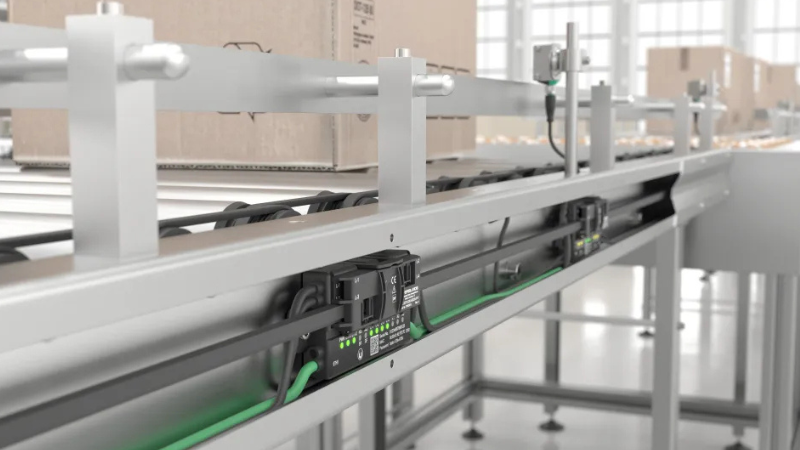
The G20 Ethernet controller mounted inside the conveyor rail. Image used courtesy of Pepperl+Fuchs
Tool-Free Mounting, Rugged Design
Motor controllers are often bulky and can sometimes get damaged by moving carts. Pepperl+Fuchs has designed the G20 system to mount within the conveyor's rail system. This design not only protects the module from bumps or moving carts but also provides convenient cable management. The controller is IP67-rated and operates from -25°C to 70°C, making it an excellent choice for virtually any conveyor control application.
In an automated warehouse, roller conveyors provide a path for packaged goods to reach customers. As warehouses become more automated, the conveyor system that interacts with that automation needs to be expandable and future-proof. The G20 Ethernet system supports simple or complex designs with minimal impact on existing networks and uses modern communication protocols.