Facebook
 Google
 GitHub
 Linkedin
Telemecanique Sensors Introduces Ultrasonic Fork Sensor for Packaging
Ultrasonic waves can detect labels that optical sensors might miss. Telemecanique Sensors’ XUVU04 ultrasonic fork sensor is designed to detect various label types in compact setups and high-speed operations.
Telemecanique Sensors, part of the Yaego Group, has developed a new, ultrasonic fork sensor to detect labels. Label detection systems are used to detect and label items for inventory tracking purposes. Telemecanique Sensors has designed its latest product, the XUVU04, to do this process more efficiently and quickly, even with hard-to-detect labels.
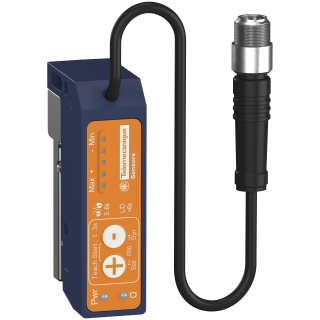
Telemecanique Sensors’ XUVU04 ultrasonic fork sensor features a low 5.5 mm fork height. Image courtesy of Telemecanique Sensors
What Is an Ultrasonic Fork Sensor?
Many fork sensors are optical. They emit an infrared beam and detect when an object breaks the beam. While this works in many cases, certain label materials and environments can trick an optical sensor. Metallic, transparent, or irregularly shaped labels can be missed by optical sensors, leading to products being mislabeled.
For example, a transparent serial number label with black writing is non-obtrusive on a consumer product, but may not be detected by an optical scanner. An occasional label may pass through the sensor without being selected, and the next product is marked with the wrong serial label. All subsequent products will follow suit. If this item were part of a product recall, this would lead to a major headache.

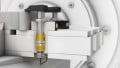
The XUVU04 ultrasonic fork sensors can detect hard-to-read label types, like transparent and reflective labels. GIF used courtesy of Telemecanique Sensors
Dusty environments or environments with mist droplets can also fool an optical sensor. Despite good industrial hygiene, many manufacturing environments may generate enough interfering signals to cause problems.
By using sound waves, ultrasonic fork sensors are less sensitive to these problems. As the ultrasonic wave passes through the label, it produces a different reflection than the sound through the webbing alone. It provides a positive response, even with transparent, metallic, or other difficult-to-detect labels that trick optical sensors.
XUVU04 Ultrasonic Fork Sensors
Telemecanique Sensors’ newest XUVU04 is an ultrasonic fork sensor, which has inherent advantages over optical detection systems. Besides that, it is also tiny—only 20 mm wide with a lower fork only 5.5 mm across. This small form factor allows it to be placed much more closely to the applicator arm that separates the label from the webbing. According to Telemecanique Sensors, the XUVU04 delivers reliable detection, even with gaps as small as 1 mm.
The XUVU04 is also designed to be lightning fast. Detection is possible at speeds of up to 440 µs, allowing labels to pass through at speeds of 240 m/min. The sensors have been designed with an integrated HMI, IO-Link communication, and rapid setup to make it easy to install on an existing labeling line.
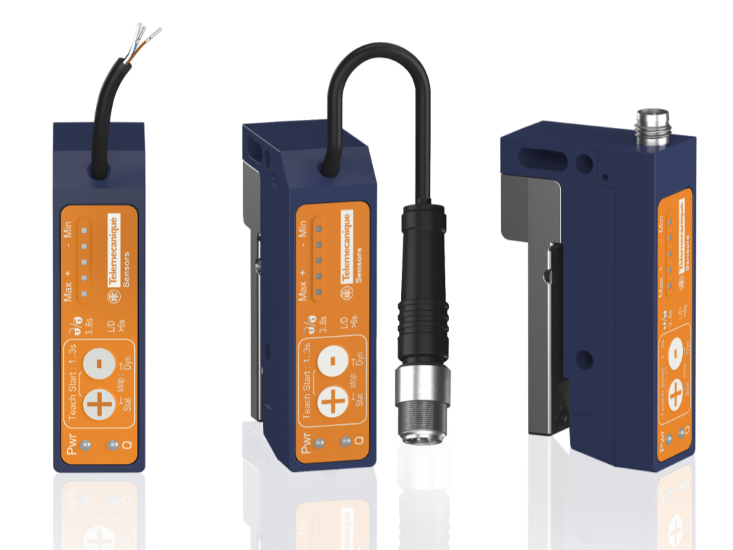
The XUVU04 is available with pigtail M12 (left), pre-cabled (center), and M8 connection options. Image courtesy of Telemecanique Sensors
Label Detection for Packaging
Labeling is not just a way to tell the end user something about the product; it is a way to track the product throughout its whole journey in the manufacturing plant. Often, labels have barcodes or QR codes that are scanned at each stage of production to ensure that all steps have been performed. Not only does it prevent missed steps, it also provides a way to track where a particular piece of equipment may be failing, what corrective actions should be taken, and which products may be affected. To that end, the XUVU04 is suitable for virtually any consumer goods manufacturing line.