Facebook
 Google
 GitHub
 Linkedin
PickNik Robotics’s Movelt Pro 6 Platform Brings Flexibility to Robotics
PickNik Robotics launched the upgraded Movelt Pro Release 6, an innovative hardware-agnostic platform for rapidly designing and developing robotics applications.
PickNik Robotics (PR) unveiled its MoveIt Pro Release 6, the latest version of its flexible, open development platform for robotic applications spanning multiple industries. The hardware-agnostic, AI-driven system now has a true-to-life simulation engine for digital twins or virtual representations of physical assets and processes.
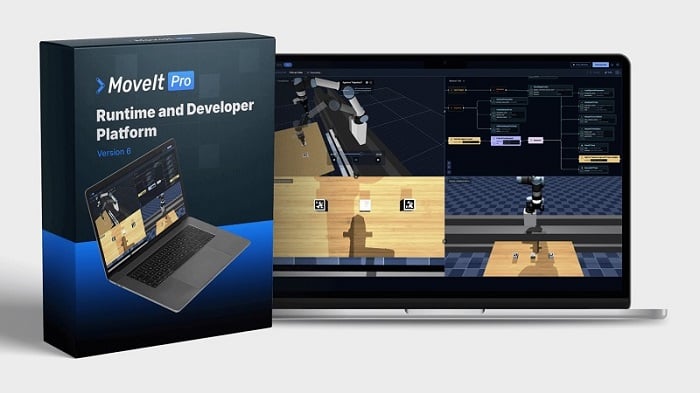
The Movelt Pro Runtime and Developer Platform offers a detailed simulation engine to evaluate and fine-tune robot application prototypes. Image used courtesy of PickNik Robotics
Eradicating Existing Limitations to Robotics Systems
Artificial Intelligence is revolutionizing robotics in industrial settings by increasing system flexibility and implementation speed. AI robots can recognize and manage a wide range of items, adapt to changing environments, and maximize the efficiency of tasks by utilizing real-time data. Robots no longer require continual reprogramming thanks to machine learning, as they learn from past operations and increase precision and effectiveness. AI also removes the challenge of time-consuming programming by facilitating user-friendly technologies like low-code or no-code technology platforms, significantly shortening implementation times and requiring less expert assistance.
The Movelt Pro 6 Release
PR’s Movel Pro Release 6 also makes tools and Python-based API available for developers to incorporate their machine learning models.
PR offers a user-friendly GUI with drag-and-drop functions to set objectives in behavior trees and build applications more rapidly. Video used courtesy of PickNik Robotics
Alternatively, foundation models are available to customers who seek to get their applications up and running as soon as possible. In machine learning, a foundation model represents a comprehensive, pre-trained model that can handle various tasks and is constructed using a significant amount of distinct data. It provides a robust foundation for computer vision and natural language processing. It can also be modified for specific use cases with less data once it has been trained, saving time and effort during development.
Customers can implement motion primitives—preset patterns of movement such as grasping, pulling, rotating, and reaching—to build a sequence of complex steps for specific tasks. These mobility building blocks help robotic systems plan and execute tasks in a streamlined, stepwise fashion, leading to rapid decision-making and adaptability in unstructured environments. The platform uses powerful algorithms for robot perception, motion control, planning, and teleoperation. In teleoperations, users can execute manual joint control and endpoint Cartesian control.
An overview of Molvelt Pro Runtime and Developer Platform. Video used courtesy of Picknik Robotics
The Digital Twin technology employed by the Movlet Pro platform employs robot runtime algorithms in a true-to-life physics simulator. Users benefit from many reference applications, including bin-picking, welding/cutting, door opening (for facility access), preassembly and assembly, mobile manipulation, and more. Customers can also integrate the Movelt Pro Platform into fleet management platforms to provide a holistic view of operations.
The Movelt Pro platform employs a gamified graphical user interface with drag-and-drop functionalities for rapid prototyping and debugging. Cached skills and behaviors can be assembled into behavior trees to build applications.
The system was constructed to deal with differences in the dimensions, mass, and orientation of objects. It also supports numerous parts, including hundreds of robotic arms, end effectors, cameras, and other auxiliary devices. Because of its adaptability, hardware may be matched to specific needs and budget restrictions, utilizing standard components to lower project costs.
Related Content