Facebook
 Google
 GitHub
 Linkedin
The IDEC FS1B: Safety Control Made Simple
The FS1B controller from IDEC simplifies installation without programming; simply wire and flip the DIP switches, and the FS1B will do the rest.
IDEC’s newest safety controller, the FS1B, promises simple, reliable operation of safety systems. By checking the status of safety interlocks, light curtains, emergency stop buttons, and other safety hardware, the FS1B can ensure that emergency stops and safety excursions can be handled immediately. It can be configured quickly, as the user selects operation modes via DIP switches instead of programming control software.
Why Use a Separate Safety Control System?
The advantage of using a separate safety control system over an integrated one in the regular control system is that the separate safety control system can react much more quickly to safety problems. Typically, the safety control system is mounted locally to the device and only handles data from safety systems. It does not handle process data, performance metrics, or other concerns unless routed through the safety system directly. This speeds up reaction time and simplifies performance, ensuring safe machine stops.
Safety control systems often have multiple inputs from light curtains, interlocks, emergency stop buttons, and other safety-related hardware. They can also route concerning conditions through the safety controller as well. For example, a motor may be running a little hot. Above a certain threshold, the motor controller can send a “STOP” signal to the safety control system to quickly shut down the motor and notify a technician.
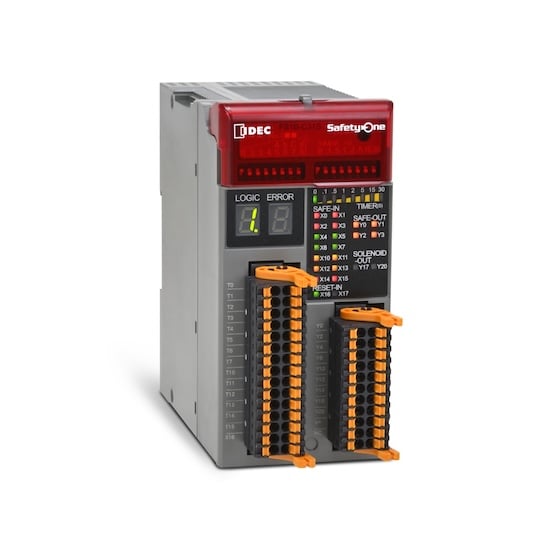
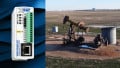
The IDEC FS1B Safety Controller. Image used courtesy of IDEC
The FS1B Safety Controllers
IDEC’s FS1B safety controllers are designed for quick response and reliable operation, even in the harshest industrial environments. They can monitor six input devices and control four output devices at a time.
One of the primary advantages of the FS1B system over many other safety controllers on the market is its ease of use. Instead of having to learn complex programming, the user can choose between 24 pre-programmed routines, including partial stops, mode switching control, full stop, and others. The user only has to set some DIP switches to the proper positions to access these. The DIP switches are protected by a translucent plastic cover to protect them from unintentional activation.
Simulating Safety
Want to learn more about how IDEC’s safety systems function? They offer a free, web-based simulator where multiple common equipment schemes are shown. From there, the user runs the simulation and then manipulates the inputs to see how the controller will behave in each scenario. In the example below, several emergency stops and safety interlocks are combined through an AND gate, along with a motor control. It uses “true” logic, where “true” signifies the system is behaving normally, and “false” means there is a fault that requires an emergency stop. “H” is high, and the motors are moving. If one of the inputs to the AND gate is opened, the “H”s will disappear, and the motor will stop.
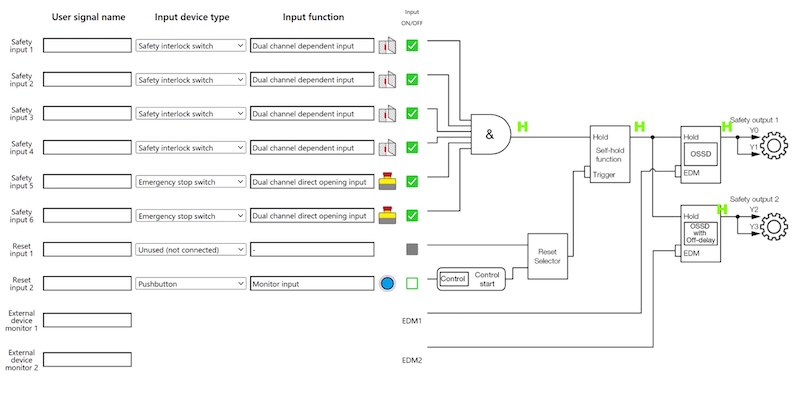
Screenshot of the free web-based simulation module. Image used courtesy of IDEC
The Bottom Line
At first glance, a safety controller may seem like an additional expense with little return on investment (ROI), if any. However, keeping technicians safe is always a wise investment. Furthermore, by separating safety control from regular machine control, both systems are simplified. This leads to fewer accidental bypasses of safety systems, drastically reduces troubleshooting time, and can also reduce training time for new technicians. Overall, the ROI can be substantial.
IDEC’s FS1B is rugged in design, easy to use, and quick to respond–all of which protect technicians.