Facebook
 Google
 GitHub
 Linkedin
UnitX DeteX Brings AI Vision Inspection Online in Minutes
AI-powered DeteX simplifies machine vision with five-image training, fast integration, and support for defect detection and code reading.
UnitX demonstrated its DeteX AI smart camera at Automate 2026, showcasing a machine vision system that can be deployed in under a minute and delivers advanced AI-powered inspection capabilities. Designed to bridge the gap between basic vision sensors and complex enterprise systems, DeteX combines rapid setup with tools for defect detection, dimensional measurement, multi-class classification, and code reading. The result is a flexible inspection platform that helps manufacturers improve quality control without lengthy integration or training.
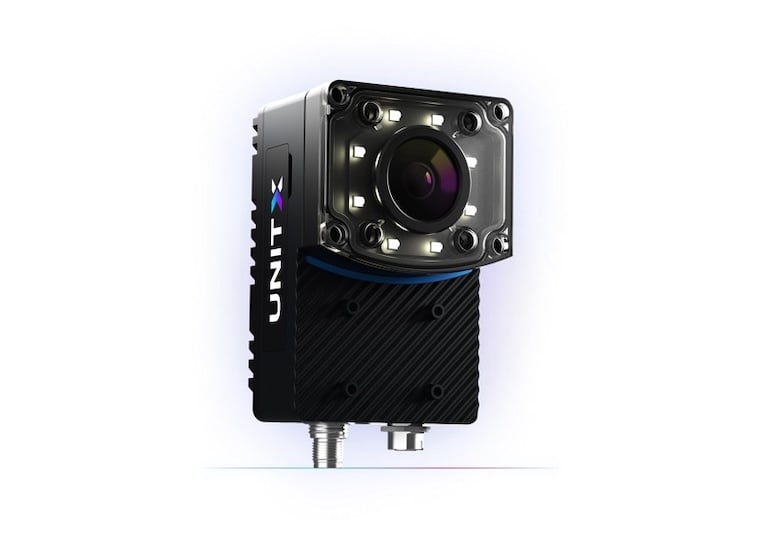
The UnitX DeteX AI camera. Image used courtesy of UnitX
The Vision Gap
UnitX has identified a gap in how vision systems are imagined. On the one hand, plenty of companies produce basic vision sensors. Each sensor has limited internal capabilities and, by itself, can only perform the simplest inspection tasks. It takes little to set up, but it is not versatile across new situations or product lines.
On the opposite end of the spectrum is the enterprise system. It can perform all sorts of inspection tasks and adapt to new inspection tasks. What it cannot do is be configured and deployed quickly; some systems take weeks to install and train.
The “Vision Gap” is the sweet spot in between. UnitX asked, “What if a sensor could be AI-enhanced in a way that allowed it to perform the inspection task?” This way, the sensor could be deployed quickly and is adaptable across new situations. This led to the development of the DeteX.
DeteX Ease of Deployment
The DeteX can be installed and running in less than a minute. The setup consists of three steps: setting imaging parameters, selecting tools, and mapping communications connections to a PLC. They provide a step-by-step guide to working through each of these pieces, and the whole process takes very little time. Furthermore, when setting the imaging parameters, DeteX requires only 5 images to be fully trained.
DeteX Operations
AI enhances the DeteX usability in five key ways. The first four directly align with inspection tasks, such that each camera can be used for AI segmentation, AI multi-classification, dimensional output measurements, and code reading. AI segmentation can help find defects, such as scratches and missing screws. The AI multi-classification tool can be used to track multiple components simultaneously and ensure they are within specifications. The dimensional output mode is used to verify component measurements. The code reading mode turns this camera into a capable inventory-tracking device by reading 1D and 2D codes in many challenging lighting conditions.
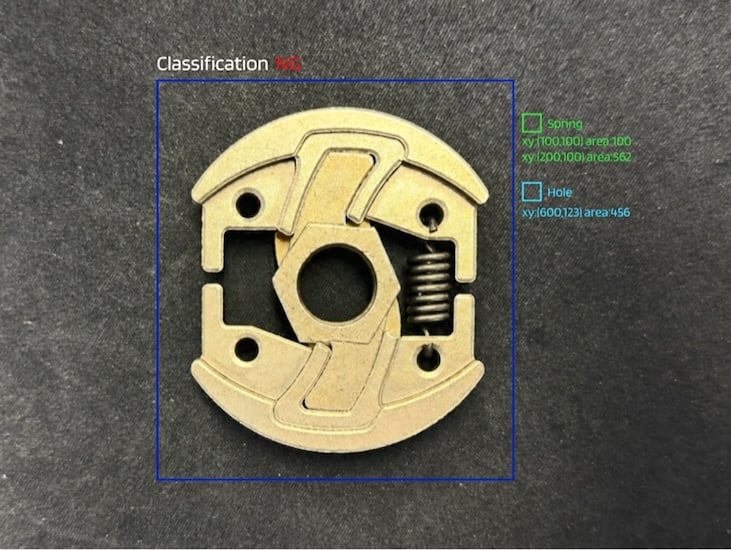
DeteX is an AI-enhanced multi-classification tool. In this image, AI correctly identifies the spring and the holes, with coordinates and area measurements. Image used courtesy of UnitX
AI also simplifies integration across multiple cameras and devices, helping build an enterprise system that would otherwise have taken weeks to deploy. Devices are auto-detected, and users can create platform-independent dashboards that allow them to view the inspection line at a glance.
Potential Applications
UnitX currently maintains about $15 billion in the machine vision and automated inspection space, with systems deployed in over 190 countries. This market is expected to grow as more factories are turning to automation for quality control and inspection tasks. These cameras, with their ease of deployment and AI capabilities, will benefit virtually any manufacturing or industrial facility. Even some commercial outfits, such as package-handling, shipping-and-receiving operations, and warehousing, will be able to use the DeteX to reduce shrink and improve throughput.