Facebook
 Google
 GitHub
 Linkedin
Walmart’s Symbotic Solution: AI-Powered Warehouses Are Here
Walmart partners with Symbotic to automate warehousing, investing $520M in AI-driven robotics for faster, safer, and more efficient fulfillment.
Symbotic will soon develop all of Walmart's robotics applications. After a competitive selection process, Walmart chose Symbotic to build and deploy automation solutions to speed up warehousing, shipping, and customer fulfillment operations. Walmart paid $520 million to outfit 400 Accelerated Pickup and Delivery (APD) centers throughout the country, $230 million of which was transferred at the closing of this deal. Walmart has the option to add more APDs in the future for an additional cost.
Walmart Robotics Applications
At first glance, one might ask the question, “Where does Walmart use robots?” As it turns out, there are plenty of applications in order processing, warehouse operations, and other materials handling tasks that are safer and more efficient when performed by a robot.
Palletization is one example of how Symbotic is optimizing the commercial market. The old, manual method of palletizing goods was to pile boxes of mixed merchandise onto pallets, hopefully without damaging the boxes below. A big case of soup will easily squash a case of lightbulbs, and wrapped bags of cat litter tend to shift during shipping, though these considerations are often ignored during manual loading. Furthermore, little effort is made to organize how the pallet is stacked for efficient unloading.
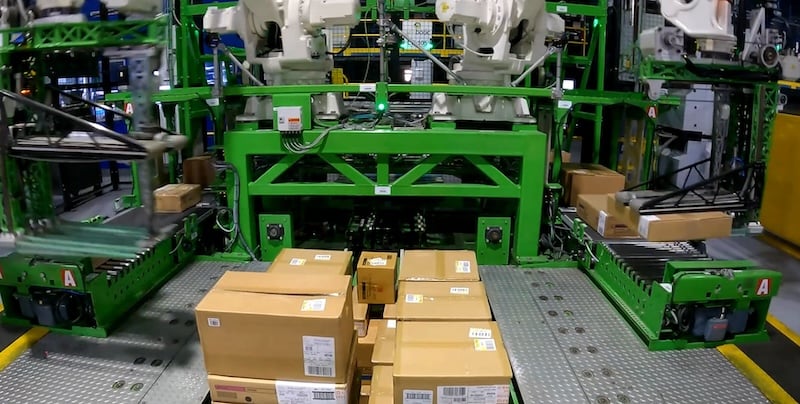
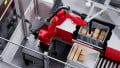
Twin robots move boxes of mixed SKUs onto a pallet. Advanced palletization algorithms optimize stacking based on the size and weight of packages as well as store layout. Image used courtesy of Symbotic
Symbotic’s palletization algorithms leverage AI and machine learning to consider the size, center of mass, and crush criteria for boxes. It also takes into account how the pallet will be unloaded at the destination store. In manual depalletization, workers disassemble the pallet and place each case on carts to take down each aisle. With the Symbotic system, the layout of the store is considered, making the depalletization much more efficient. Items that belong near each other on the shelves are packed together. It also considers common allergens so that bags of flour are not palletized near gluten-free items, for example.
Improperly palletized items are a major source of injury for stocking and warehouse personnel. Collapsed boxes lead to unstable stacks that fall on workers, or workers attempt to prevent the stack from falling and receive skeletomuscular injuries. All of this can be minimized through optimization of the palletization process.
This is just one mechanism that Symbotic has employed to optimize Walmart's supply chains.
Who is Symbotic?
Symbotic serves commercial markets with automation solutions. It has developed AI-driven algorithms for many complex logistics and supply chain-related problems, including palletization, shipping, storage, and other such challenges.
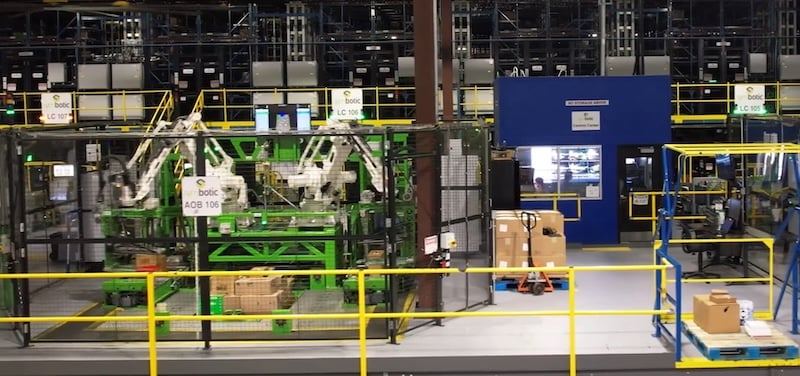
Palletization robot cell with enclosure to protect workers while efficiently stacking and wrapping pallets. Image used courtesy of Symbotic
The company has established itself as a global leader in these markets. With the latest Walmart contract included, it is up to $5 billion in project backlog and has expanded its addressable market by $300 billion in the United States.
Consumer Benefits
As a result of this partnership, the consumer will see fewer supply chain interruptions, more efficient ordering, stocking, delivery of products, and several other key advantages. Automation of these tasks will reduce shrink from damaged goods due to improper palletization and shipping, ultimately leading to lower prices.
Featured image used courtesy of Symbotic