Facebook
 Google
 GitHub
 Linkedin
Phoenix Contact Introduces PLC-Interface Ethernet Gateway
The new modular remote relay system handles up to 56 I/O channels and supports EtherNet/IP, PROFINET Class C, and Modbus/TCP, as well as S2 redundancy for simple decentralized applications.
Phoenix Contact has just released an Ethernet gateway designed to simplify communication between PLCs and relays. The new PLC-Interface Ethernet Gateway is a remote relay system that provides communication over a single Ethernet cable, rather than numerous fine wires, making installation and troubleshooting much simpler. It can be purchased as a standalone item, expanded upon with an extension module, or purchased as a starter kit that includes two different relay modules.
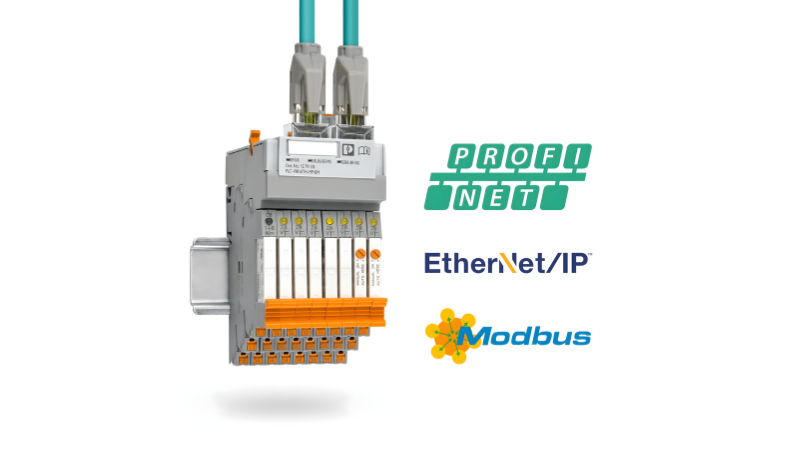
The PLC-Interface Ethernet Gateway supports EtherNet/IP, PROFINET Class C, and Modbus/TCP. Image used courtesy of Phoenix Contact
What Is an Ethernet Gateway?
Ethernet gateways act as communication bridges between systems, sensors, and protocols. They handle communication conversions, timing, error handling, and several other vital functions that integrate hardware systems and make automation possible.
For example, consider an automation system with multiple relays. The relays will each open or close based on a control signal. Rather than wiring every relay control signal, the PLC decides which signals to send to each relay, and the PLC-Interface Ethernet Gateway handles communication between the PLC and the relay banks.
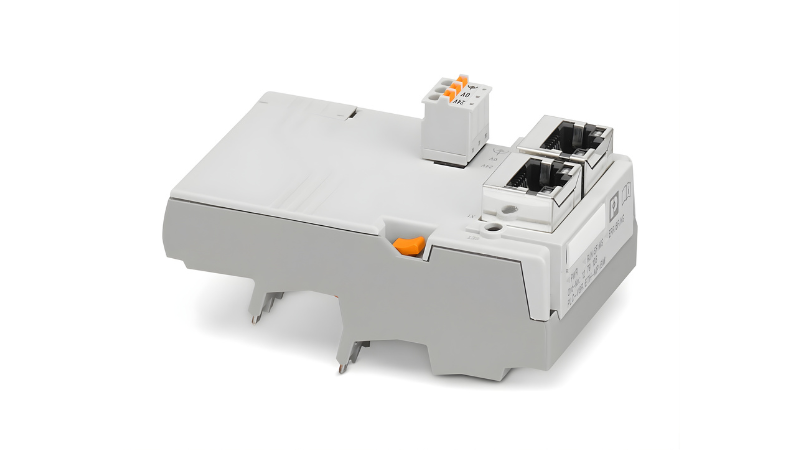
Phoenix Contact’s PLC-INTERFACE Ethernet Gateway basic module, the PLC-V8R/ETH-MP/BM. Image used courtesy of Phoenix Contact
Phoenix Contact’s Remote Relay System
The PLC-Interface Ethernet Gateway combines relays and communication into a single package, controlled via a single Ethernet cable. The system is expandable, handling up to 56 digital or analog I/O channels for simple applications. It also supports many commonly used industrial protocols, such as Modbus/TCP, EtherNet/IP, PROFINET Class C, as well as S2 redundancy. Furthermore, the gateway’s firmware is easily updated, enabling long-term support and potential new features.
The system also allows relays to be placed a long distance from the PLC, where the PLC-Interface Ethernet Gateway acts as a remote I/O head. Signals can travel from the PLC to the gateway over Ethernet at distances of up to 100 m—a vast improvement over traditional wiring schemes. By using distributed I/O relay blocks, automation engineers have more flexibility in system design. This flexibility also allows for system expansion without the need for another PLC or a new cabinet, as the gateway can be placed near the location where relays are used.
As part of Phoenix Contact’s PLC-Interface ecosystem, the gateway integrates seamlessly with the company’s line of relays, circuit-breaking relays, and other such components. Ultimately, Phoenix Contact has designed the PLC-Interface Ethernet Gateway to simplify both installation and troubleshooting by turning banks of individual relays into an Ethernet controllable system. With fewer wires, there are fewer failure points and less opportunity for installation problems. The system also saves space inside already-cramped control cabinets, resulting in neater, cleaner installations.
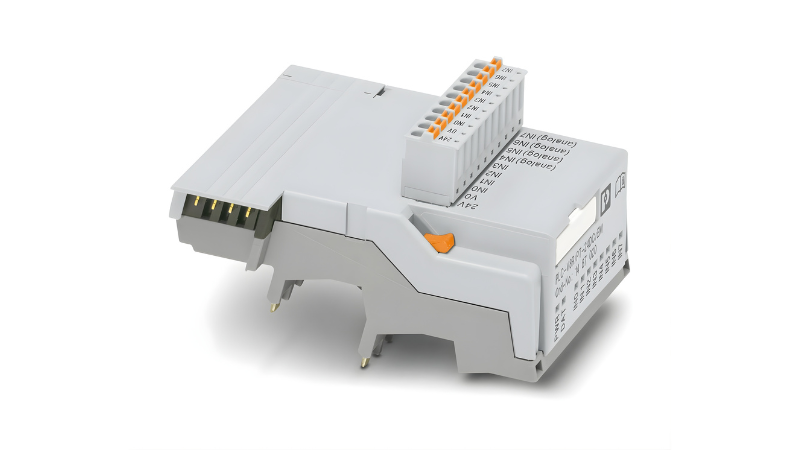
Phoenix Contact’s PLC-INTERFACE Ethernet Gateway extension module, the PLC-V8R/PT-24DC/EM, features 16 I/Os. Image used courtesy of Phoenix Contact
Scalable, Decentralized Control
Machine and automation designers are always looking for ways to simplify wiring for both installation and troubleshooting. Phoenix Contact’s new PLC-Interface Ethernet Gateway does just that: it reduces messy cabling to a single Ethernet cable. Every machine builder can appreciate using one wire to replace a bird’s nest of wires.
The system’s starter kit, the PLC-V8R-STARTERKIT, looks like a great way to get started with either building a new automation system or upgrading a complex one with troublesome wiring. With relay modules included, the system allows rapid deployment without waiting for additional hardware to arrive.