Facebook
 Google
 GitHub
 Linkedin
Banner Pushes Control Logic Beyond the Cabinet With DXMR50
DXMR50 Logic Blocks handle timers, counters, scaling, and I/O directly on equipment, enabling cabinet-free automation for smaller systems.
Control logic has long been tied to electrical cabinets, PLCs, and layers of wiring. Banner’s DXMR50 Logic Blocks challenge that model by moving automation directly to the machine. These compact field-mounted controllers handle common logic functions such as timing, counting, scaling, and signal conversion without requiring a full PLC system. With sealed housings, flexible I/O options, and straightforward setup software, they offer a practical way to simplify smaller automation tasks.
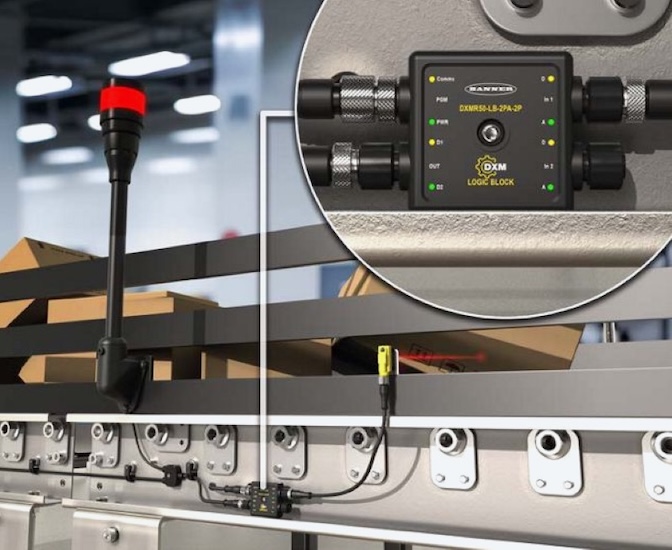
Mounted directly on equipment, the logic block handles local inputs and outputs in the field, reducing wiring and eliminating the need for cabinet-based control. Image used courtesy of Banner
What the Device Actually Does
The DXMR50 functions as a small configurable controller. It can run common logic operations such as AND, OR, timing, counting, and even scaling. It also supports threshold-based rules and basic calculations. For many applications, that’s enough to replace what would normally require a PLC. The difference is that it does it without the same level of complexity or overhead. The device is designed for field use. Its IP67/IP68-rated housing means it doesn’t need an enclosure, DIN rail, or panel wiring. It can be mounted directly onto equipment, reducing install time and simplifying layout. LEDs on both sides display input, output, and power status, making it easier to diagnose issues without opening anything.
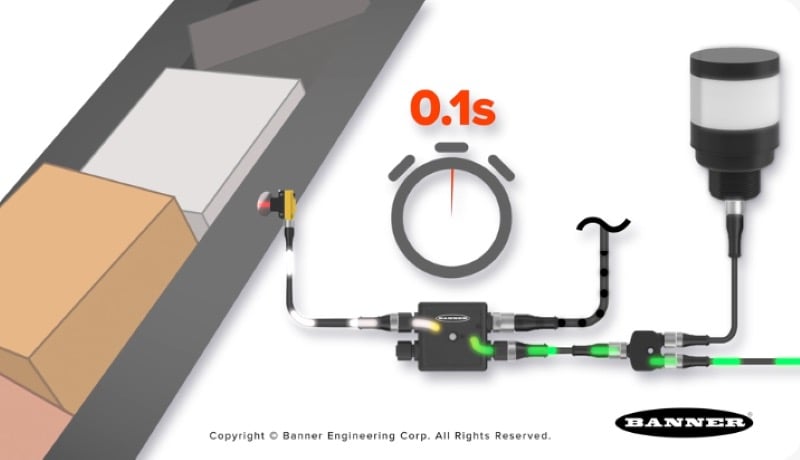
Logic blocks can directly control tasks such as timing and signal response at the machine, without routing everything back to a central controller. Image used courtesy of Banner
Flexible I/O Without Overcomplication
A big part of the system's flexibility comes from how it handles inputs and outputs. The DXMR50 is available in nine different models. Some versions support Modbus communication alongside analog and discrete inputs, making it easier to connect different device types into a single system. Others focus on local signals or dual Modbus ports for communication between devices. The options include discrete PNP, 4–20 mA, and 0–10 V signals on the output side.
How It’s Used in Practice
A common use case is tank level monitoring. An analog signal from a level sensor can be brought into the logic block and scaled to match the desired range. It can be sent over Modbus to a local display for visualization. Then the system can output that signal back to a PLC as an analog value. That means the existing control system stays intact while the logic block adds local processing and visibility.
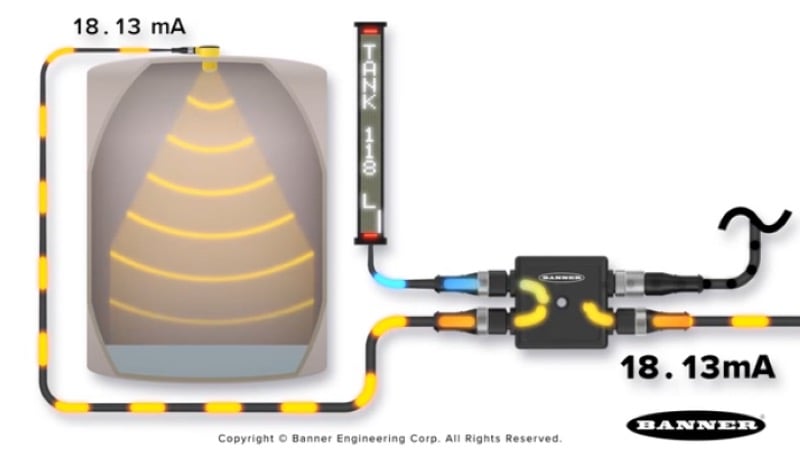
Analog tank-level signals can be scaled, displayed locally, and returned to a PLC simultaneously without changing the existing system. Image used courtesy of Banner
Configuration is handled through free software. Logic is built using standard functions and mapped directly to inputs and outputs. It doesn’t require deep programming knowledge, which makes it easier to deploy without specialized expertise.
Where It Fits
The DXMR50 Logic Blocks are best suited for applications where a full control system would be excessive. That includes tasks like tank level indication, machine health monitoring, or jam detection. The logic is handled at the source instead of sending signals back through multiple layers of hardware. Wiring becomes simpler, installation is faster, and smaller automation problems can be solved without scaling up the entire system.
Related Content