Facebook
 Google
 GitHub
 Linkedin
Turck Pulls Automation Out of the Control Cabinet at MODEX
Turck placed a spotlight on decentralized control concepts, highlighting several product lines at MODEX: MDR controls, multiprotocol fieldbus, and RFID inventory tracking solutions.
The 2026 edition of the MODEX show revealed a few themes, one of them being the ongoing shift from central to decentralized control. This strategy drives more flexibility and accelerates project development because so many of the assemblies can be entirely configured well before installation.
One of the leading drivers of this movement is Turck. This exhibit presented several key hardware lines designed to tackle several of supply chain's most persistent bottlenecks, including motor controls, fieldbus, and inventory tracking.
Decentralized MDR Control
Traditional conveyor systems rely on complex and rigid centralized wiring, where motor power lines all feed back to motor control centers (MCCs). Turck addressed this challenge at the show with its motor-driven roller (MDR) controllers. These IP67-rated blocks with embedded I/O connections are engineered to control four roller motors directly in the field, including the sensors that detect package proximity and position.

Turck presented motion, communication, and inventory tracking solutions at MODEX 2026.
By placing the control algorithms right at the point of application, Turck enables much faster response times for cyclic actions (as compared to all control originating at a PLC). This speed allows for precise “zero-pressure” accumulation, preventing package jams and reducing mechanical wear. Beyond the mechanics, the Turck Automation Suite (TAS) platform provides a convenient method of commissioning and updating motors, and performing predictive maintenance tasks.
Multiprotocol Fieldbus Technology
A recurring challenge for system integrators is the variety of communication protocols used across different facilities, and even within the various systems inside a single facility: PROFINET, Ethernet, EtherCAT, IO-Link, Modbus, and more. Turck’s support for all kinds of fieldbus technology served as a highlight of their exhibit, and beyond the show, they provide a breath of fresh air for warehouse integrators.

Turck’s support for IO-Link across nearly every network protocol.
A variety of I/O blocks allow for connectivity of sensors and actuators throughout the warehouse. Some of these are in-cabinet, since that is still common for many applications. But others are designed for the convenience of decentralized control, but they must be designed for harsher conditions.
By consolidating wiring through these industry-standard hubs, Turck demonstrated how a single network node can handle up to 16 sensors or actuators. This reduction in cabling not only reduces installation time but also simplifies troubleshooting and scaling of automation lines.
RFID Inventory Tracking
High-speed conveyance and communication around a warehouse are useless if you don't know what you’re moving. Turck’s third main theme at MODEX was its inventory and product tracking products, headlined by UHF RFID technology. RFID scanners, gates, and tunnels can identify hundreds of items without the need for direct line of sight or perfect lighting conditions like those required for barcode scanners.
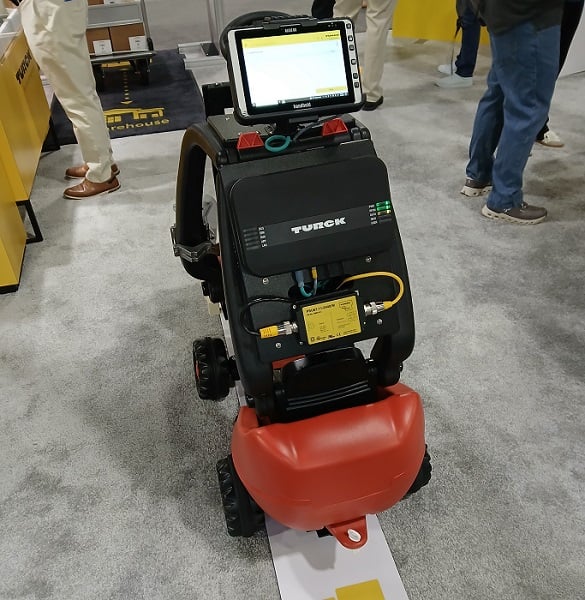
RFID and tracking devices are used for both navigation and tracking products.
RFID paired with optical code scanning can provide options for tracking inventories, but also navigation around a facility. In a mobile booth demo, a small autonomous robot moved between simulated stations indicated by codes on the ground below. As the robot progressed to another station, the tracking system updated its status, which would normally be relayed to the warehouse management system (WMS). The RFID scanner detected tags on packages to keep the proper flow of items around the warehouse.
The Future: Beyond 2026
Turck's message is clear: the future of warehousing and supply chain lies in decentralization. By placing control as close to the end devices as possible, and providing flexibility in product and robot motion while communicating with the management systems, suppliers can keep up with the ever-increasing demands of goods around the globe.
Related Content