Facebook
 Google
 GitHub
 Linkedin
KUKA Brings LBR iisy Cobots to iiQKA.OS2 Automation Platform
Industrial robots become easier to deploy and scale as KUKA combines its LBR iisy robots with the cybersecure iiQKA.OS2 operating system.
KUKA announced the integration of its smart, flexible, safety-enhanced LBR iisy cobots with its iiQKA.OS2 operating system. According to KUKA, the culmination of these two technologies serves as a key entry point into KUKA’s automation ecosystem. Industrial-grade, dynamic, manual hand-guidable hardware meets a central, cyber-resilient, customizable, and scalable operating system.
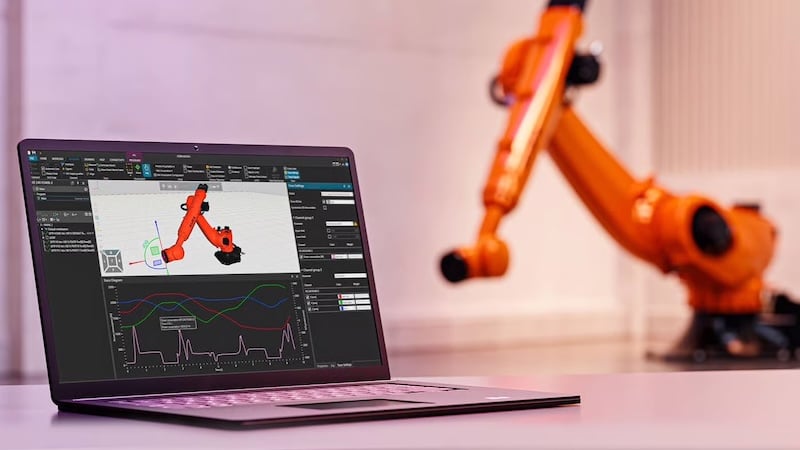
Customers can tap into the central control center, iiQWorks.Cockpit to load data, monitor assets, manage licenses, program applications, and test and evaluate through simulation. Image used courtesy of KUKA
Promoting Automation Adoption and Scalability
Production systems face the selective pressures of changing consumer demands, varying production quotas, flexible and efficient workflows that prioritize speed and quality, and a shortage of skilled workers to operate new innovative technologies. New tech and software associated with production operations need to be intuitive, centralized, safe (in terms of human-machine collaborative working), interoperable, and scalable. On top of all of this, adoption of automated production technologies relies on low-code, hassle-free setup procedures that bypass adoption inertia.
KUKA is aiming to tackle these issues with the announcement of the integration of its industrial performance cobots, LBR iisy, with its scalable, Linux-based, cybersecure operating system, iiQKA.OS2.
KUKA’s iiQKA.OS2 Operating System
The iiQKA.OS2 system, part of the comprehensive iiQWorks Engineering Suite, provides KUKA customers with a user-friendly interface for program development, safety-enhancing operating tools, advanced fieldbus communication, IoT capabilities, sophisticated programming options, and a choice of up to 31 languages for the user interface.
Configuration and I/O mapping is available for PROFINET, EtherNet/IP, Interbus, MODBUS, CC-Link, DeviceNet, PROFIBUS, EtherCAT, and CC-Link IE field. Customers can leverage statement-based KRL (KUKA Robot Language) programming code to help streamline application development.
Engineers and technicians can also use KUKA Load to assess the feasibility of applying a particular load to a specific robot. Customers can also simulate their robot application setup through iiQWorks.Sim Basic to evaluate and modify for deployment in a real-world industrial setting. Need to measure the load for tool attachments? You can turn to the iiQKA.LoadDataDetermination package. Teaming up bots and synchronizing motion and load handling is offered through iiQKA.RoboTeam. Another integral step to your connected system might be through the iiQKA.ConveyorTech technology package, where you can synchronize robot motion with that of your chosen conveyor systems.
Kinematic control of KUKA robots extends to Delta, Scara, and LBR iisy bots. KUKA states that the combination of artificial intelligence-backed technology and compliance with new safety standards (ISO 10218:2025) provides a future-proof system for production operations.
See the single centralized, cyber-resilient operating system for all KUKA robots. Video used courtesy of KUKA
A Closer Look at LBR iisy
KUKA’s LBR iisy cobots are designed to perform in and withstand demanding industrial environments. The bots offer customers an IP 30 protection rating, a 3 to 15 kg load capacity, and a reach range of 760 to 1300 mm depending on the model selected.
Typical industries for application deployment include industrial machinery and equipment manufacturing, automotive, metal fabrication and processing, consumer goods manufacturing, packaging, packaging machinery, logistics and intralogistics, and electronics manufacturing. LBR iisy is ideally suited for applications that require high-quality results, repetitive tasks, and consistency, such as machine tending, pick-and-place operations, packaging and order fulfillment, assembly procedures, screwdriving applications, palletizing and depalletizing, quality and visual inspection, validation and testing, code reading, part identification, machine loading, material handling, and mig/mag welding. LBR issy cobots are designed to support high-mix to serial manufacturing.
LBR iisy cobots come with integrated safety functions, laser scanners, light curtains, safe I/O, safe fieldbus systems, and iiQKA.SafeOperation for tracking speed, positioning, defined protection zones, and workspace environment with scalable license packages.
Customers can also benefit from built-in wizards and templates to speed up time to deployment, error messages, intuitive programming, and clear diagnostics. Linking with the iiQKA.OS2 operating system supports scalability across cells, robots, and manufacturing areas.
Related Content