Facebook
 Google
 GitHub
 Linkedin
Mecha Clean: KUKA KMR iisy CR Brings Cleanroom Precision to AMRs
The KMR iisy CR from KUKA combines mobile robotics with ISO Class 3 precision, expanding automation into sensitive cleanroom environments.
Cleanroom robotics has long been a specialized niche, but as automation increasingly approaches contamination-sensitive processes, the industry is seeing a push for mobile robots that meet more stringent standards. KUKA’s latest announcement signals that trend in motion: the KMR iisy CR, a mobile manipulator built for cleanroom use, is now officially certified to ISO Class 3, one of the highest grades of particulate cleanliness.
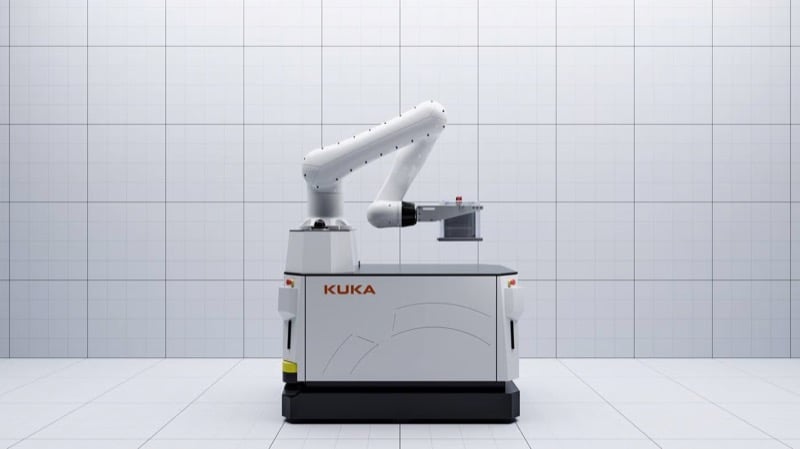
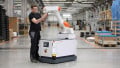
The KMR iisy CR brings cleanroom automation on wheels, combining mobile flexibility with ISO Class 3-certified precision for contamination-sensitive environments. Image used courtesy of KUKA
The KMR iisy CR combines KUKA’s proven AMR platform and its collaborative LBR iisy robotic arm, both now verified by the Fraunhofer Institute to meet DIN EN ISO 14644-1 Class 3 cleanroom standards. Thanks to its low particle emissions, ESD compliance, and minimal outgassing, the KMR iisy CR is built for cleanroom tasks that used to rely on manual labor or bulky, fixed systems. While cleanroom robots aren’t mainstream, this certification marks a step forward, helping prove the platform’s readiness for use in semiconductor fabs, medical labs, and other tightly controlled environments.
Cleanroom Automation Gets a Mobile Upgrade
The KMR iisy CR pairs a self-driving AMR platform with a six-axis robotic arm, giving it the mobility and dexterity to move, sort, or palletize parts throughout cleanroom facilities. The KMR iisy has passed rigorous particle and outgassing tests from the Fraunhofer Institute, confirming it meets ISO Class 3 requirements.
Cleanroom applications go well beyond semiconductors. Pharmaceutical labs, medical production lines, and high-purity food processing face strict contamination limits and frequent changeovers. In these environments, rigid conveyor systems often fall short. The KMR iisy CR offers a more adaptable approach to reroute or switch tasks as needed while maintaining strict air quality standards.
Certified for Clean; Built for Flexibility
Unlike fixed automation, the KMR iisy CR isn’t tethered to a single production line. It can connect and disconnect from any number of workstations, enabling dynamic workflows and small-batch flexibility, both of which are increasingly important in electronics manufacturing and medical device assembly. The platform’s AI-powered KUKA AMR Fleet software handles coordination across multiple mobile units, while the LBR iisy robot runs on KUKA’s modular iiQKA. The OS2 operating system, which includes a virtual robot controller, meets modern safety standards, such as ISO 10218.
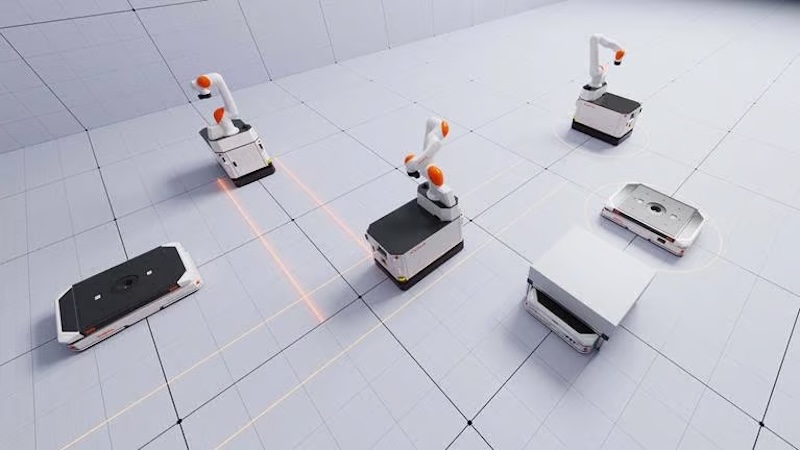
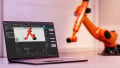
KUKA AMR Fleet software coordinates multiple mobile robots in real-time, enabling smart and flexible material handling across cleanroom workstations. Image used courtesy of KUKA
Operators can use KUKA’s smartPAD pro for direct control or the KUKA smartPLUG to interface with tablets or third-party HMIs. This design makes the system easier to integrate into diverse factory settings, especially those evolving toward mixed fleets of robots and mobile platforms.
Applications Emerging but Still Maturing
Though the KMR iisy CR is a technological step forward, cleanroom adoption of mobile robotics remains uneven. In semiconductors, the use cases are clearest for handling FOUPs, SMIF pods, or open cassettes, but in pharmaceuticals and healthcare, implementation is more experimental. Cleanroom robotics is still largely driven by automation vendors rather than mass market pull. That said, as the demand for traceability, repeatability, and sterile handling increases, cleanroom-ready AMRs like the KMR iisy CR are positioned to meet tomorrow’s automation needs.
With ISO Class 3 certification, KUKA’s KMR iisy CR demonstrates that advanced robotics can meet the demanding standards of next-gen manufacturing environments. Adoption may still be in the early stages. Still, platforms like the KMR iisy CR show how cleanroom automation could evolve, where mobile robots handle sensitive tasks with the same agility and precision already common in warehouse settings.