
 Facebook
 Google
 GitHub
 Linkedin
Radiative Temperature Measurement
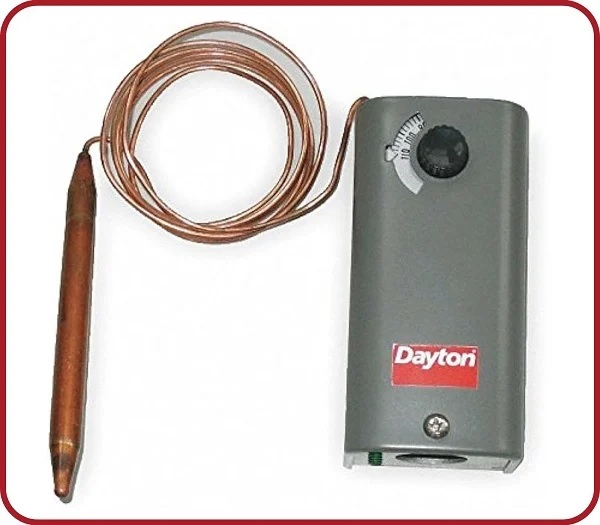
While contact temp sensors touch the measured object, the radiated heat can also be detected
Radiative temperature measurement uses the Stefan-Boltzmann equation to convert the emission of electromagnetic energy into a physical temperature unit.
Temperature measurement devices may be classified into two broad types: contact and non-contact. Contact-type temperature sensors detect temperature by directly touching the material to be measured, and there are several varieties in this category. Non-contact temperature sensors work by detecting light emitted by hot objects.
Energy radiated in the form of electromagnetic waves (photons, or light) relates to object temperature by an equation known as the Stefan-Boltzmann equation, which tells us the rate of heat lost by radiant emission from a hot object is proportional to the fourth power of its absolute temperature:
\[P = e \sigma A T^4\]
Where,
\(P\) = Radiated energy power (watts)
\(e\) = Emissivity factor (unitless)
\(\sigma\) = Stefan-Boltzmann constant (5.67 \(\times\) \(10^{-8}\) W / m\(^{2}\) \(\cdot\) K\(^{4}\))
\(A\) = Surface area (square meters)
\(T\) = Absolute temperature (Kelvin)
Solving for temperature (\(T\)) involves the use of the fourth root, to “un-do” the fourth power function inherent to the original function:
\[T = \root 4 \of {P \over {e \sigma A}}\]
Any optical temperature sensor measuring the emitted power (\(P\)) must “characterize” the power measurement using the above equation to arrive at an inferred temperature. This characterization is typically performed inside the temperature sensor by a microcomputer.
