GE Mark VIe - Trying to change a TMR setup from a 0-5VDC to a 4-20mA transmitter..

Hello all, looking for some assistance. Im trying to replace some old rosemount transmitters with updated ones and in this current case, its a externally powered not smart 0-5VDC, setup as TMR. After i hook up the new rosemount running hart 4-20ma, i can get a good reading in toolbox once downloading the new parameters to controller R. Once i update S, the readings go negative -33PSI on both, then once i update controller T, all 3 are -55psi (Should be 0PSI). Am i missing something obvious here or is this why it was originally a 0-5 setup and 4-20ma will not work in this case?

Thanks
 
@RizerGLI,

I presume you are replacing CPD or P2 transmitters on GE-design heavy duty gas turbines. You need to use GEH-5980, the Mark* V Application Manual's Appendix D 'Signal Flow Diagram' drawings to see how the input/output terminal board (the TBQC on <R>, if I recall correctly) is used to accept either 0-5 VDC or 4-20 mA inputs while providing excitation (power) to the devices. You will probably need to move some hardware ("Berg") jumpers, also, to make the configuration complete. Then configure the inputs in the I/O Configurator, Verify, Save & Exit, and download the I/O Config partition to <R>, <S> & <T> and then reboot them, one at a time waiting 3-5 minutes after the processor being rebooted reaches A7 before rebooting the next processor.

I want to strongly caution you that smart transmitters (Rosemount smart transmitters) were NOT deemed to respond fast enough to provide proper indication to control and protect the machine when the Mark* V *or Mark* VI or early versions of the Mark* VIe) were being included with GE-design machines (including most steam turbine control and protection applications). CPD and P2 pressure control, particularly with Mark* V turbine control systems, requires fast feedback/input from the transmitters sensing the pressures for stable operation. That's the primary reason GE didn't switch to smart transmitters when many other original equipment providers originally did. Now, this situation might have changed in recent years but it's definitely something to be considered when choosing transmitter replacements. Ease of maintenance and calibration/verification is great, but proper control and protection is king.

Anyway, that's all I can say based on the information you provided. You didn't say how the transmitters were being powered (excited in GE language) or what parameter they were sensing or how they were ultimately connected to the Mark* V input/output terminal board or how the I/O Conifiguration was modified before downloading.
 
@RizerGLI,

I presume you are replacing CPD or P2 transmitters on GE-design heavy duty gas turbines. You need to use GEH-5980, the Mark* V Application Manual's Appendix D 'Signal Flow Diagram' drawings to see how the input/output terminal board (the TBQC on <R>, if I recall correctly) is used to accept either 0-5 VDC or 4-20 mA inputs while providing excitation (power) to the devices. You will probably need to move some hardware ("Berg") jumpers, also, to make the configuration complete. Then configure the inputs in the I/O Configurator, Verify, Save & Exit, and download the I/O Config partition to <R>, <S> & <T> and then reboot them, one at a time waiting 3-5 minutes after the processor being rebooted reaches A7 before rebooting the next processor.

I want to strongly caution you that smart transmitters (Rosemount smart transmitters) were NOT deemed to respond fast enough to provide proper indication to control and protect the machine when the Mark* V *or Mark* VI or early versions of the Mark* VIe) were being included with GE-design machines (including most steam turbine control and protection applications). CPD and P2 pressure control, particularly with Mark* V turbine control systems, requires fast feedback/input from the transmitters sensing the pressures for stable operation. That's the primary reason GE didn't switch to smart transmitters when many other original equipment providers originally did. Now, this situation might have changed in recent years but it's definitely something to be considered when choosing transmitter replacements. Ease of maintenance and calibration/verification is great, but proper control and protection is king.

Anyway, that's all I can say based on the information you provided. You didn't say how the transmitters were being powered (excited in GE language) or what parameter they were sensing or how they were ultimately connected to the Mark* V input/output terminal board or how the I/O Conifiguration was modified before downloading.
Thank you for the response! You are correct, it is for the CPD setup. As it currently stands, i have the single xtmr weird up running on 4-20 hart. (it was previously a 0-5V and setup externally powered). I relocated the wires on the TB so its 24V powered and running on the return leg.(Including the 250ohm resister inboard). Parameters were changed in toolbox from 0-5V to 4-20ma and i also updated the min low and min high settings. After i download the parameters, the CPD reads perfect but soon as i downloaded the next two (S & T), the readings go to -33V then -50 after the final controller is downloaded to. If i disconnect 2 of out 3 from the i/o boards, the expected reading returns. Hope that helps
 
When a single device works OK but additional signal inputs cause offsets or faults up-scale or down-scale when devices are added to a non-isolated analog input board, a known cause is common mode voltage ground loops.

HART transmitters are typically isolated (the housing is grounded, but the circuits are isolated from the housing). But single ended inputs can still see ground loops when multiple DC power supplies are involved.
 
@RizerGLI,

I don’t have access to a copy the Mark* V Application Manual, but I am very sure you need to move some hardware (Berg) jumpers to add a dropping resistor in to the input circuit. If you are using a single 4-20 mA transmitter and are jumpering the same input current to all three control processor inputs that is going to screw up the readings. With ONE transmitter input for three control processors you only need ONE dropping resistor to convert the current to voltage—the SAME voltage for all three control processors. It seems you have that right but it’s not clear to me what’s causing the issue you are experiencing. I strongly suspect it’s a wiring or hardware jumper issue, but that’s just my guess at this point.

This should be clear on the relevant Signal Flow Diagram in App. D of the Application Manual.

It would help (me, at least) if you would sketch the wiring configuration with terminal board numbers and show the hardware jumper(s) you have IN. Follow the example of the relevant Signal Flow Diagram. Then take a clear photo of sketch and attach it to a reply to this thread. I may be near a Mark* V Application Manual over this holiday weekend, but I don’t have access to one now.

The Mark* V has a lot of nuances and possibilities for misinterpretations and misunderstandings. Unfortunately.
 
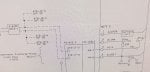
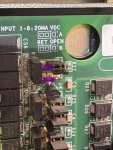
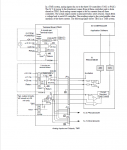
Thank you everyone for the replies. I didn’t get a chance to see these till I got home but I did have some pictures saved that might assist. With the 0-5 setup, wires were landed on spot 3 and 4 (on right under words Note 2) and the jumpers were installed on spots 2&3 for both rows (second picture with the purple highlights).

With the 4-20 transmitter, wires are now landed on spots 1&2 and 2 jumpers both installed on 1&2 for both rows (as purple highlights illustrates. I did this on all 3 i/o boards. I will be able to provide more info tomorrow but maybe this might help.

IMG_0075.jpegIMG_2409.jpeg
 
@RizerGLI,

My sincerest apologies for mistaking your post to be about a Mark* V and not about a Mark* VIe. Sorry for any confusion. This appears to be a Mark* IV-to-Mark* VIe conversion. The relevant manual would be the Mark* VIe System Guide for information about analog inputs.

Best of luck with your issue.
 
Correct, it was originally a 4-wire 0-5DC setup but quickly learning this might not work out trying to split the signal to 3 processors like it was setup with the 0-5vdc transmitter.
Well, I am not sure about that.

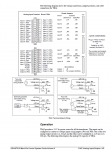
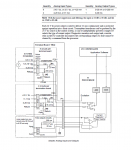
Examining the last attachment of GEH-6721G, it appears that the TBAI card is provided for the exact function of sharing single 4-20mA signals across all 3 controllers.

Also if memory serves there were specific I/O cards for HART, but I'm not sure that's your problem.

So 2 things to try:

Wire you device to one processor (R) as shown in the last attachment of GEH-6721G, sorry I did not include the page number in that attachment. We can see that from there it is wired to S and T through JS1 and JT1. you can test if this works by powering down one core and see if the signal remains healthy on the other processors.

And/Or.

Simulate a 4-20mA signal using a process meter or similar and see if the HART protocol is casing any issues, I doubt that it is.

Let us know how you go.
 
Top