Facebook
 Google
 GitHub
 Linkedin
https://control.com/forums/threads/...-y-probes-vibration-switching-randomly.54493/
Referring to the thread linked above, a Vibration Analysis was carried out by the Bentley Nevada team on both steady load and coast-down to shutdown (rolling - 4RPM) data.
Based on the analysis recommendations, bearing 1 was physically inspected. The bearing’s condition was found to be normal, and all clearances were within the acceptable limits.
- All operating parameters were found normal.
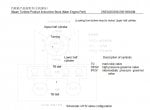
One of the recommendations was to inspect the steam control valves. The HP turbine steam inlet consists of four control valves installed downstream of two Main Stop Valves (the valve configuration is attached).
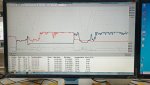
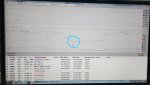
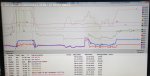
Upon startup, vibrations were initially very low but gradually started to rise by small increments (trend line for before and after the outage is attached).
Since the valves could not be physically inspected, it was decided to test the control valves (CVs) through the control system to identify any faulty or malfunctioning valve.
The planned test involved taking manual control of the CVs and adjusting the percentage opening of each valve to determine if any are malfunctioning.
There are 2 control modes in the system: Single Control Mode & Sequential Control Mode.
With Single Mode, all valves operate at equal percentage for all operating conditions and loads. At full load these valve generally operate at around 40~45%, and around 20~25% at half load.
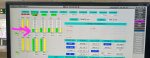
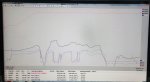
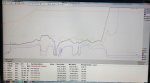
With Sequential, at full load, CV1, 2 & 3 operate at 100% while CV4 is in controlling mode, adjusting itself and operating around 22%. At half load, CV1 & 2 operate at around 45% load and CV3 & 4 drop to 0% opening. Though, their relation in the midde of these load conditions is not linear and each valve follow its own control curve (Curves attached).
The test was conducted and each valve was individually put into manual mode and values forced to see impact on vibration. In general, Reducing CV1 & 4 reduced the vibration and increasing CV2 & 3 reduced the vibration. Conversely, decreasing CV3 increased the vibration.
- During testing, on occasions, 2 valves were at a time forced as changing position of valve would cause vibration to reach upto 120um.
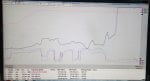
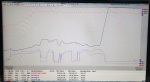
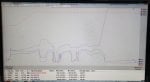
After the test, the mode was switched back to sequential. However, due to high amount of fluctuations on CV3 at full load (trend attached), on 19th, the mode was changed back to single and another test was conducted:
1. CV4 was put on manual mode and forced to operate at around 20%. While the vibrations reduced for brief time, Y probe vibrations rose again during load ramp up from half load to full load.
2. CV4 was put back in auto mode and CV1 was put in manual mode and forced at 25% at full load. Vibrations reduced and have remained very low since then.
I have few queries related to this:
1. in Seq. mode, at full load, CV1, 2 & 3 are 100% open and CV4 operates at around 20%. When same is mimicked in Single Mode and CV4 is foreced to operate at 20%, why do all other valves reach upto 45% only to achieve full load? Steam pressure, flow and Load remain same.
2. Assuming all CVs are physically healthy, why forcing a valve (putting uneven steam force) is reducing the vibration? We have two such units at plant and the other is operating at single mode with all valves operating at 45% with minimum vibrations. So, why is vibrations high on this?
- If assumed otherwise, does it mean that forcing one CV is actually an indication that this particular valve is faulty and not injecting proper steam at normal operating condition?
- Can uneven / abnormal steam injection be somehow related to internal path of steam turbine? Nozzle chest / nozzle ring condition perhaps?
3. For a brief moment during load reduction, position of CV2, 3 & 4 stepped below forced value of CV1 which immediately caused spike in vibration, until CV1 value was manually reduced below others, bringing the vibration back. Does that indicate anything with regards to health of CV or any other indication?
Note: I have uploaded several DCS graphs and configuration of CVs in the post. Can post further any particular trend if required for discussion.
P.S: Please don't limit to only the questions posted above. Perhaps the problem is entirely elsewhere.
Referring to the thread linked above, a Vibration Analysis was carried out by the Bentley Nevada team on both steady load and coast-down to shutdown (rolling - 4RPM) data.
Based on the analysis recommendations, bearing 1 was physically inspected. The bearing’s condition was found to be normal, and all clearances were within the acceptable limits.
- All operating parameters were found normal.
One of the recommendations was to inspect the steam control valves. The HP turbine steam inlet consists of four control valves installed downstream of two Main Stop Valves (the valve configuration is attached).
- Following the recommendation, the LVDTs of all valves were inspected, and faulty ones were replaced.
- Due to the limited shutdown timeframe, a physical inspection of the valves could not be performed.
Upon startup, vibrations were initially very low but gradually started to rise by small increments (trend line for before and after the outage is attached).
Since the valves could not be physically inspected, it was decided to test the control valves (CVs) through the control system to identify any faulty or malfunctioning valve.
The planned test involved taking manual control of the CVs and adjusting the percentage opening of each valve to determine if any are malfunctioning.
There are 2 control modes in the system: Single Control Mode & Sequential Control Mode.
With Single Mode, all valves operate at equal percentage for all operating conditions and loads. At full load these valve generally operate at around 40~45%, and around 20~25% at half load.
With Sequential, at full load, CV1, 2 & 3 operate at 100% while CV4 is in controlling mode, adjusting itself and operating around 22%. At half load, CV1 & 2 operate at around 45% load and CV3 & 4 drop to 0% opening. Though, their relation in the midde of these load conditions is not linear and each valve follow its own control curve (Curves attached).
The test was conducted and each valve was individually put into manual mode and values forced to see impact on vibration. In general, Reducing CV1 & 4 reduced the vibration and increasing CV2 & 3 reduced the vibration. Conversely, decreasing CV3 increased the vibration.
- During testing, on occasions, 2 valves were at a time forced as changing position of valve would cause vibration to reach upto 120um.
After the test, the mode was switched back to sequential. However, due to high amount of fluctuations on CV3 at full load (trend attached), on 19th, the mode was changed back to single and another test was conducted:
1. CV4 was put on manual mode and forced to operate at around 20%. While the vibrations reduced for brief time, Y probe vibrations rose again during load ramp up from half load to full load.
2. CV4 was put back in auto mode and CV1 was put in manual mode and forced at 25% at full load. Vibrations reduced and have remained very low since then.
I have few queries related to this:
1. in Seq. mode, at full load, CV1, 2 & 3 are 100% open and CV4 operates at around 20%. When same is mimicked in Single Mode and CV4 is foreced to operate at 20%, why do all other valves reach upto 45% only to achieve full load? Steam pressure, flow and Load remain same.
2. Assuming all CVs are physically healthy, why forcing a valve (putting uneven steam force) is reducing the vibration? We have two such units at plant and the other is operating at single mode with all valves operating at 45% with minimum vibrations. So, why is vibrations high on this?
- If assumed otherwise, does it mean that forcing one CV is actually an indication that this particular valve is faulty and not injecting proper steam at normal operating condition?
- Can uneven / abnormal steam injection be somehow related to internal path of steam turbine? Nozzle chest / nozzle ring condition perhaps?
3. For a brief moment during load reduction, position of CV2, 3 & 4 stepped below forced value of CV1 which immediately caused spike in vibration, until CV1 value was manually reduced below others, bringing the vibration back. Does that indicate anything with regards to health of CV or any other indication?
Note: I have uploaded several DCS graphs and configuration of CVs in the post. Can post further any particular trend if required for discussion.
P.S: Please don't limit to only the questions posted above. Perhaps the problem is entirely elsewhere.
Attachments
-
 68 KB Views: 20
 -
 118.9 KB Views: 21
 -
 95.8 KB Views: 17
 -
 207.4 KB Views: 14
 -
 338.4 KB Views: 15
 -
 674.7 KB Views: 15
 -
 1.1 MB Views: 12
 -
 796.1 KB Views: 9
 -
 935.4 KB Views: 9
 -
 1,022.7 KB Views: 9