6B Turbine, mkIV controls; High exhaust temps causing FSRT to hold turbine at <50% during startup.

What would cause FSRT to limit FSR during a startup resulting in turbine speed leveling out at just less than 50%. I know that exhaust temp is the immediate answer. On two startups separated by only a few hours: the first one went normal temps rising but leveling out at about 900 before starting to go down again. FSRT dropped but not enough to take over and as temperatures leveled out and dropped FSRT stayed out of the way. Then we had synchronizer check relay problems and decided to shut down and investigate. Only a few hours later, on our next startup, the rate of exhaust gas temperature rise never started decreasing, and after the first bump, started rising linearly until they hit 1055 causing FSRT to take over and stop turbine acceleration. Any ideas on what would cause this?

Comparing the two startup trends: It looks like Exhaust O2 was a little lower on the second startup, (Natural Gas) fuel flows were exactly the same prior to and at the FSRT takeover point, CPD very close but was a little lower than the other startup (5# vs. 8#) but it seemed to stop increasing at an increasing rate because speed started to level out.
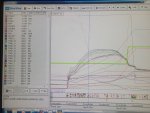
 
@cactus_chris.

The below presumes a machine with conventional combustors (NOT DLN-I combustors) and modulated IGVs (IGVs that can vary position finely--not just open or closed (sometimes called bang-bang IGVs)).

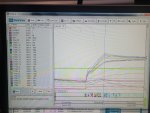
From a very quick review of the data in the left window TTXM is 1051 deg F at a NH of 36.60%, and that's the average of the 18 exhaust T/Cs AFTER ignoring the highest (1215 deg F) and the lowest (876 deg F). The difference between the highest and lowest exhast T/Cs is (1215-876=339 deg F) and that's pretty high--even for a turbine start/acceleration. While it's not uncommon for spreads to be high during starting/acceleration the usual reason is that there is a problem with the flame in one or more combustors (excessive fuel flow to one combustor--not usually likely) or (much more likely) loss of flame in one, sometimes more, combustors during starting/acceleration. Sometimes the flame in one or more combustors will "flicker" during starting/acceleration which can be very problematic. This usually isn't a problem with natural gas--unless there is something amiss with the GCV LVDT calibration OR the P2 pressure or the gas fuel flow is somehow restricted (which would be indicated by an unusually large SRV opening during firing/starting/acceleration and usually problems maintaining FSNL and/or loading the machine after synchronization (inability to reach higher/Base Load). (Usually as the machine accelerates all of the combustors eventually "light off" and the exhaust spreads/differentials settle out greatly, usually especially after the IGVs start to open--and the gas fuel flow-rate increases as machine speed increases.)

Natural gas suppliers have cut costs over the years by shipping dirty gas (containing compressor lubricating oil, compressor seal oil, diesel oil, gasoline, rocks and sand (which may not be captured with the y-strainer upstream of the SRV) and weld slag and scarf. These contaminants, in addition to silica entrained in the natural gas (which has been on the increase in the USA), can cause problems for the smaller orifices in DLN-I fuel nozzles, with build-ups of carbon on the tips and in the orifices, as well as worn fuel nozzle orifices.

IGVs should be at the closed position (approx. 34 DGA) until around 70-80% TNH at which time they will start moving to the minimum operating position (usually 57 DGA). It would be unusual--but not impossible--for IGV LVDT calibration problems to cause the IGVs to be seriously out of calibration causing air flow through the axial compressor and turbine/exhaust to be much lower than normal (leading to high exhaust temperatures) during starting/acceleration.

The axial compressor bleed valves should be open until the machine reaches 95% TNH (or sometimes FSNL) which does decrease the air flow through the axial compressor and turbine/exhaust--but that's necessary and normal (for the bleed valves to be open during starting and shutdown).

I don't know what you're monitoring natural gas fuel flow with, but if it's GE-supplied instrumentation it's pretty crude and not very accurate--especially at low gas fuel flow-rates (such as during starting/acceleration).

A failing torque converter can cause a slower-than-normal acceleration rate which can lead to higher-than-normal exhaust temperatures. I have also seen the suction strainer/foot valves of torque converters which have been choked/plugged and the foot valve spring broken which caused very low oil flows through the torque converter which caused the torque converter housing to be VERY hot. And, cause problems with high exhaust temperatures during starting/acceleration.

Exhaust T/C issues cannot be ruled out. Exhaust T/Cs do degrade over time and require replacement. People working in the exhaust duct during maintenance outages like to play with the exhaust T/C tips in the radiation shields and they can be bent out of shape can cause problems. Also, improper insertion of exhaust T/Cs can cause the tips to be touching the metal of the radiation shield and cause erroneous readings.

There are lots of possibilities. If the machine has DLN-I combustors, it's possible one or more of the multiple, smaller fuel nozzles in one or more combustors to be choked/plugged.

So, there's many things to consider. Often, as has been written many times on Control.com, troubleshooting is a process of elimination if the root cause isn't obvious or the first couple of checks don't result in successful starting/operation. Site personnel need to prioritize (based on their experience) what may or may not be the problem(s) and start checking them one at a time, until the root cause(s) are identified and resolved.

Please write back to let us know what you find.

By the way, the graphs are nice but very difficult to read accurately from a photograph. ALSO, most Mark* IV turbine control systems could only provide data via MODBUS to such HMI software and so the time intervals can be slow and not really reflective of actual conditions because of delays in transmission and display. They're better than nothing, and certainly better than the black-and-white CRT of the original Mark* IV, but not much better. And, again, photos of graphs can be difficult to review and analyze from a photo even on a large monitor (the traces are very thin and colors can blend and be difficult to distinguish).

Please write back to let us know what you find and how you resolve the problem!
 
Top