Expert opinion on Turbine Vibration Dips Issue and Remedial Actions

Machine Overview
Subject turbine is 6 stage Rateau turbine of 2721 HP, coupled with High Pressure BFW Pump through a reduction gear box.

Parameters
Values
  • Power
  • 2721 hp (2 MW)
  • Rated Speed
  • 6800 RPM
  • 1st Critical Speed
  • 4256 RPM
  • Minimum/Maximum Speed
  • 5780/7140 RPM
  • Inlet Steam Pressure
  • 38 – 40 kg/cm2
  • Temperature
  • 370 – 390 oC
  • Exhaust Steam Pressure
  • 4.5 kg/cm2
  • Sealing
  • Carbon Seals
  • Lube Oil Pressure
  • 1.5 bar
  • Lube Oil Temperature (Cooler Outlet)
  • 50 oC
  • Lube Oil Bearing Outlet Temperature
  • 60 oC
  • Outboard Bearing Clearance
  • 0.13 mm (Rec. 0.15 – 0.2)
  • Inboard Bearing Clearance
  • 0.13 mm (Rec. 0.15 – 0.2)
  • Outboard Bearing Crush
  • 0.02 mm
  • Inboard Bearing Crush
  • 0.04 mm
  • Driven Pump Speed
  • 2980 RPM
  • BFW flow
  • 335 – 345 m3/hr

Problem Statement
There is a consistent problem of Vibration Dips at Outboard and Inboard Bearings of the turbine which appears intermittently for short duration and gets restored without any action. Sometimes, subject issue is observed without any change in process parameters or ambient conditions. However, in few instances same problem is observed with slight change in process parameters (e.g. load change, lube oil temperature change etc.) and ambient conditions like rainfall etc.

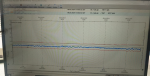
At Outboard, the vibration changes as described below:

  • VI-302A reduces from 60 microns to 25 microns
  • VI-302B reduces from 55 microns to 35 microns

At Inboard, the vibration changes as described below:

  • VI-301A reduces from 28 microns to 23 microns
  • VI-302B reduces from 30 microns to 25 microns
Key Observations:

More than 70% of the time vibration drops without any changes in:
  • Lube oil in & out temperature
  • Lube oil pressure
  • Steam temperature and pressure
  • XT (Axial displacement)
  • Gap Voltage
  • BFW flow/load on pump
  • Steam flow
  • RPM
All of the listed parameters above remain constant throughout most of the time.
  • The vibration dip corresponds to 1X vibration. 1X components is dominant, there are no sub-synchronous components. 1X component is also the major component 90% of direct vibration along with 2X & 3X (1X harmonics).
  • Shaft Centerline plot denotes movement of shaft inside bearing around 32 microns.
  • The orbit shape is like circular ellipse (vertically up).
1722940181100.png

1722940200418.png
 
@Abu Bakar Arshad,

I see this is the first time you have posted to Control.com.

This site is primarily for discussion and assistance with controls-related problems. While you have provided some very good information you have not provided any details about the manufacturer of the steam turbine, the manufacturer/model of the control system in use on the machine, or the type of vibration monitor/equipment being used on the machine. You also haven't provided any information about when the problem started (after a maintenance outage; if it was after a maintnenance outage how long after the maintenance outage; it was after a trip from load; if it was after a maintenance outage what was done during the maintenance outage--and specifically if the vibration sensors were removed/reinstalled after the mechanical work was done; if it was after a trip from load why did the machine trip and what was done to resolve the problem; if the problem started without any trigger event how long has it been persisting; etc.). The problem appears to have existed for at least one month (if the time scales on the photographs are correct.) We also don't know what system you are viewing this data on--a vibration monitoring system (Bently-Nevada system; or???) or are you looking at data which is being obtained from a vibration monitoring system and displayed for the operator on a DCS or data archival/retrieval system (such as PI, or ???). If it's being viewed on a DCS or some other system, what is the data capture rate (in Hz, or in second/milliseconds)?

So, you see we don't have much information we can use to suggest a course of action. Other than to say are 100% confident of the wiring between the sensors on the machine and the vibration monitoring system (and/or turbine control system)--meaning there is probably twisted-shielded pair wiring (or possible three-wire, twisted-shielded cabling) being used to get the signal from the sensors to the monitoring equipment and have you VERIFIED the tightness of all the terminations and crimp terminals (if used) and made sure the shield drain wire is properly grounded (it should be either continuous throughout the length of the each circuit and grounded at ONE end only, or if multiple pairs/cables are using along each circuit and not continuous the drain wires of each pair/cable should be grounded at ONE end only). Further, have there been any wiring changes to the plant such as new motors installed, and were the power wires for the motors run in properly segregated wire trays/troughs/conduits that are sufficiently isolated from the signal wiring of the vibration sensors?

But, again, while you have pretty clearly stated the problem, there are STILL a LOT of details missing--and the most important detail is: What troubleshooting have you done and what were the results of the troubleshooting?

Finally, when this decrease in vibration occurs, has anyone been near the machine to feel/experience if there is a noticeable change in vibration level(s)--lower, or, possibly, higher?

But, in all honestly, sir, this is a controls-related forum and for the most part all we can suggest or recommend is to be certain of the interconnecting wiring, power supply(s) to the various control system(s), proper grounding of shield drain wires, firm connections at all terminal points along the length of each sensor circuit. When it comes to trying to tell you what to do mechanically, this is not the proper forum for such information. And expert analysis is usually not free. It's entirely possible with a more details someone has experienced a similar problem and might have a suggestion or two, but it isn't really a good bet. If you're concerned about the mechanical health of the machine you should really have a knowledgeable, experienced vibration analyst come to site to evaluate and make recommendations.

I know (from decades of experience working on large, high-speed rotating equipment)--the "control system" ALWAYS get blamed for any problems which the mechanical department/management can't fix with their knoweldge and experience. ALWAYS. And, in my experience it's one of two things: a control system problem (wiring; terminations; sensor installation; heat degradation; improper (re-)installation; failed or failing monitors/power supplies) or the information being reported is true and correct and the control system (including the wiring, terminations, sensor, monitors and power supplies) are reporting a real problem. (I suspect a sudden, extended decrease in vibrations isn't the latter, but more related to the first scenario. And, I'm also certain the mechanical department is ADAMANT the problem is the control system. And it's easiest to eliminate the control system (wiring; sensors; terminations; monitor; power supplies) and then focus on the mechanical issue(s). Because it can be pretty embarrassing to take a machine apart and find nothing and then find some (simple) controls-related problem (failed or failing sensors; improperly re-installed wiring; water or lube oil in a junction box (which is really a mechanical problem...) which, if the control system had been completely verified prior to disassembling the machine could have quickly been resolved.

That's all I can say, sir. Best of luck. It would be very kind of you to write back to let us know what the root cause is ultimately determined to be. And if you believe you can get some assistance here you need to provide the information requested above.
 
Boiler feed water pumps are subject to a vast number of process variables, so you'll have to spend a lot of time getting familiar with the actual operating environment.
 
Top