Gas Turbine Tripping on Coupling Compartment Temperature Switch Actuation

Dear Community Member,

We've recently faced an outage of our GE Frame V Gas Turbine due to Coupling/Gear Compartment Temperature Switch Actuation. Below are the initial findings:
1. 02 Temperature switches are installed inside coupling compartment, 01 of them operated leading to CO2 release and tripping the turbine.
2. We replaced the temperature switch preventively, and tested the removed switch multiple times but its operation was found normal i.e. it kept on operating at 316 deg.C (its preset set-point)
3. We also found 02 very minor hairline cracks on the supporting ribs of casing between coupling compartment and turbine compartment. Preventively applied belzona to avoid any actual heat ingress from turbine compartment.
4. Turbine was taken in service and we kept on measuring the temperatures on coupling compartment using thermography as there was no temperature measurement instrumentation installed in coupling compartment.
5. After 4-5 hrs. of operation, we found that temperatures in coupling compartment are again on the higher side i.e. ~337 deg.C and we also compared this value with other Gas Turbine running on similar load and that was running on much lower temperature than this (~257 deg.C).
6. We shutdown the turbine again and found that 01 of the exhaust damper operated after CO2 release in the coupling compartment was closed
7. There are 02 manual dampers installed on exhaust of coupling compartment. Operations team only check the 01 damper whose limit switch is in start permissive of Gas Turbine. However, 2nd shutter type manual damper installed underneath the main exhaust damper is never checked by operations team.
8. So, turbine was taken back in service after opening this 2nd exhaust damper.
9. Meanwhile, our instrument team installed RTD just above the temperature switch to check actual temperatures at the location instead of performing thermography again and again.
10. Now, temperatures are well within range.

My query here is; what should be the cause of 1st actuation? As I stated, temperature switch seems fine we have 02 options left, 01 option is to consider the actual heat ingress inside coupling compartment from minor cracks observed in supporting ribs of casing between coupling and turbine compartment and 2nd option is to consider that manual damper was closed even before CO2 release that day.
Can turbine remain operational for long period if 01 of the exhaust dampers of coupling compartment remain close for long duration, like a year or so?

Please share your opinions.

Regards, Arslan
 
@Arslan,

It is presumed that BOTH dampers have CO2 pressure-operated latches to hold the dampers open (this type of latch--operated by CO2 pressure when a fire was detected and CO2 was discharged; the pressure of the CO2 would open the latch and the weight of the damper would close it to prevent air from entering the compartment AND to build up and maintain a concentration of CO2 to both extinguish the fire AND keep it from igniting again because of the presence of air (oxygen). The CO2 both displaces air to remove one of the key elements of combustion and then, by maintaining a high concentration of CO2 over a period of time (20-45 minutes, usually) the CO2 concentration would prevent re-ignition of the fire hopefully removing the temperatures required to re-ignite the fire as well as maintaining a very low level of air (oxygen) and a high level of CO2.

Based on the information provided it would appear the cause of the initial trip and discharge of CO2 was likely caused by one of the exhaust dampers being closed prior to the actuation of the CO2 system. The latches mentioned above were very prone to loosen--especially if not properly latched--allowing a damper to close during normal turbine operation and prevent the normal flow of cooling air in and through the Load Compartment (or the turbine or accessory compartment if one or more of the dampers in those compartments were also latched open with CO2 pressure-operated latches). Often the metal chains attached to the dampers and held in the "hook" of the latch would rust, or the hooks would not be properly latched prior to re-starting the turbine and normal turbine vibration (and high air flows) would cause the latches (which were usually made of brass to prevent them from rusting).

You mentioned two temperature switches. What is the function of the other temperature switch? Should it alert the operator(s) of a high temperature BEFORE the second switch initiates a trip and CO2 discharge? Typical GE fire detection/protection systems usually had redundant switches--which means two (or more) switches (temperature switches--sometimes switches designed for detection of fires in high temperature compartments/enclosures) would have to indicate a fire/high temperature before the machine would be tripped and CO2 would be discharged. GE licensed different companies to package GE-designed turbines and those companies would often make "subtle" changes to typical GE control and protection schemes--such are using non-redundant devices (temperature switches; vibration sensors; pressure switches; etc.) which would not provide the reliability of redundant devices in preventing shutdowns and/or trips. BUT, if there's a second switch was it tested to see if it is working properly and is its function known and has it been tested recently? (There is a very large--and, in my personal opinion, dangerous--change in operation and maintenance practices that has severely reduced the verification of the operation of switches and transmitters in order to reduce maintenance costs and outage times. It's usually called "calibration"--but what it really is periodic testing of the switches and transmitters--AND the wiring to the turbine control system, or the fire detection/protection system--to ensure everything is working properly and is at specification (the "calibration" portion of what is really verification testing).)

Anyway, now you have a method of monitoring the temperature in the compartment--at least in the area of the switch which is known to have tripped the machine and discharged CO2. (Newer GE-design machines mostly have these kinds of sensors (thermocouples, usually) which work well in the beginning but don't get the proper attention when they've been removed for a maintenance outage and are pooly re-installed (leading some sites to abandon them because of "false" indications....)

That's about all that can be said based on the information provided (which was actually pretty good). Pictures and drawings can be attached to posts here on Control.com and can be very helpful in troubleshooting.
 
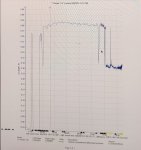
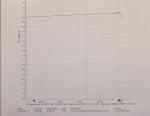
Below trends might further help to rule out the scenario of damper closing prior to CO2 discharge. Below trend shows pressure of turbine casing (adjacent to gear box casing, as there's no pressure monitoring in gear box compartment) before turbine trip/ CO2 discharge. Turbine Compartment Pressure before Trip.jpg
We can clearly see the pressure increase in turbine compartment after turbine re-start without opening the manual shutter type damper installed under main exhaust damper of gearbox compartment. As the main header is same, so if exhaust damper of any compartment closes it would definitely increase the pressure in turbine casing (Where pressure measurement is installed)
Turbine Compartment Pressure After Starup with Shutter or damper closed.jpg

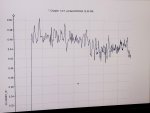
After manual shutdown of turbine and re-starting with exhaust opened, we can see again the pressure has stabilized to 0.5
Turbine Compartment Pressure After Damper Opening.jpg
P.S. fluctuation in above image comparative to 1st image is due to resolution scale.

Further to your query of 02 temperature switches in gear box compartment, please find below picture. These switches are installed at opposite ends of casing and are not redundant i.e. if any 01 temperature switch actuates, it will initiate CO2 discharge and turbine trip. Both temperature switches were replaced after the tripping preventively and both were tested multiple times and we found their calibration within range.DSCF9557.jpg
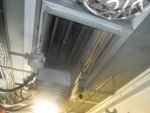
Moreover, the exhaust damper switch which actuates with CO2 pressure is found in good condition i.e. it was not corroded or there were no signs of it to mal-operate during normal operation. Refer below picture.
Manual Damper and its operating mechanism with CO2 pressure.jpgHaving said that, please share your thoughts on these findings.
 
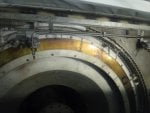
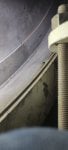
I am also attaching pictures of hair line cracks found on the supporting ribs of casing between coupling compartment and turbine compartment. Preventively applied belzona to avoid any actual heat ingress from turbine compartment. Please review if these cracks can lead to actual heat ingress from turbine to coupling. gearbox compartment. Location of these cracks was at the bottom while switches are installed at top.
Crack Pic-1.jpg
Fig.1
Crack Pic-2.jpgFig. 2
 
I've read and re-read and re-read the two most recent posts and I must admit, I'm more confused than ever.

I don't believe there is any question that some damper was somehow closed in the ventilation system of the Load Compartment. Without having access to the Cooling & Sealing Air P&ID it's unknown whether the damper in the photo was in the duct before or after the Load Compartment Vent Fan(s)--but if it was closed it would certainly impede air flow, and if there were even small exhaust leaks (which there almost always are in most Load Compartments of this type of machine--even when new) the lack of ventilation would elevate the temperature in the compartment. I've not seen that type of latch (it's not a switch; it has no wires or conduit connected to it), but in order for it to operate properly (meaning reliably unlatch when CO2 pressure is present in the tubing connected to the damper) it needs to be properly latched--and that, in my personal experience, is a task that is almost always hurriedly completed (if it is remembered prior to STARTing) and often not well. Vibration and heat (which causes expansion) can work together to cause the latch to open without CO2 pressure if it's not been correctly latched. Usually the lighting in the Load Compartment is not the best, even during the day when the sun is not obstructed by the clouds (I'm presuming this machine is located outdoors--it may not be, in which case lighting will most likely be poor no matter the time of day) and often a small stepstool or ladder is necessary to be able to see that the latch is properly secured. And, even then, vibration and heat can still cause the latch to prematurely open.

(There have been two basic types of compartment ventilation systems used on GE-design heavy duty gas turbines and Load Compartment--one that draw ambient air through the fan and create pressure on the discharge that is used to blow hot air and combustible gases out of the compartment through other opening (dampers; louvers; etc.). The other is a system whereby the fan draws ambient air into the compartment , usually through gravity-operated dampers or louvers--sometimes, but not always, held open with CO2-operated latches) in the lower areas of the compartment, through the compartment and into the fan's suction and then discharges the hot air outside the compartment. There are subtle variations of these two, but they are the basic types. Of course, there has to be some method of closing openings to prevent air from feeding a real fire--and that's usually done by either gravity-operated dampers (unlatched or latched with CO2-operated latches) or dampers that have to be manually latched open and closed by actuating some kind of latch mechanism to allow the dampers to close). We have no way of knowing which basic type of system you have and how and where all the openings (inlet and outlet) are located without being able to see the Cooling & Sealing Air P&ID.)

As for the "temperature switches" in the photo, they look more like fire detector switches (often manufactured by a company called Fenwal) that not only operate on temperature (in the case of fire, a high temperature--above what could normally be tolerated in the Load Compartment) but also will actuate on an excessive rate of increase in the temperature. The switches used for fire detection can be damaged if not tested properly which makes then unreliable. Also, even small "dings" (dents) in the body of the switch can cause issues when the temperature in the compartment is elevated. The fire detector switches are not usually treated well during maintenance outages because even if one is familiar with its purpose (which many mechanics and pipe fitters are not) they look simple, when in fact they are rather sophisticated devices.

Without being able to see the Fire Detection/Protection P&ID AND the fire detection/discharge scheme it's impossible to say for sure how the system operates. It would be unusual in this day and time for a fire detection system to not have redundant detectors to improve reliability and prevent "false" trips and discharges of CO2 when, in fact, there was no fire. Not impossible, but unusual--since running reliability is extremely important.

Anyway, that's all I got.
 
Thanks for the prompt response. Yes, the temperature switches are actually heat rise detectors (Fenwal 20000 series). But we have tested them multiple times by evenly applying heat by heat guns and they operate at setpoint value.
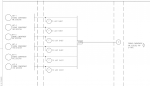
Further, your point regarding redundancy of these switches is well noted for reliability enhancement and we're already working in this direction. Currently they are not redundant, as can be seen from below figure. The switch which caused trip was 45FT-6.F&G Logic.png

Moreover, as inquired please find attached cooling and sealing air circuit P&ID for review. It shows that closure of damper will obviously lead to pressure increase in adjacent compartment as well. So, we can be sure that damper was not closed/ maloperated before CO2 discharge/trip and switch 45FT-6 operated due to actual heat detection.

Now, further narrow it down and advise, can the hair line cracks (pictures shared in my earlier thread) cause heat rise to this level? or we should look for another root cause.
 

Attachments

It's not possible for me to comment on the source of the temperature rise. We don't know what the typical temperature in the Load Compartment when the unit has been operating stably for several hours minimum. We don't know what the time was from the time the temperature in the Load Compartment started rising to when the unit was tripped.

If pressed I would say based on the picture provided the hairline cracks are, by themselves--as indicatined in the picture--enough to cause the temperature to rise to the point the unit would be tripped if the Load Compartment ventilation system was properly in service (all latched dampers latched in their normal running position(s); all gravity-operated dampers working properly (free to operate when air is flowing through the dampers); etc.).

Typically, and in general, the most common source of leaks is from the flex seals around the edge of the exhaust (made of segments of stainless steel which have to be properly staggered when installed). These flex seal strips can become loose over time and with changes in temperature during starting and stopping of the machine, which can also loosen the bolts on the metal bars which hold the edges of the flex seal strips in place. That's the hottest air which would flow into the Load Compartment. (This presumes there is no rusted plates around the #2 turbine bearing and no missing insulation around the gas turbine exhaust diffuser (which is inside the machine exhaust). There is also, usually, some fiberglass insulation behind the flex seal strips, and over time with the seal strips becoming loose and shifting the insulation can be blown out of place--sometimes into the Load Compartment (though not usually) and most often into the exhaust duct.

But those hairline cracks in the pictures you posted would probably NOT be the source of enough flow of exhaust gases into the Load Compartment to actuate the Fenwal switches.

I've seen it several times--the CO2-operated latch isn't properly made up or verified after being re-latched and it allows the damper to change position. Also, sometimes vibration can cause in poorly latched damper to come loose and change position. I've also had site personnel whisper to me that the latched damper has been forgotten to be closed in prior starts.... though management doesn't know that or chooses to ignore it. The latch in the photograph you provided is much more substantial than the brass latches I have most of my experience with and doesn't look like it would easily become unlatched--but anything is possible. The machine runs at 5100+ RPM, and there is a gear box in the Load Compartment, and the generator runs at 3000 or 3600 RPM. There's lot of vibration, and if the machine is started and stopped often there would be a lot of temperature differentials experienced in short periods of time.

That's ALL I can (or will) add to this thread based on the information provided.
 
Sorry for any confusion, but I meant to add to my previous response that I probably mis-typed when I said Cooling & Sealing Air P&ID; I meant the Heating & Ventilation system P&ID. Specifically, it would be good to be able to see the P&ID which shows the compartment heating and ventilation arrangement for the Load Compartment.
 
Top