Facebook
 Google
 GitHub
 Linkedin

Dear Community Member,
We've recently faced an outage of our GE Frame V Gas Turbine due to Coupling/Gear Compartment Temperature Switch Actuation. Below are the initial findings:
1. 02 Temperature switches are installed inside coupling compartment, 01 of them operated leading to CO2 release and tripping the turbine.
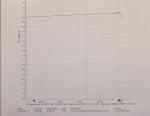
2. We replaced the temperature switch preventively, and tested the removed switch multiple times but its operation was found normal i.e. it kept on operating at 316 deg.C (its preset set-point)
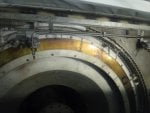
3. We also found 02 very minor hairline cracks on the supporting ribs of casing between coupling compartment and turbine compartment. Preventively applied belzona to avoid any actual heat ingress from turbine compartment.
4. Turbine was taken in service and we kept on measuring the temperatures on coupling compartment using thermography as there was no temperature measurement instrumentation installed in coupling compartment.
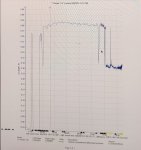
5. After 4-5 hrs. of operation, we found that temperatures in coupling compartment are again on the higher side i.e. ~337 deg.C and we also compared this value with other Gas Turbine running on similar load and that was running on much lower temperature than this (~257 deg.C).
6. We shutdown the turbine again and found that 01 of the exhaust damper operated after CO2 release in the coupling compartment was closed
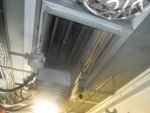
7. There are 02 manual dampers installed on exhaust of coupling compartment. Operations team only check the 01 damper whose limit switch is in start permissive of Gas Turbine. However, 2nd shutter type manual damper installed underneath the main exhaust damper is never checked by operations team.
8. So, turbine was taken back in service after opening this 2nd exhaust damper.
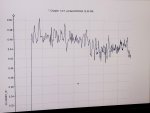
9. Meanwhile, our instrument team installed RTD just above the temperature switch to check actual temperatures at the location instead of performing thermography again and again.
10. Now, temperatures are well within range.
My query here is; what should be the cause of 1st actuation? As I stated, temperature switch seems fine we have 02 options left, 01 option is to consider the actual heat ingress inside coupling compartment from minor cracks observed in supporting ribs of casing between coupling and turbine compartment and 2nd option is to consider that manual damper was closed even before CO2 release that day.
Can turbine remain operational for long period if 01 of the exhaust dampers of coupling compartment remain close for long duration, like a year or so?
Please share your opinions.
Regards, Arslan
We've recently faced an outage of our GE Frame V Gas Turbine due to Coupling/Gear Compartment Temperature Switch Actuation. Below are the initial findings:
1. 02 Temperature switches are installed inside coupling compartment, 01 of them operated leading to CO2 release and tripping the turbine.
2. We replaced the temperature switch preventively, and tested the removed switch multiple times but its operation was found normal i.e. it kept on operating at 316 deg.C (its preset set-point)
3. We also found 02 very minor hairline cracks on the supporting ribs of casing between coupling compartment and turbine compartment. Preventively applied belzona to avoid any actual heat ingress from turbine compartment.
4. Turbine was taken in service and we kept on measuring the temperatures on coupling compartment using thermography as there was no temperature measurement instrumentation installed in coupling compartment.
5. After 4-5 hrs. of operation, we found that temperatures in coupling compartment are again on the higher side i.e. ~337 deg.C and we also compared this value with other Gas Turbine running on similar load and that was running on much lower temperature than this (~257 deg.C).
6. We shutdown the turbine again and found that 01 of the exhaust damper operated after CO2 release in the coupling compartment was closed
7. There are 02 manual dampers installed on exhaust of coupling compartment. Operations team only check the 01 damper whose limit switch is in start permissive of Gas Turbine. However, 2nd shutter type manual damper installed underneath the main exhaust damper is never checked by operations team.
8. So, turbine was taken back in service after opening this 2nd exhaust damper.
9. Meanwhile, our instrument team installed RTD just above the temperature switch to check actual temperatures at the location instead of performing thermography again and again.
10. Now, temperatures are well within range.
My query here is; what should be the cause of 1st actuation? As I stated, temperature switch seems fine we have 02 options left, 01 option is to consider the actual heat ingress inside coupling compartment from minor cracks observed in supporting ribs of casing between coupling and turbine compartment and 2nd option is to consider that manual damper was closed even before CO2 release that day.
Can turbine remain operational for long period if 01 of the exhaust dampers of coupling compartment remain close for long duration, like a year or so?
Please share your opinions.
Regards, Arslan