Facebook
 Google
 GitHub
 Linkedin
Carlo Gavazzi Announces Wireless Multiprotocol Energy Analyzer Series
The new EM600 W series energy meters feature two versions, both offering Wi-Fi connectivity and multiprotocol support for single-, two-, and three-phase systems.
Understanding power consumption in a factory, a building, or even a home is a way to help identify problems before they occur. In an HVAC system, for example, a spike in power consumption could indicate a failing refrigerator unit or heat pump, and early detection can prevent lengthy downtime.
Carlo Gavazzi’s new EM series of energy analyzers offers real-time monitoring of three-phase, two-phase, and single-phase systems up to 480 VAC. The latest devices feature dual Wi-Fi for access point or LAN configuration, as well as support for Modbus TCP/IP or HTTPS REST API communications.
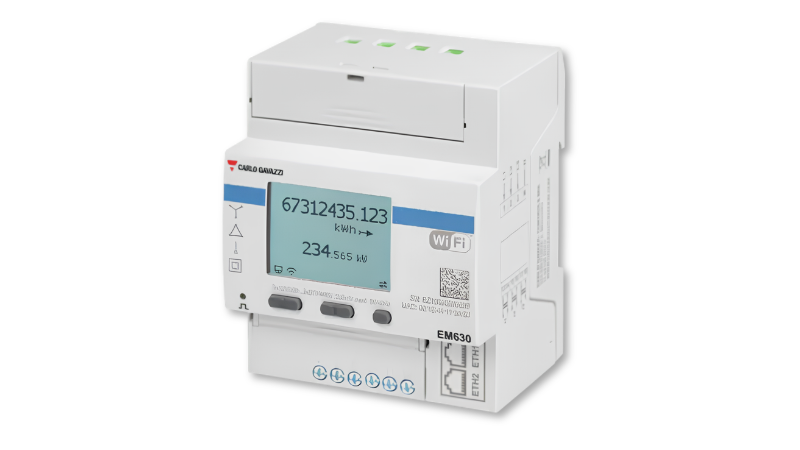
The EM630 energy analyzer for single-, two-, and three-phase systems. Image used courtesy of Carlo Gavazzi
The EM600 W Series: Faster Integration, Less Downtime
The EM600 W series energy analyzers come in two versions: the EM630 and EM640.
The EM630 monitors single-, two-, and three-phase systems up to 480 V, connecting via a 5 A current transformer or a 333 mV current sensor. The EM640 also monitors single-, two-, and three-phase systems up to 480 V, as well as current up to 65 A, connecting directly to mobile or desktop devices via Wi-Fi.
Soft-touch buttons and a digital display make quick configuration possible for first-time users. After initial configuration, the built-in web server or a mobile app can be used for further configuration and system monitoring. The series can be mounted in electrical cabinets on existing DIN rails.
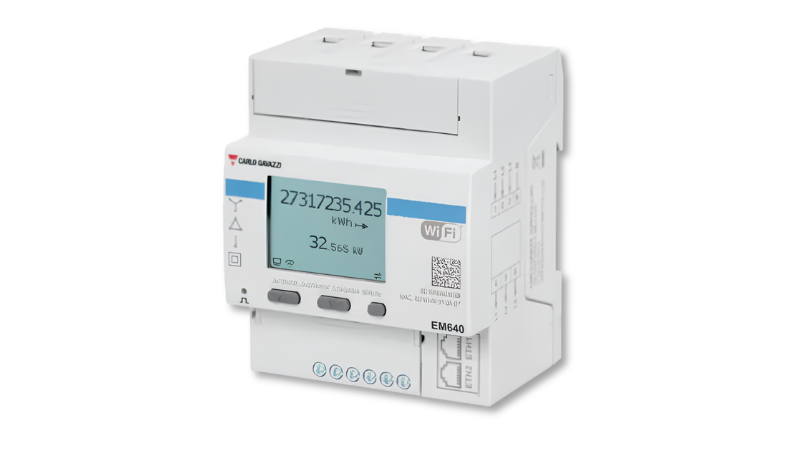
The EM640 energy analyzer features built-in Wi-Fi connectivity for direct configuration and monitoring. Image used courtesy of Carlo Gavazzi
Dual Ethernet ports are provided for easy daisy-chaining or ring topologies, along with a Wi-Fi option for fewer cables and fewer switch connections. Each EM600 can measure active energy consumption to a resolution of 0.001 kWh with a frequency resolution of 0.001 Hz.
The EM600 is equipped with one input for start, stop, reset, or remote status functions, and supports 5 VDC with a maximum of 30 VDC. One output is provided for alarm conditions, or a pulse output for counting blocks of power consumption.
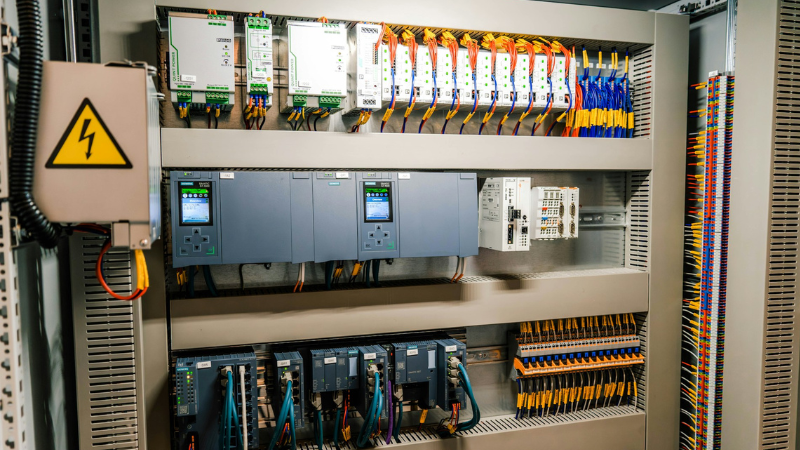
An industrial electrical cabinet with a control system, likely used for industrial automation, that could utilize a power monitor. Image used courtesy of Unsplash
Understanding Electrical Loading
There are many reasons to monitor electrical loading within industrial equipment. One reason is for safety. Electrical designers calculate maximum and average loads based on documentation from component suppliers. These calculated loads are not always accurate, and when an electrician is tasked with adding additional electrical load to a building or equipment, they need to understand the actual existing electrical load. By integrating a power monitor into equipment, building technicians and electricians can better understand the electrical load the equipment requires.
While power monitors may not be required in specific areas, they do provide vital information to technicians, engineers, and inspectors. By adding a power monitor, such as the EM600 with multiple protocol options, machine builders can create or provide information-rich dashboards and alarms that notify people of anomalies or enable future data analysis.
Features such as an HTTPS API make the EM600 future-proof, enabling third-party software to gather data and interact with the monitor. Having a device like the EM600 in the cabinet provides valuable data that customers can use throughout the equipment's life.