Facebook
 Google
 GitHub
 Linkedin
Ethernet-Driven Energy Monitoring Arrives with EM600 Series
Carlo Gavazzi’s EM600 Series transforms energy analyzers into connected, real-time system components with flexible integration options.
The EM600 Series marks a shift toward real-time, Ethernet-driven energy monitoring in industrial and building systems. Designed as the successor to the EM24 line, these analyzers integrate dual Ethernet connectivity, fast data refresh rates, and modern communication protocols to support both legacy and advanced platforms. By embedding connectivity and interoperability at the core, the EM600 moves beyond traditional metering, enabling energy data to be accessed, analyzed, and acted on as an active part of connected automation environments.
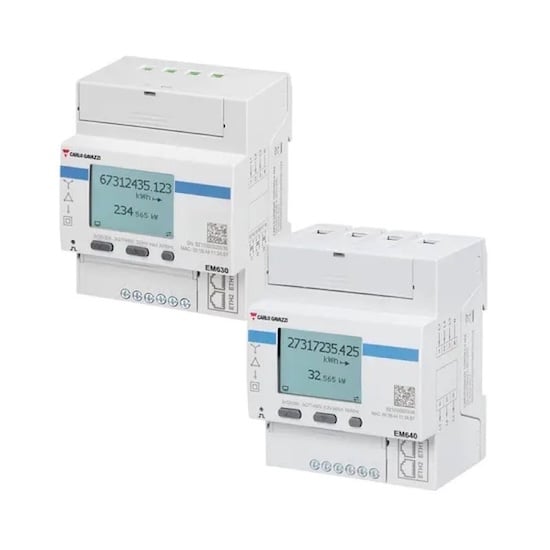
The EM630 and EM640 models. Image used courtesy of Carlo Gavazzi
Moving Beyond Traditional Communication Limits
One of the most noticeable shifts in the EM600 Series is the move toward fully Ethernet-based communication. Each unit includes dual Ethernet ports, allowing multiple devices to be daisy-chained directly without the need for external switches. Small details such as this help reduce panel complexity and lower installation costs while making scaling more practical in dense deployments. At the same time, the device operates at a 100-millisecond refresh rate, providing energy data closer to real-time visibility. For applications that depend on fast feedback, that difference is not marginal. It changes how quickly systems can respond and adjust.
The communication stack reflects this same direction. Support for Modbus TCP/IP keeps the device aligned with existing industrial systems, while the addition of an HTTPS REST API opens the door to more modern, software-driven environments. Instead of forcing a choice between legacy compatibility and forward-looking integration, the EM600 operates comfortably in both.
Built for Integration, Not Isolation
Energy meters have traditionally been treated as isolated measurement tools. The EM600 shifts that role toward a networked component within a larger system. Support for DHCP and mDNS enables devices to be automatically discovered on the network. Integration into PLCs, SCADA systems, or broader energy management platforms becomes simple.
The inclusion of SUNSPEC compliance further strengthens this position. Interoperability is no longer optional as renewable energy systems and distributed energy resources become more common. Devices are expected to communicate efficiently across mixed environments, and the EM600 is built with that expectation in mind.
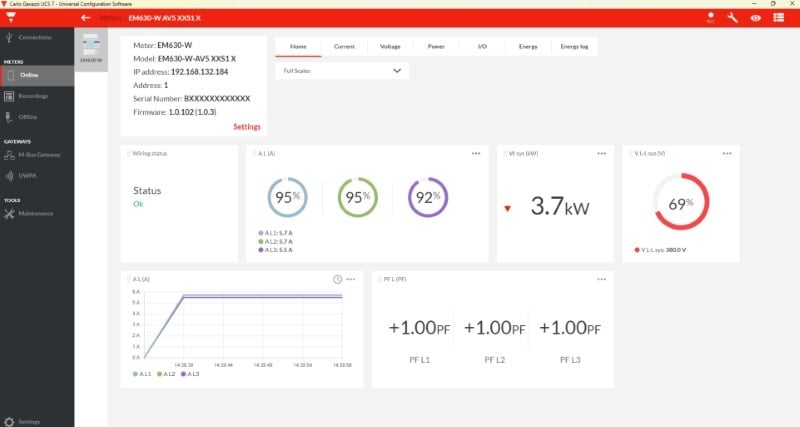
Real-time monitoring and diagnostics are accessible through integrated software platforms. Image used courtesy of Carlo Gavazzi
Flexible Hardware Without Added Complexity
The EM600 Series even maintains flexibility across different installation scenarios without introducing unnecessary complications. The EM640 B supports direct connection up to 65 amps, while the EM630 B is designed for use with 5 amp current transformers or 333 millivolt sensors. This allows the platform to adapt to both retrofit applications and new system designs. The devices are also self-powered up to 480 volts line-to-line. This capability further simplifies wiring requirements and reduces reliance on external power supplies, potentially saving more cabinet space.
Measurement accuracy aligns with expected performance levels: Class 1 for the EM640 and Class 0.5S for the EM630. The result is a system that remains precise without being overengineered.
A Noticeable Step Forward in Usability
User interaction has often been overlooked in energy metering, but the EM600 makes a clear improvement. The 128 by 96 backlit display provides high-contrast visibility, making readings easier to interpret across a range of environments. The front keypad supports a guided setup process that reduces reliance on external documentation. It’s worth noting that configuration can also be handled through the UCS software or the UCS Mobile app.
What Actually Changes With the EM600
Taken together, the updates in the EM600 Series reflect a shift in how energy data is handled. Information is no longer collected and reviewed after the fact; it is made available in near real time. Connectivity is no longer treated as an add-on feature; it is built into the device's foundation. Integration is no longer a custom effort but an expected capability. This moves the role of the energy analyzer closer to an active participant in the system rather than a passive measurement tool.
Where This Fits Going Forward
The direction of the EM600 Series aligns with broader industry changes. Data cycles are steadily accelerating, systems are becoming increasingly interconnected, and, of course, the distinction between monitoring and control continues to narrow. Carlo Gavazzi positions the EM600 as the foundation for a broader platform, with future expansion expected to include additional communication methods and wireless capabilities.
Featured image used courtesy of Adobe Stock