Immersion or space heater 23QT on a Fr6B

I am currently on a platform with a Thommasen.B.V FR6B following an MI service. For years they have had an on going issue with the Immersion heater tripping the starter cubicle on the heaters own internal thermostat 49QT after only 20-40sec operation. It is now never used and the same remedial action has always been to just try changing the heater again and again.
On a previous visit back in 2017 I enquired on this website for a GE TIL 1428-3 that described a mod to change the electrical termination linkage from Delta to Star thereby reducing the output from 15KW to 5KW. This was carried out at the time but the heater still continued to trip but maybe after a slightly longer time of operation.
As the heater here can be removed from a thermowell in the tank it is in effect I would say rather a space heater, heating the air space rather than in direct contact with the oil medium. All of the drawings describe this an immersion heater rather than a space heater. I have now been coming to the conclusion that the heater is tripping because the coils are not immersed and it is overheating as it is not being used as designed. But then I read some past threads here and this conclusion is contradicted and indeed the heaters are normally inserted into a well for ease of replacement.
As the units I visit are normally operational I have never really had the opportunity to see an empty lube oil tank and how the heater is found in the tank so now questioning if some units have a thermowell and others don't. for different manufacturers

Could anyone advise on clarifying whether
a) that the normal configuration for the immersion heater is indeed to be inserted into a thermowell for ease of replacement and to prevent having to drain tanks
b) that the description as an "Immersion heater" is really not correct as the heater coils are not normally immersed at all.
c) Whether the type of heater required needs to be specific to operating in an air pocket.

Have got myself in a twist on now thinking that the heater coils have to immersed in the lube oil for proper heat convection to prevent coil overheating, but then realise the tank would have to be drained every time you had a faulty heater which would make no sense.

I would add that electrically the MCC starter and thermostats etc have all been checked many times and that the same 49QT thernostat tripping action also occurs on the platforms other FR6B.

Thanks for any comments
 

Attachments

I am currently on a platform with a Thommasen.B.V FR6B following an MI service. For years they have had an on going issue with the Immersion heater tripping the starter cubicle on the heaters own internal thermostat 49QT after only 20-40sec operation. It is now never used and the same remedial action has always been to just try changing the heater again and again.
On a previous visit back in 2017 I enquired on this website for a GE TIL 1314 that described a mod to change the electrical termination linkage from Delta to Star thereby reducing the output from 15KW to 5KW. This was carried out at the time but the heater still continued to trip but maybe after a slightly longer time of operation.
As the heater here can be removed from a thermowell in the tank it is in effect I would say rather a space heater, heating the air space rather than in direct contact with the oil medium. All of the drawings describe this an immersion heater rather than a space heater. I have now been coming to the conclusion that the heater is tripping because the coils are not immersed and it is overheating as it is not being used as designed. But then I read some past threads here and this conclusion is contradicted and indeed the heaters are normally inserted into a well for ease of replacement.
As the units I visit are normally operational I have never really had the opportunity to see an empty lube oil tank and how the heater is found in the tank so now questioning if some units have a thermowell and others don't. for different manufacturers

Could anyone advise on clarifying whether
a) that the normal configuration for the immersion heater is indeed to be inserted into a thermowell for ease of replacement and to prevent having to drain tanks
b) that the description as an "Immersion heater" is really not correct as the heater coils are not normally immersed at all.
c) Whether the type of heater required needs to be specific to operating in an air pocket.

Have got myself in a twist on now thinking that the heater coils have to immersed in the lube oil for proper heat convection to prevent coil overheating, but then realise the tank would have to be drained every time you had a faulty heater which would make no sense.

I would add that electrically the MCC starter and thermostats etc have all been checked many times and that the same 49QT thernostat tripping action also occurs on the platforms other FR6B.

Thanks for any comments
Do you have. Device part /reference number from device summary...
 
Need to get installation drawings/schematics like the one from Thomassen that you shared here ..

It should be a good thing to ask Packager of this unit ...about the questions that you posted ...
 
I can't recall ever seeing the actual heating elements immersed in the L.O. tank in direct contact with the oil; they've always been in a pipe (thermowell, to be formal). I think it's called an Immersion Heater because it's not like a plate type or shell-and-tube type heat exchanger, and the pipe (thermowell) which contains the heating elements is "immersed" in the tank. But, to be honest, I've never really given it a lot of thought (why it's called an immersion heater, that is).

Yes; there was a TIL about re-connecting the heater to reduce the amperage. But, if the SAME problem still exists after the change--AND the amperage was measured before and after and found to be reduced--then one has to think there's some issue with the thermal overload "relay" or the heater strip in the thermal overload relay. You say the motor starter had been gone over MANY times but, again, if the current draw was reduced by a third or so and the SAME problem still occurs, then it has to be something is amiss with the starter/overload relay/overload relay thermal strip set-up.

I don't know what manufacturer of motor control center equipment Thomassen (sp?) used, so I can't really say for sure how it's configured. But, knowing what the actual current draw was BEFORE the heater elements were re-configured, and what the current draw is now after re-configuration, should be important (critical) data to the troubleshooting exercise. The GE MCC motor starters have a small knob which is kind of like a very small adjustment (usually less than +/-10%) which I have found broken many times (because of over twisting by very strong men with very little time trying to solve a problem without knowing how far the knob rotates (usually less than 90 degrees). Which definitely makes the thermal overload relay latch stop working.

Perhaps you could take a photo of the motor starter and thermal overload sensing relay/device? Can you correlate the rating of the sensing device element to a current range? (Usually the range of the strips in the GE MCC starters was about 2 amps or so (x amps, +/- 1 amp), and there are literally HUNDREDS of the strips for just about imaginable current rating, and the rotating knob could be used to "dial in" the setting to almost spot on.)

But, it seems (to me) very important to understand what the current flow was before reconfiguring the heater elements, and then after reconfiguration to know if the desired effect was achieved (reducing the current flow) and what that effect should have been on the thermal overload sensing relay/device. And, if it was reconfigured and the current reduced by a third or so, was the sensing element of the thermal overload relay/device replaced with an appropriate sensing element for the reduced current flow?

Can the entire thermal overload relay/device be replaced with a "new" (unused) one? Or one from a known working starter?

In regards to your question c), there is certainly very little air flow across the heating elements ("rods") but, again, I've never seen this problem you are describing before, and I've always seen the 23QT heating element installed in a pipe (thermowell) and it's always worked without problem. (Some sites just run the Aux. L.O. pump in HAND (or forced) for hours and that action of pumping the L.O. continuously adds a lot of temperature to the oil just by itself. Though if you're in the North Sea, it's pretty damn cold there and that might not really work very well there....)

Something's definitely not right, but I don't think it's the location of the heating elements. Of course, it IS entirely possible that Thomassen used or purchased or was provided the wrong heaters for these two units.... Stranger things have happened! But, still, one would think (thinking logically and critically) that reducing the amperage by reconfiguring the heater elements would have had a better outcome than it did. It's entirely possible Thomassen purchased or was provided the wrong heater element which is not suited for installation in a pipe (thermowell). This is one of the things about licensed packagers of GE heavy duty gas turbine designs--they provided all the auxiliaries and enclosures and the L.O. tank, etc. And, sometimes, mistakes were made. Even by GE!!!

We'd love to know what you discover, though on situations like this where things have been checked over and over, repeatedly, it's really hard to get good data or to get someone in the owner/operator organization to spend any more money to troubleshoot this and they are just asking hoping to get a shot-in-the-dark answer which proves to be correct. My guess is either the thermal overload relay/device and/or its sensing device is not working properly, the interconnecting wiring is incorrect and has been for ever, or the heating elements are not what they should be for the application. But someone has to have actionable data (as has been written here on Control.com many times before) and in this case that's amperage readings before and after the heater reconfiguration.

Has anyone ever meggared the wiring/heater elements from the outlet terminals of the motor starter??? If so, what where the results (in megohms--not just "pass/fail").
 
Thanks guys for your input

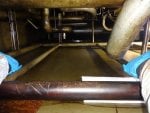
From your feedback and also talking to other engineers in the field I am now pretty ok for thinking that point a) is answered and that the standard is for the heater is to be installed in a thermowell. and that it is not just a unique configuration on this unit. A photo is attached showing the tank and the tube from a past inspection

DSC07946.JPG


Also I am more comfortable with my question b) and the fact that it is called an immersion heater when it is not really immersed. It is more to do with the type of heater being used rather than being directly tied to its function.

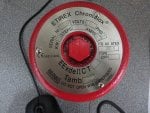
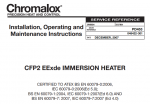
On question c) I continue to investigate this and I am looking at the heater type currently installed. This is a ETIREX Chromalox CPF2L. From the Operating and maintenance manual it states that the "L" denotes liquid use and that a version for air use would be a G2. Both L and G2 version come with the thermal cut-out and G1 does not. So I have this to question first if the wrong type is being installed.

IMG_1384.JPG


Secondly the Maintenance manual does have a specific procedure for the initial commissioning of the thermal cut-out. If the heaters have just been installed without this adjustment this may also be a factor. Possibly the customer has assumed a factory setting.

1671793587005.png


Finally on the materials drawing from the OEM Thommasen from away back in 1994 the bundle is shown with spacers and supports that centralise the coils within the tube so they are not touching the tube walls. I need to check that these are still being supplied and the heater installed properly in the thermowell.

This issue has been the same on both GT Units so there is a common denominator. Hopefully I am zeroing in. As the unit is offline for an MI it maybe sometime before power is de-isolated and I can report back further. Again thanks for your thoughts controlguy25 and WTF?

regards
Topcat123
 
Thanks for the photos. (Ain't smarter-than-me-phones great for taking pictures?) Chromalox seems to be a familiar name for the heater elements (one that GE probably used when they packaged turbines). I am confused about this 'thermal cut-out'. And is it the same as the thermal overload relay/device which is tripping? Again, my experience is almost exclusively with GE-packaged equipment and the GE MCC (Motor Control Center) line-up would have a three-phase motor starter, often controlled by the Mark*, but many times controlled by one or sometimes two temperature switches on the L.O. tank, and the motor starter would have a thermal overload relay added to the output terminals (it looks integral but it is an optional add-on component), with three thermal sensing "strips" (one per phase) which when "excess" current is flowing through any phase the heat generated by the strip(s) unlatches a normally closed contact, which opens to generate the overload alarm (usually the well-liked and well-understood AUX MOTOR OVERLOAD alarm (which is usually a long series string of NC contacts that is connected to a single input to the Mark* and a conscious user has to go to the MCC line-up to determine which "motor" (or heater in this case) has detected an overload (because GE almost NEVERS trips a motor on a GE-design heavy duty gas turbine on motor overload--it only alarms (the philosophy behind this is that it's better to sacrifice a motor to get the unit running than to trip the unit because a motor had an overload--that reliability thing they are so well-known and liked for!)).

AND, there's ZERO current readings here .... Surely with all of the troubleshooting which has occurred over the years SOMEONE has taken and recorded current readings before the device "trips". (I know; I'm thinking logically--and a former colleague always cautioned me against that, but it's my nature).

I would definitely investigate the presence or absence of the heater supports to prevent one or more of the elements from contacting another--or the thermowell. Several heater elements I have seen pulled out of the thermowell over the years were severely bowed (sagging) because the supports had just deteriorated over many years/decades.
 
WTF?

I have no real knowledge of this problem existing before maybe 2013 although it probably did. The dark discolouration could be from a time when the lube oil heaters actually functioned normally, warming the oil tank. The heater elements have always worked, but only for about 30-40 secs before the heater thermostat cuts out. This happens on both units.

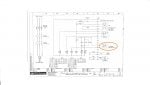
There is no thermal overload in this starter cubicle probably as its not a supply to a motor. The thermal cut out switch is in the heater itself and has been labelled 49QT-1 and comes into the cubicle on input contacts 24,25.

MCC 23QT-1.jpg


Unfortunately being an offshore platform the shifts and personnel come and go and readings that were once taken the last time anyone took notice of this are not available. I am now fairly sure the problem originates from the heaters themselves. Whether after clarifying my original thermowell/immersion question that is now an issue of wrong instrument type, incorrect setting of thermal cut-out or an issue with the installation in the tube is still to be determined.

Temperature switch 26QL goes directly to the MK5 panel logic and in series with L14HR drives the L4QT command to stop/start the heater when the unit is offline.

Topcat
 
Top