All this while that i've been working with instruments on frame vi GE gas turbine system, I notice that IGV angle start from 33degree and not zero degree and end at 86 degree and not 100degree. Please I need detail information about this from the whole house.
thanks.
Please take time to read and re-read (and re-re-read) this response if necessary, because it's not intuitive and it doesn't make many people happy when it's first presented. It WILL begin to make sense if you consider it, and re-consider it, and mull it over in your mind.
The positions (not the angular measurements--the <i><b>positions</b></i>) of the IGVs of GE-design heavy duty gas turbines are a function of the air flow through the machine at various operating conditions (starting and acceleration; rated speed, zero load; part load operation; full ("Base") load operation; shutdown).
The designers could very easily have chosen 0- and 100 for the minimum and maximum positions--but the choice of engineering units (degrees; percent; etc.) was foremost in their minds as designers--and as practical people (yes; practicality did play a part in many decisions, though it's not always evident or clear). The designers chose degrees angle, based on the everyday measurement of angles--where 360 degrees is a full circle, and 90 degrees is a quarter circle.
By doing so, it enabled mechanical workmen (factory workers and field workers) and instrument technicians to measure the IGVs using a standard machinists' protractor, something which is (usually) readily available in any self-respecting machinist's or mechanics tool container. And, it just so happened that the minimum operating angle for GE-design B/E-class heavy duty gas turbines occurs at around 34 degrees angle, as measured with a machinists' protractor, and the maximum operating angle, as measured with a machinists' protractor, occurs at around 86 degrees.
Now, they could have chosen 0- and 100 "degrees", or 0- and 100 "percent"--but then there would have had to be a special tool that would have to be used to measure against some specified and unmovable reference point to use to confirm 0- and 100 "degrees", or 0- and 100 "percent"--which would have increased the cost of the machine to produce and supply, and which would have made measuring and setting angles impossible without. And would have increased the complexity of the operation, also.
Instead, the designers chose to use a readily available tool which could be obtained from any machine shop supply store, and to use readily available reference points for that tool (the adjacent IGV blades).
It's no more complicated or simple than that. The minimum air flow during starting, acceleration (and shutdown) occurs when the IGVs, as measured with a machinists' protractor against adjacent IGVs are at an angle of approximately 34 degrees. If you want to think of that as "zero" that's entirely your prerogative. And the minimum air flow at rated speed with zero load occurs at approximately 57 degrees when measured with a machinists' protractor against adjacent IGVs, and the maximum air flow at rated speed and full load occurs at approximately 86 degrees when measured with a machinists' protractor against adjacent IGVs. And, if you want to consider that as "100" that also is entirely your prerogative.
The designers could have chosen 0- and 100 "degrees" or "percent"--but then some special tool, or a conversion chart could probably have been made to convert degrees as measured with a machinists' protractor, would have to be used to measure (and convert) IGV positions. Instead, they used a readily available tool with readily available reference points and standard measurement units: degrees.
If you, as a technician, had to use a special tool to confirm or measure IGV positions or use a machinists' protractor and a conversion chart every time there was a question about IGV positions/LVDT calibrations, that would probably greatly increase the time required as well as the complexity--and you would likely have to be continually explaining the measurement and/or conversion every time there was a question. AND, we all know how well GE documents things. NOT very well, as it turns out.
So, given the above description and possibilities for describing IGV positions and angles, what would you choose? (I know what I would choose!)
Yes; the designers did provide a <b>crude</b> pointer/indicator on the side of axial compressor casing for IGV angle measurement--but they also recognized that that would have to be calibrated and verified in some manner and that mechanics and pipe fitters and electricians would ALL use the indicator as a foot-hold when crawling around the unit and would ONLY be as good as the day-to-day "care" it received. Using a readily available machinists' protractor to check actual IGV positions (angles) against adjacent IGVs or even to verify or (something I've RARELY seen done!) adjust the pointer/indicator on the side of the axial compressor casing is a simple, and elegant, choice given the alternatives.
AND, given that GE uses percent speed (TNH) to describe shaft speed--and EVERYONE (especially at first!!!) complains loudly and to everyone else within earshot that GE <b>should have</b> used RPM instead, using standard degrees for IGV angle measurement and description is just plain simple (and elegant).
Hope this helps! If it's not immediately clear on the first read, re-read (and re-re-read) the above; it will make perfect sense after some time has passed.
Why didn't the designers make the minimum angle 0 degrees and the maximum angle 100 degrees, and let the turbine control system control to whatever positions (34, 57, 84 or 86) were required?
Well, they didn't want the IGVs to close below approximately 33 DGA, because if the IGVs ever went to less than 34 DGA when the axial compressor was at rated speed, well, it's possible the IGVs would be sucked into the axial compressor, or (has happened on occasion) a sudden closure of the IGVs (to even 33 DGA) while at rated speed could cause a collapse of the combustion liners as well as damage to the axial compressor (surge/stall).
And, same above 84 or 86 DGA--too much air flow could also damage the axial compressor, especially when ambient temperatures are below design. And, excessively open IGVs could lead to excessive over-firing of the unit when operating at Base Load, which decreases hot gas path parts life.
SOOO, the designers chose to mechanically limit the IGV travel at both ends of travel (closed and open) to protect the IGVs, axial compressor and combustors and hot gas path parts life.
Finally, how does one measure 0 DGA with a machinists' protractor? (NOT VERY EASILY!) So, the chosen minimum- and maximum mechanical stops also serve another purpose--to make it easy to measure using a machinists' protractor and adjacent IGV blades.
Can anyone please help me understand how the IGV angle is visualised?
I mean I need to understand how its measured (For example, I know where is inlet metal angle but I need to learn how is IGV angle measured (Not talking about the tool... HopeI made my question clear....)
I'm curious about the reason for setting the angle of the IGV (Inlet Guide Vanes) from 34 degrees to 86 degrees in GE gas turbines. In particular, I don't understand the explanation that excessive combustion can occur when the IGV opens too much. It seems like the combustion temperature would drop as the air flow increases, but you mentioned that excessive combustion occurs. Is this because more fuel is also introduced to match the air-fuel ratio when the air flow increases? Can you clearly explain the relationship between increased air flow and excessive combustion?
In particular, I don't understand where you read this explanation, or who told you this: "... In particular, I don't understand the explanation that excessive combustion can occur when the IGV opens too much...." I don't where you obtained this explanation, but without understanding the source AND the context it's impossible to say anything more about its veracity and applicability to your query.
In general--speaking of rated speed operation--as the machine is loaded the IGVs are usually opened as fuel flow-rate increases--GENERALLY. If the machine has DLN (Dry Low NOx) combustors, the IGV angle is controlled to limit air flow to maintain low NOx emissions AND to limit exhaust temperature as fuel flow-rate is increased. So, the type of combustion system also determines how the IGVs are programmed.
I don't know if I really understand the question you are asking, so I'm going to describe the IGVs and how their position is relates to the air flow into the machine, and then method by which GE-design heavy duty gas turbines monitor IGV position (angle).
IGVs are curved devices (air foils). But their position is relative to whether or not those curved devices are parallel to the axis of air flow into the axial compressor of a combustion turbine. If IGVs could be moved to a position of 0 DGA (DeGrees Angle)--with they cannot be--they would be perpendicular to the air flow into the machine--in effect stopping the flow of air into the machine. If IGVs could be moved to a position of 90 DGA they would be parallel to the flow of air into the machine, in effect permitting maximum air flow into the axial compressor of the machine. (There are mechanical stops that prevent the closure of the IGVs of many GE-design heavy duty gas turbines below approximately 32 DGA and above approximately 88 DGA (some machines have slightly larger operating ranges, say 30 to 90 DGA).
The IGV hydraulic actuator has two (2) LVDTs (Linear Variable Differential Transformers) attached to it. As the hydraulic actuator extends or retracts there are rods (called cores) that move inside a stationary set of coils (called armatures). One set of coils is powered by (excited) the Mark* turbine control system. As the hydraulic actuator piston and rod moves up and down to open and close the IGVs the LVDT cores move up and down inside the stationary coils and the voltage developed on the second set of coils changes (varies). This voltage is connected to the Mark* turbine control system. The LVDT output voltage changes with the position of the cores inside the stationary armatures as the actuator rod moves to change the IGV angle.
The LVDT output voltage is linear--meaning the voltage varies by the same amount as the core moves up and down inside the armature. For example (this is ONLY an example!), a movement of 13mm (approximately 0.5 inch) might cause the LVDT output voltage to change by 0.7 V AC RMS. Each movement of 13mm causes the output to change by 0.7 VAC RMS--meaning the LVDT output voltage is linear with respect to movement. (And each movement of 13mm might cause the IGVs to move by approximately 15 DGA (DeGrees Angle).
This means that to make the IGV position measurement reflect the ACTUAL physical position of the IGVs the LVDT output voltage that is connected to the Mark* turbine control panel must be "calibrated"--because there can be differences in LVDT output voltages for any given IGV position between not only individual LVDTs on the IGV hydraulic actuator but between machines. It's important to ACCURATELY calibrate the LVDT output voltage to the ACTUAL physical position of the IGVs. This is done using the calibration feature of the Mark* AND should (must, really) be verified using a machinist's protractor (or a similar tool/method).
The beauty of LVDTs as position measurement devices is:
1) They are capable of prolonged operation in high-temperature environments and low-temperature environments
2) They are capable of prolonged operation in high-vibration environments
3) The output voltages DO NOT drift (change) over time
4) There is only one moving part, and when properly installed and maintained, there is no contact between the moving part and the stationary part.
(The above reasons are why LVDTs are used on aircraft to measure flap angle and elevator angle AND on rocket motors--they are simple, rugged devices and their output does not drift (change) over time like so many other types of position-measuring devices. Far too many people have the idea that LVDT output voltage versus position can change over time--which is nearly impossible to do)--and so they think the answer to every perceived problem which be remotely attributed to the IGVs requires "calibration" of the LVDT feedback voltage to the Mark*, which usually ends up resulting in more problems than it might have solved. BEFORE any LVDT feedback is "calibrated" it should FIRST be checked by positioning the IGVs and measuring the position and comparing it to the IGV position on the HMI screen to determine if the output has drifted/changed and requires recalibration. AND, if the output has indeed changed then some further investigation should be performed as to why it has changed (some mechanical problem most likely) and resolve that issue before "calibrating." Have you ever known a passenger jet to have to recalibrate their flap angles mid-flight??? LVDTs are very reliable devices. Many of those same people who think LVDT output voltage can and does drift/change over time requiring calibration also believe that using the calibration feature of the Mark* turbine control system somehow magically affects the electro-hydraulic servo valve used to cause the IGV actuator to open and close--which is ABSOLUTLEY NOT TRUE--and so they think they are getting a "two-fer" (two results for a single action) by calibrating the IGVs or the fuel control valves whenever there is some kind of problem (real or perceived).)
Anyway, I hope I have answered your "question." You can refer to the Operation and Maintenance Manuals provided with GE-design heavy duty gas turbines for pictures and brief descriptions of operation, or if you require clarification, you can write back with a better description of what you're asking.
I don't know if I really understand the question you are asking, so I'm going to describe the IGVs and how their position is relates to the air flow into the machine, and then method by which GE-design heavy duty gas turbines monitor IGV position (angle).
IGVs are curved devices (air foils). But their position is relative to whether or not those curved devices are parallel to the axis of air flow into the axial compressor of a combustion turbine. If IGVs could be moved to a position of 0 DGA (DeGrees Angle)--with they cannot be--they would be perpendicular to the air flow into the machine--in effect stopping the flow of air into the machine. If IGVs could be moved to a position of 90 DGA they would be parallel to the flow of air into the machine, in effect permitting maximum air flow into the axial compressor of the machine. (There are mechanical stops that prevent the closure of the IGVs of many GE-design heavy duty gas turbines below approximately 32 DGA and above approximately 88 DGA (some machines have slightly larger operating ranges, say 30 to 90 DGA).
The IGV hydraulic actuator has two (2) LVDTs (Linear Variable Differential Transformers) attached to it. As the hydraulic actuator extends or retracts there are rods (called cores) that move inside a stationary set of coils (called armatures). One set of coils is powered by (excited) the Mark* turbine control system. As the hydraulic actuator piston and rod moves up and down to open and close the IGVs the LVDT cores move up and down inside the stationary coils and the voltage developed on the second set of coils changes (varies). This voltage is connected to the Mark* turbine control system. The LVDT output voltage changes with the position of the cores inside the stationary armatures as the actuator rod moves to change the IGV angle.
The LVDT output voltage is linear--meaning the voltage varies by the same amount as the core moves up and down inside the armature. For example (this is ONLY an example!), a movement of 13mm (approximately 0.5 inch) might cause the LVDT output voltage to change by 0.7 V AC RMS. Each movement of 13mm causes the output to change by 0.7 VAC RMS--meaning the LVDT output voltage is linear with respect to movement. (And each movement of 13mm might cause the IGVs to move by approximately 15 DGA (DeGrees Angle).
This means that to make the IGV position measurement reflect the ACTUAL physical position of the IGVs the LVDT output voltage that is connected to the Mark* turbine control panel must be "calibrated"--because there can be differences in LVDT output voltages for any given IGV position between not only individual LVDTs on the IGV hydraulic actuator but between machines. It's important to ACCURATELY calibrate the LVDT output voltage to the ACTUAL physical position of the IGVs. This is done using the calibration feature of the Mark* AND should (must, really) be verified using a machinist's protractor (or a similar tool/method).
The beauty of LVDTs as position measurement devices is:
1) They are capable of prolonged operation in high-temperature environments and low-temperature environments
2) They are capable of prolonged operation in high-vibration environments
3) The output voltages DO NOT drift (change) over time
4) There is only one moving part, and when properly installed and maintained, there is no contact between the moving part and the stationary part.
(The above reasons are why LVDTs are used on aircraft to measure flap angle and elevator angle AND on rocket motors--they are simple, rugged devices and their output does not drift (change) over time like so many other types of position-measuring devices. Far too many people have the idea that LVDT output voltage versus position can change over time--which is nearly impossible to do)--and so they think the answer to every perceived problem which be remotely attributed to the IGVs requires "calibration" of the LVDT feedback voltage to the Mark*, which usually ends up resulting in more problems than it might have solved. BEFORE any LVDT feedback is "calibrated" it should FIRST be checked by positioning the IGVs and measuring the position and comparing it to the IGV position on the HMI screen to determine if the output has drifted/changed and requires recalibration. AND, if the output has indeed changed then some further investigation should be performed as to why it has changed (some mechanical problem most likely) and resolve that issue before "calibrating." Have you ever known a passenger jet to have to recalibrate their flap angles mid-flight??? LVDTs are very reliable devices. Many of those same people who think LVDT output voltage can and does drift/change over time requiring calibration also believe that using the calibration feature of the Mark* turbine control system somehow magically affects the electro-hydraulic servo valve used to cause the IGV actuator to open and close--which is ABSOLUTLEY NOT TRUE--and so they think they are getting a "two-fer" (two results for a single action) by calibrating the IGVs or the fuel control valves whenever there is some kind of problem (real or perceived).)
Anyway, I hope I have answered your "question." You can refer to the Operation and Maintenance Manuals provided with GE-design heavy duty gas turbines for pictures and brief descriptions of operation, or if you require clarification, you can write back with a better description of what you're asking.
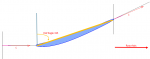
First of all, thanks for your detailed reply, it was very intersting and I think I got my answer....But to be sure, I am trying to find the right IGV position in a simulation software, so consider following picture (its section view of just one IGV blade, the rest of blades will be replicated around the rotor axis) : Based on your explanation I think IGV is measured with the angle I shown, am I right?
Thank you

 Facebook
 Google
 GitHub
 Linkedin