Facebook
 Google
 GitHub
 Linkedin
IIoT, Cloud Services, and Edge AI Combined Through Arduino
Pairing IIoT with cloud services provides industrial and manufacturing facilities with real-time data displayed in intuitive dashboards and reduces downtime.
When paired together, cloud services and the Industrial Internet of Things (IIoT) are a powerful combination for industrial and manufacturing monitoring and control. Integrating numerous sensors and actuators into a unified service accessible from any approved device allows plant managers and maintenance technicians to always know what is happening on the production floor.
Cloud services make it possible to organize and intuitively display data, remotely control equipment, develop a predictive and preventative maintenance schedule for machines, and ensure data security. Getting started in cloud services can seem intimidating, but with the right choice of hardware and service provider, it can reduce equipment headaches and production bottlenecks.
Many industrial clients are already experiencing the advantages of combining cloud data with IIoT. Atlas Machine Supply has implemented Arduino’s Opta micro PLC and Cloud for Business services to monitor core metrics on their air compressors. In another example, Steelcase was able to retrofit its wood panel destacking machine and detect faults before the machines could damage materials. AMB Vapor Monitoring learned that Arduino could provide quicker reporting of pressure data in a more connected environment.
IIoT, Cloud Services, and Edge AI
The IIoT, considered a subset of Industry 4.0, includes all of the sensors and hardware that collect data and work together over an internet or intranet connection. Instead of sending an operator around to check the status of machines, sensors can send data to the cloud, which is accessible from secure devices throughout the factory. Also, Industry 4.0 encompasses digital tools, such as a digital twin, which is a model of a process or piece of equipment that can clearly represent wear points or damage on physical machines.
The cloud is an internet-based storage facility that guarantees data security while still allowing approved technicians and engineers access. It can be used to store data, execute scripts, deploy code, and perform numerous other tasks. With a cloud service provider, the complexity of designing the architecture and maintaining the cloud can be passed onto a trusted provider.
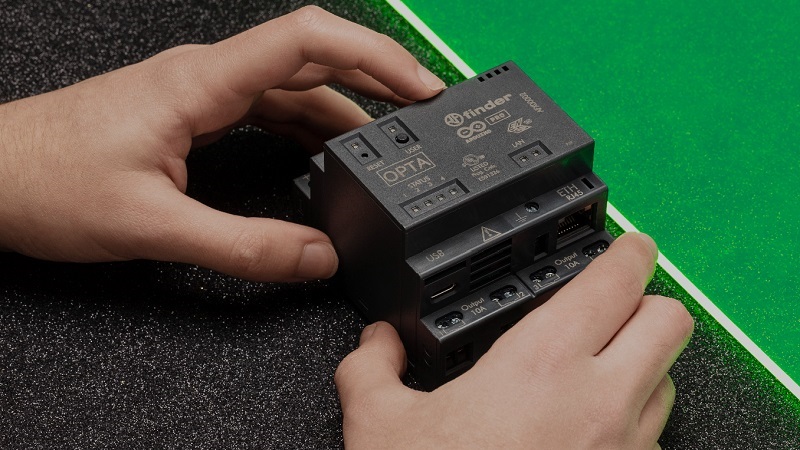
Figure 1. This Arduino Opta can easily integrate between sensors and the cloud. Image used courtesy of Arduino
IIoT and cloud services are only part of the picture. Edge computing and edge AI can be integrated into the sensor and control system. Edge computing takes some of the computing load away from the centralized system and puts it at the “edge” of the network. Just as the nervous system handles quick decisions and the brain handles complex data analysis, the edge devices handle immediate process control, while the central control system handles more complicated decisions.
Consider a large-scale manufacturing system with thousands of sensors and actuators running an assembly line. Rather than sending each piece of data back to the central control system, edge computing makes it possible to handle low-level decisions, such as monitoring machine vitals locally. By handling data locally, edge computing saves bandwidth on the system rather than transmitting everything across the network.
Connection and Access to the Cloud
Cloud connections are more than just routes into a database for storing process data to be accessed when a problem arises. The cloud can be used to run code, deploy new code to devices, and rapidly access data from any approved device, including other control systems.
A robust hardware and cloud services platform allows connections using multiple means. If there are multiple pathways to transfer data to and from the cloud, there are simply more options to work around electrical noise, plant logistics, and other considerations.
Using the Arduino Opta platform and Arduino Cloud services, diverse industrial scenarios can seamlessly converge through a unified solution. With multi-protocol connectivity, including Wi-Fi, Bluetooth, Ethernet, and Modbus/Modbus RTU, Arduino enables seamless communication across different systems, bridging the gap between local automation and cloud-based intelligence for enhanced efficiency and scalability.
Matching Devices to Cloud Service
With many players in the IIoT and cloud service market, matching hardware to software and cloud services offers tremendous advantages. If these are mismatched, reliability suffers. Sometimes, communication between the services simply doesn’t happen. In other, potentially worse, cases, communication is intermittent; it will work just often enough to fool operators into thinking it works…until it doesn’t.
According to a recent global study by Vanson Bourne, 82% of companies have experienced at least one unplanned outage of services over the past year. Mismatched systems can generate a variety of communication errors and lead to unplanned outages. By matching IIoT to cloud services, such as Arduino hardware to the Arduino Cloud, compatibility between devices and the cloud is guaranteed. The interfacing between devices is simplified, making setup, troubleshooting, and modifications easy to perform.
Along these lines, technicians only need to learn Arduino programming and installation, yielding a gentler learning curve. Technicians will require less training overall to become proficient at installing and modifying systems if they only need to learn one platform.
Besides programming, Arduino’s IIoT hardware and Arduino Cloud for Business can be combined to make intuitive dashboards and interfaces for equipment operators. For staff members who do not know how to program, monitoring and control of equipment can be displayed conveniently, showing operators the information they need to see without information overload or the need to become a computer expert.
Ultimately, all of these advantages lead to rapid installations, quick modifications, and less unplanned downtime. Virtually any industrial or manufacturing outfit can benefit from these advantages.
Case Studies
Numerous examples exist of targeted deployment of an Arduino Opta linked to Arduino Cloud for Business, used for IIoT applications. Three standout examples, Atlas Machine and Supply, Steelcase, and AMB Vapor Monitoring, are realizing the quick ROI and other advantages of matching hardware to cloud services.
Atlas Machine and Supply
Atlas Machine and Supply maintains and services air compressors for a huge range of clients who use pneumatic tools and equipment. Each compressor has a lifetime of 25 years or more, and so Atlas has amassed an assortment of control systems and sensors. Because each system is different, fixing things as they fail – a.k.a. “reactive maintenance” – can lead to significant downtime.
After learning that Arduino could service industrial equipment, Atlas Machine and Supply outfitted each of their clients’ air compressors with an Arduino Opta. From there, data from each compressor could be monitored, collected, and analyzed. Data could be displayed on intuitive, customized dashboards. Soon, patterns began to appear in the failures of various components, and those patterns led the engineers at Atlas to develop preventative maintenance schedules instead of reactive maintenance when components failed.
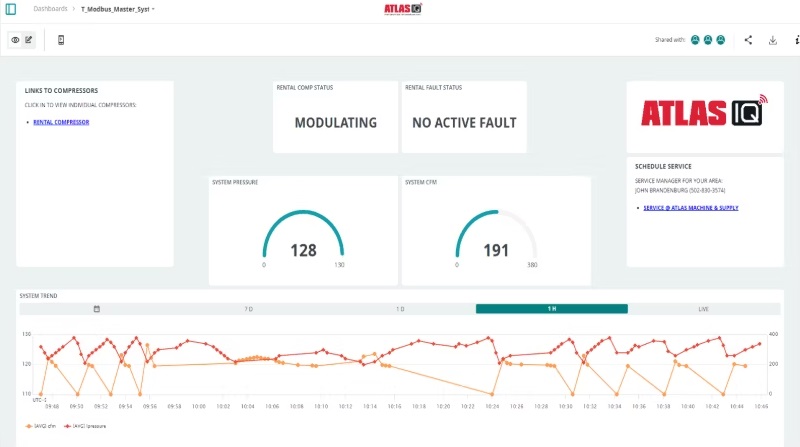
Figure 2. A dashboard from Atlas that shows compressor fault status, overall system pressure and volumetric flow rate at a glance. Image used courtesy of Arduino
Ultimately, Arduino was able to provide a platform for monitoring that drastically reduced downtime and simplified troubleshooting.
Steelcase
Steelcase, an office furniture supply manufacturer, also turned to the Arduino Opta. Their wood panel destacker was designed to take wood panels and place them on a conveyor for further assembly. However, it often underperformed, forming a bottleneck in the entire process.
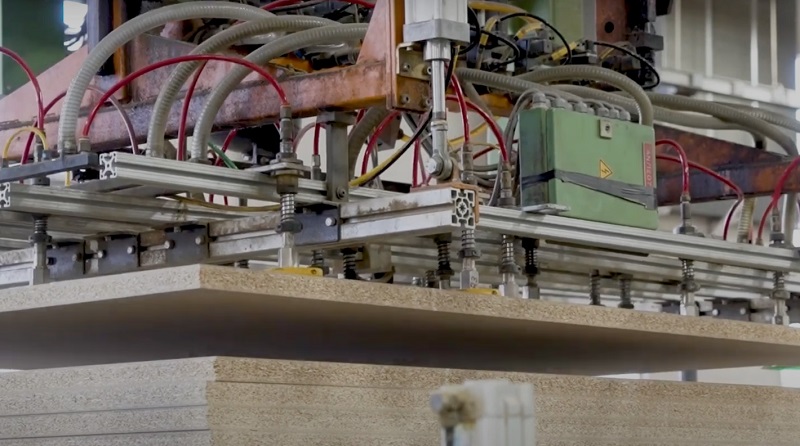
Figure 3. Wood panel destacker in operation. Image used courtesy of Arduino
First, the destacker was outfitted with an Arduino Opta, allowing more sensor data to be collected in real time. From there, a digital twin was created to model the stacker. This model data was used to optimize the process parameters.
Between the output from the digital twin and the real-time data collected from the Arduino Opta, faults could be detected earlier, boosting throughput. The bottleneck was removed entirely at thirteen separate assembly plants.
AMB Vapor Monitoring
Outgassing from contaminated soil or water, radon, and other vapors can permeate concrete foundations and basements, putting the occupants at risk. Typically, a technician must come to the site, take manual measurements, then return to a lab and compile the results.
AMB Vapor Monitoring developed a system to take real-time measurements and process them using an Arduino Opta instead. Data is transferred to Arduino Cloud for easy monitoring via customized dashboards, which can be accessed remotely using a smartphone or tablet. Changes in vapor contaminants can be detected quickly, alert the appropriate personnel, and they can deploy remediation mechanisms earlier than ever before.
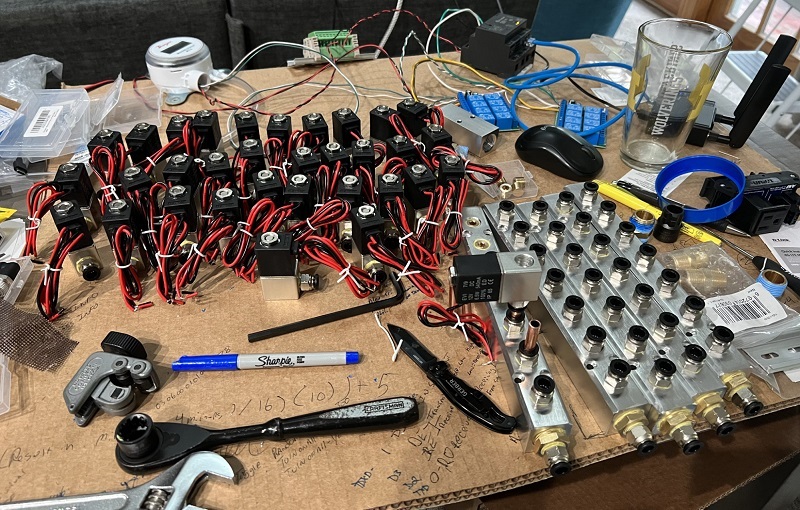
Figure 4. R&D efforts for the vapor monitoring system were made more cost-effective with Arduino. Image used courtesy of Arduino
This remote monitoring solution was ideated and prototyped in a record three months, thanks to programming resources available within the ecosystem and support from the Arduino Pro Customer Success team. Ultimately, turning to an open-source solution saved thousands of dollars in licensing fees alone during the research and development phase.
The Bottom Line
Arduino Cloud for Business has been designed for industry. Pairing IIoT with cloud services provides industrial and manufacturing facilities with real-time data displayed in intuitive dashboards and reduces downtime. Find out more about Opta (https://www.arduino.cc/pro/hardware-product-family-opta-family/) and Arduino Cloud for Business (https://cloud.arduino.cc/cloud-for-business/), or contact an Arduino Pro representative (https://www.arduino.cc/pro/contact-us).