Facebook
 Google
 GitHub
 Linkedin
A Look at STMicroelectronics’ Software for AI‑Enhanced Motor Control
The software development kit for low-voltage three-phase brushless motors gives designers the power of AI and machine learning without requiring years of experience.
STMicroelectronics has released the FP-IND-MCAI1, an AI-enhanced motor control software package designed for the EVLSPIN32G4-ACT evaluation motor driver board, capable of driving three-phase, low-voltage brushless motors. The FP-IND-MCAI1 software package offers designers the tools required to implement smart drive features in industrial, commercial, and robotic industries with ease.
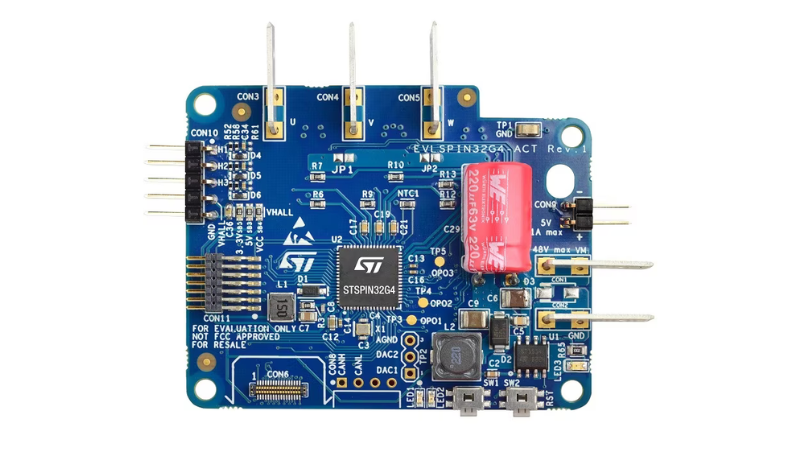
STMicroelectronics’ EVLSPIN32G4-ACT evaluation board drives three-phase BLDC motors, delivering up to 250 W. Image used courtesy of STMicroelectronics
AI-Powered Software for Drives
Servo motors use parameters often set by tuning algorithms and users to drive an axis to an accurate position — sounds simple enough, so why use AI in the drive software? Parameters dictate how aggressively the servo moves. If you drive your axis too hard to its final position, you could shorten the overall lifespan of the system. By using AI tools, historical data can be used to provide and adjust move parameters and PID gains to produce a more efficient move profile.
As the motor wears, its efficiency decreases. By using software such as STMicroelectronics’ FP-IND-MCAI1, the move profile can be dynamically adjusted over time, and the system can predict the motor’s lifespan.
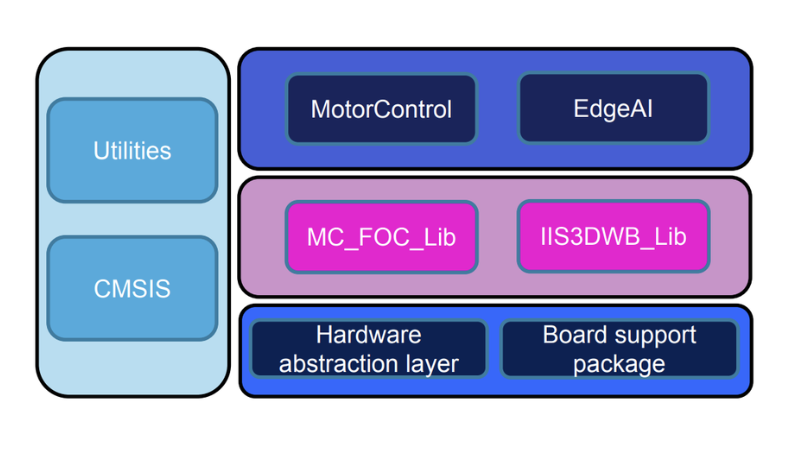
The FP-IND-MCAI1 function pack enables users to integrate smart features into low-voltage three-phase BLDC motors. Image used courtesy of STMicroelectronics
Drive Software Features
The latest drive software package for the EVLSPIN32TG4-ACT is designed to drive low-voltage, three-phase, brushless motors with field-oriented control. There are board-specific drivers that can be selected for a specific board.
A machine learning (ML) feature is added that will automatically detect normal, high-vibration, and unstable motor conditions when the optional vibration sensor is added to the system. While the motor is in operation, the software collects motor current data and streams it to the ML model where it is analyzed, and the three different classifications are reported back to the user.
The motor parameters can be set using STMicroelectronics’ STM32 motor-control SDK, and the ML model can be adjusted using NanoEdge AI Studio, which offers an ML library that can be added to end-user software.
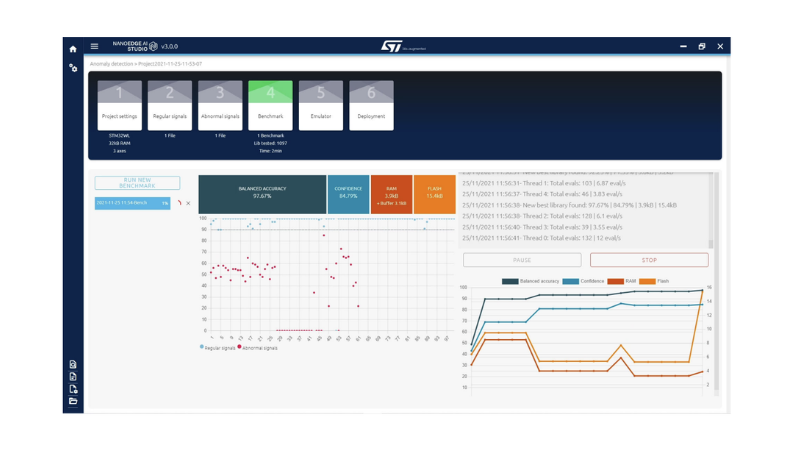
STMicroelectronics’ NanoEdge AI Studio software. Image used courtesy of STMicroelectronics
Servo Drives and Software for Developers
Not all servo drives are simple plug-and-play devices; some require integration software to be created and operated by the end user. The EVLSPIN32G4-ATC is a PCB with solder connections. This style of board is designed for component or device manufacturers who want to add servo control to their product. The same is true with the FP-IND-MCAI1 software package; it is a development package, so you will need to create a user interface to interact with the software.
While these systems require in-depth programming abilities, they do offer integrators the opportunity to develop their own system that can be deployed in a wide range of applications.
A small pick-and-place robot is often used in automated assembly machines. With the EVLSPIN32G4-ACT and the AI tools provided by the latest software release, a machine builder could easily create their own pick-and-place system that can be configured by end users and redeployed on multiple projects.
Featured image used courtesy of Adobe Stock
Related Content