Facebook
 Google
 GitHub
 Linkedin
ABB and Roche Advance Laboratory Automation with Robotics
Explore how ABB and Roche are using robotics and AI to automate clinical laboratories, helping address workforce shortages and improve diagnostic workflows.
ABB Robotics and Roche Diagnostics seek to fill the gap in professional laboratory personnel and improve the efficiency and decision-making process of diagnostic testing to meet the needs of the evolving field of modern healthcare. Bringing together Roche’s expertise in clinical testing and ABB’s broad robotics and automation hardware and software portfolios, the collaboration is intended to bring much-needed flexibility, consistency, and efficiency to clinical laboratory processes.
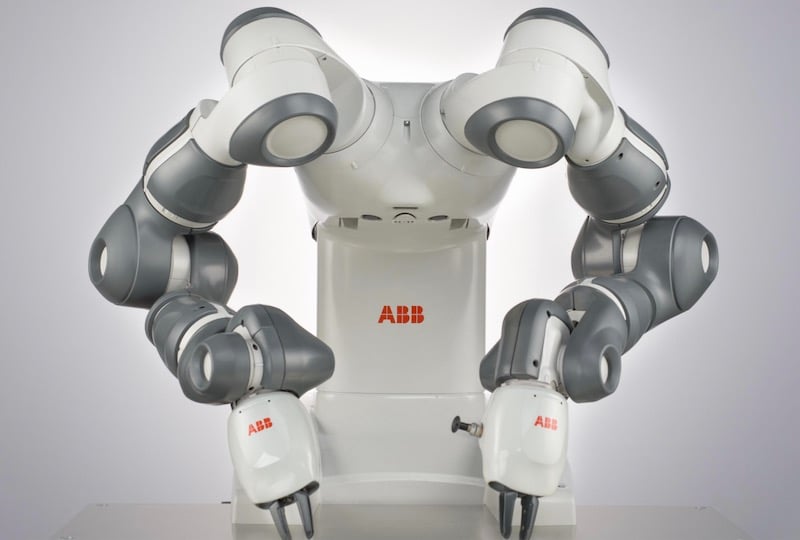
ABB works alongside partners in clinical and biomedical research to embed automated robotic solutions into laboratory processes. Image used courtesy of ABB
Robotics and Automation for Enhanced Diagnosis
Roche intends to integrate automation within laboratory workflows (through collaboration with ABB Robotics) to allow human researchers and laboratory technicians to sidestep mundane, repetitive tasks, allowing them to focus on critical analysis and further research and development, which can help advance medical test screening, diagnosis, pharmaceutical development, and, at the end-point, enhanced patient care through efficient, targeted treatment.
According to the World Health Organization, diagnostic test results are a fundamental baseline for deciding on treatment pathways for patients, contributing to around 70% of healthcare decisions. A laboratory environment requires specialists, trained scientists, and technicians to run machines and carry out complex, hygiene-critical protocols—which also require highly repetitive tasks and standardized sample preparations—to execute diagnostic testing that is efficient and error- and contaminant-free. Such dedicated lab experts are available, but a critical shortage spurs the adoption of specialized robotics and automation solutions.
How will ABB and Roche be working together to change the nature of clinical testing for the healthcare industry? Video used courtesy of ABB
Roche and ABB
Roche will bring its world-leading expertise in laboratory diagnostics to the table while ABB will provide artificial intelligence-supported, industrial-grade robotics and automation solutions.
The key area of focus will center on integrating ‘more autonomous and versatile robotics’ solutions into Roche’s pathology business segment and central diagnostics labs. For the pathology business segment, ABB will focus on delivering automated solutions to help with sample slide manipulation and organization. For the central diagnostics labs, ABB plans to provide autonomous mobile manipulators to help move diagnostic samples from one machine to another. This can help speed up diagnostic procedures and free up laboratory technicians and researchers, giving them valuable time to focus on analysis, fine-tune procedures, and further research and development. The interplay between robotics and automation and human-led diagnostic processing is intended to improve flexibility and speed up decision-making, and by extension, improve patient treatment.
A Breakthrough in Automation at Texas Children’s Hospital
In other news, ABB has made active progress in helping advance research in neurological diseases at Texas Children’s Hospital through the joint development of an automated fruit fly transfer workstation. ABB worked alongside Jan and Dan Duncan Neurological Research Institute to develop this first-of-its-kind automation solution.
See the YuMi robot in action, transferring vials of fruit fly just as human researchers would, freeing up their time and boosting process efficiency. Video used courtesy of ABB
ABB and Duncan NRI worked together to produce a robot-based solution for the anesthetic-free transfer of fruit flies to new vials containing food to maintain laboratory populations for further study. The fruit fly is a commonly used model organism in biomedical research, which shares particular genetic markers with humans. Typically, laboratory researchers would spend 20% of their time “flipping flies,” turning over around 20,000 vials every 30 days. Automated methods for this process used to involve exposing flies to conditions outside of the vials, which called for sedation to reduce stress. This can cause strain loss and, of course, add to the time needed to execute the procedure.
The ABB–Duncan NRI partnership produced a solution combining the YuMi robot with a barcode and labeling unit, and a table with vials stacked and ready for transfer. The YuMi robot can read barcodes and print labels with fly strain and genetic information (pertinent to a specific study) to allow for proper tracking and management. The YuMi robot opens the protective cellulose acetate plug, taps upended vials, and transfers the flies in much the same way as humans do: taps, labels, and scans them. The YuMi robot can place vials within standard cardboard racks with precision, reducing material costs by enabling researchers to use existing racks in their research unit.
Physical, safety–conscious, AI-backed automation such as these solutions developed and promoted by ABB is fast becoming the new mode of human-machine operational workflows in clinical and biomedical research environments, opening up new levels of flexibility and efficiency for healthcare and scientific research.