Facebook
 Google
 GitHub
 Linkedin
ABB and Agilent Unite to Advance Automation in Laboratories
ABB Robotics has teamed up with Agilent Technologies to integrate robotics and automation into laboratories. The companies aim to increase throughput, enhance quality control, and upskill workers.
Enhancing quality control, improving protocol efficiency, and boosting time to market or to a completed peer-reviewed thesis are the key attractions to onboarding robotics and automation in the life sciences industry. ABB Robotics and Agilent Technologies are striving to bring such benefits to pharmaceutical and biotechnology laboratories worldwide through their latest expertise- and knowledge-sharing-focused partnership.
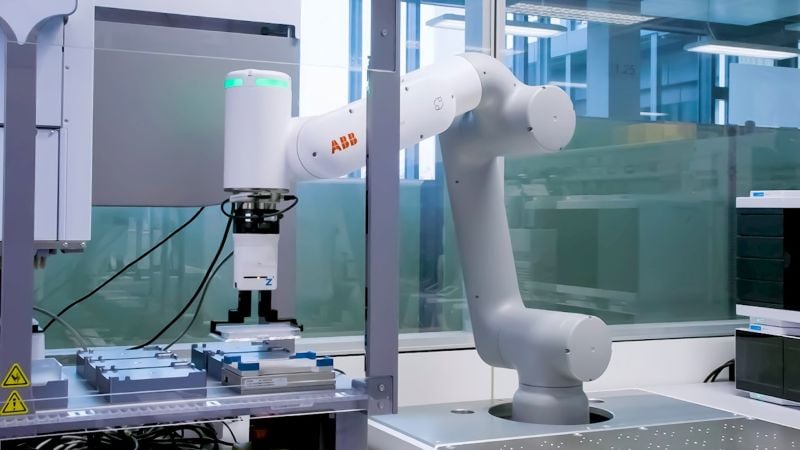
ABB will combine its robotics hardware and software knowledge with Agilent’s analytical instrument expertise to enhance automation in laboratories. Image used courtesy of ABB
Enhancing Throughput and Quality Control
In biotechnology, pharmaceutical, and academic biological and chemical laboratories across the globe, there is an emerging adoption of automated laboratory technologies to help alleviate the mundane, repetitive, labor-intensive, and error-prone nature of sampling, testing, and evaluation required to generate products and innovative methodologies and commercialize them.
Manual handling of biological samples can be a sensitive operation requiring sterile techniques that, if not carried out properly, can lead to contamination, error, and unprofitable results. Further, manual troubleshooting of complex protocols consumes a substantial amount of time and effort required to get research objectives back on track so that pharmaceutical companies and research institutions can keep products and outcomes mobilized toward achieving specific and relative goals.
This is where automation can help augment the fine-tuned skills and capabilities of scientists to cut down on protocol lead times, standardize procedures, and reduce errors/contamination through precise robotic path planning, artificial intelligence-supported task training, 24/7 uninterrupted operation, and high repeatability.

Automating laboratory tasks can improve accuracy, reduce labor, save time, and enhance sample throughput. Image used courtesy of Pixabay
Laboratory Automation Solutions
Beyond precision handling and consistency, robotics and automation can improve data gathering, analysis, and archiving in laboratories. Automated systems can work with laboratory information management systems (LIMS) to provide precise, real-time data logging, lowering the likelihood of transcription errors.
Machine vision technology can also help with identifying anomalies, quality assurance, and sample verification, which increases experiment reliability in high-throughput settings. Reagent utilization can be optimized using sophisticated robotic liquid handling devices, reducing waste and guaranteeing reproducibility in delicate tests. These solutions work together to increase laboratory efficiency while remaining compliant with regulatory norms.
Agilent Technologies
Agilent Technologies is a global provider of hardware and software solutions catering to analytical applications within the life sciences, including pathology, cell analysis, genomics, and much more. Amongst its product portfolio, the company offers microplate automation solutions spanning washers, dispensers, imagers, and readers.
One particular automation technology used by laboratories to increase sample throughput is Agilent’s ICP-OES Automation System, which includes an autodilutor, autosampler, advanced valve system, instruments, and software. The autosampler provides high-throughput sample presentation for unmanned analysis, and the dilution system handles dilution preparation. The advanced valve system increases the amount of samples analyzed in a day while reducing the need for regular maintenance.
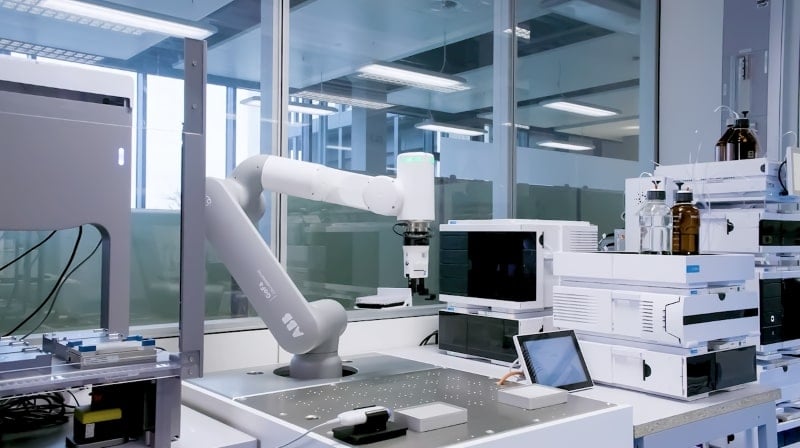
ABB’s partnership with Agilent builds on its earlier partnership with METTLER TOLEDO to expand laboratory automation. Image used courtesy of ABB
ABB and Agilent Unite
In 2024, ABB teamed with METTLER TOLEDO, a provider of analytical precision instruments, to combine their robotics with LabX, a laboratory instrument management software. This cooperation intends to improve laboratory workflows by optimizing communication between robotic technologies and laboratory instruments.
Now, ABB is combining its robotic technology with Agilent’s expertise in the life sciences and existing product portfolio of analytics instruments and innovative software to enhance laboratory workflows further.