Facebook
 Google
 GitHub
 Linkedin
Adlink and Lips Develop 3D AI Vision Sensing Solution for AMR Applications
Adlink and Lips have teamed up to create a 3D AI vision sensing solution for autonomous mobile robots (AMRs) powered by Nvidia Isaac Perceptor. The new solution is designed for use in manufacturing and logistics.
Adlink and Lips have combined their respective technologies to develop an AI-powered 3D vision sensing solution for autonomous mobile robots (AMRs). The solution integrates Adlink’s DLAP-411-Orin edge AI computing platform with Lips’ LIPSedge 3D cameras and is built on Nvidia’s Isaac Perceptor framework.
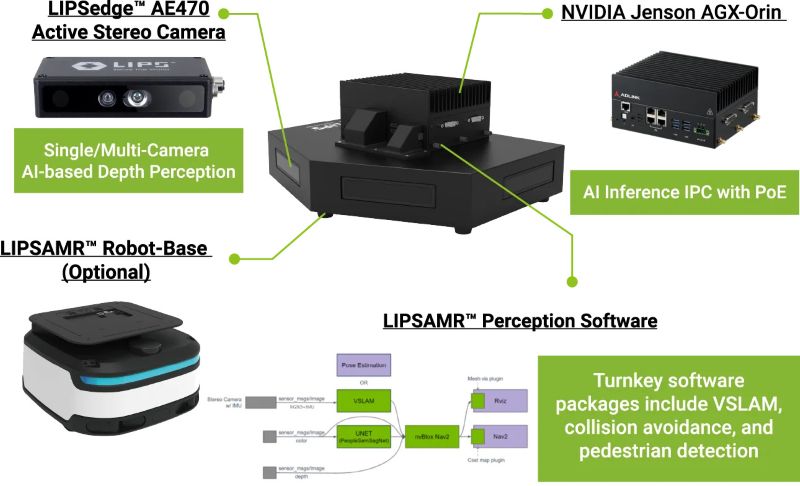
Adlink and Lips have combined their respective technologies to develop an AMR vision sensing solution. Image used courtesy of Lips
AMR 3D x AI Vision Sensing Solution
LiDAR-based navigation systems for use on AMRs have certain limitations that Adlink and Lips are looking to improve upon with their new AMR 3D x AI vision sensing solution. Traditional LiDAR-based navigation and vision systems often struggle with tasks, such as narrow field of view, low resolution depth sensing, and complex multi-camera integration. These constraints reduce AMRs' ability to navigate efficiently, avoid obstacles, and handle objects precisely.
Adlink and Lips’ new vision system is powered by Nvidia’s Isaac Perceptor. The system’s design hopes to address key limitations in existing AMR vision technology by offering enhanced 3D vision, a wider field of view, higher resolution, and AI-driven decision-making. The system includes LIPSedge AE active stereo 3D cameras that deliver a high resolution and a wide FOV for enhanced depth perception. This ensures that AMRs can detect objects more accurately. This level of accuracy will be useful for warehouse logistics, material handling, and automated quality inspection.
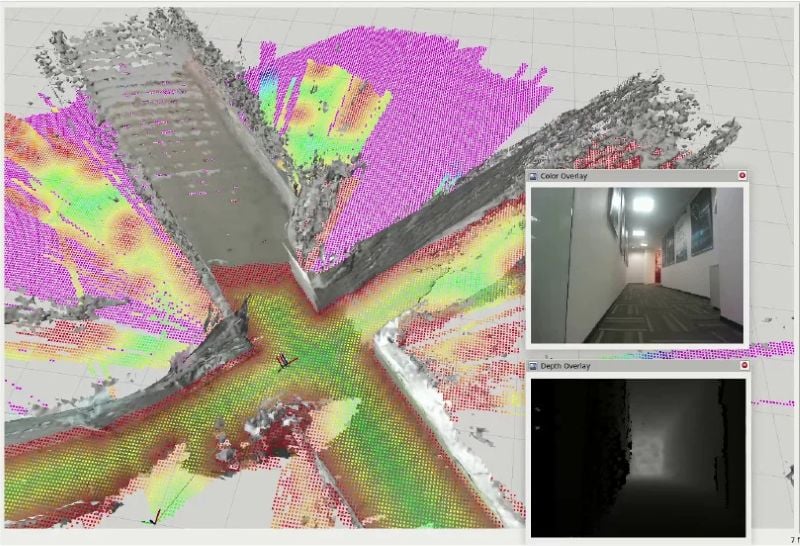
A look at Adlink and Lips’ vision system utilizing Lips’ LIPSAMR perception software for path planning and collision avoidance. Image used courtesy of Lips
AMR Deployment and Navigation
The AMR 3D x AI vision sensing solution features simple integration to reduce development time. Robotics development often requires complex software and hardware integration, leading to long deployment cycles. Adlink and Lips’ vision system is a Nvidia-certified complete solution that seamlessly integrates with existing robotic systems. This can help reduce development time while accelerating the deployment of the system into industrial applications.
Additionally, Adlink and Lips have introduced enhanced navigation and object handling in unstructured environments for the vision solution. This is useful since AMRs must navigate continuously moving, cluttered environments while performing tasks like payload extraction and placement. The new solution’s AI-driven depth sensing and real-time 3D occupancy grid mapping can improve an AMR's ability to operate in unstructured industrial settings, boosting productivity and worker safety.
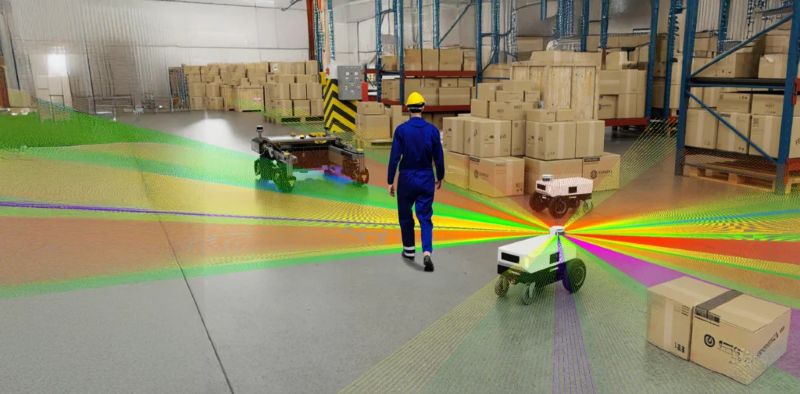
Adlink and Lips’ vision system’s multi-camera synchronization enables AMRs to be used in complex multivision applications. Image used courtesy of Lips
Multi-Camera Synchronization
The use of a simplified multi-camera synchronization in Adlink and Lips’ AMR vision system enables navigation in complex environments. Integrating multiple cameras for real-time 3D perception has traditionally been complex and computationally demanding. The AMR 3D x AI vision sensing solution enables functional multi-camera synchronization, reducing integration challenges and improving depth sensing, object detection, and robotic navigation.
Furthermore, the system’s use of AI-driven computational power makes for better real-time decision-making. Since advanced robotic vision systems require significant AI processing, Adlink and Lips have included enough power for the system to make real-time decisions. The DLAP-411-Orin platform, powered by Nvidia Jetson AGX Orin, delivers strong computing performance, enabling real-time AI inference, stereo visual odometry, and intelligent object recognition. This ensures faster, smarter, and more accurate AMR operations.
Advancing Autonomous Navigation
As the demand for automation, robotics, and intelligent logistics continues to grow, industries will require more precise, efficient, and intelligent robotic systems. New advances in vision systems, like those from Adlink and Lips, look to provide manufacturers with advancing technology for a more advanced manufacturing ecosystem. The addition of AI-driven processing to aid in real-time decision making can help make autonomous systems much more accurate and advanced as automation moves forward.