Facebook
 Google
 GitHub
 Linkedin
Aerotech Launches Miniature Hexapod for Precise Motion Control
Aerotech’s new miniature Hexapod is a six degree-of-freedom positioning system that offers quick, precise motions for the semiconductor industry and optical alignment applications.
Aerotech has released an even smaller version of its popular Hexapod positioning system. The HexGen HEX150-125HL miniature hexapod is designed for precise six degree-of-freedom (DoF) control in tight spaces, making it suitable for high-precision tasks in manufacturing and inspection.
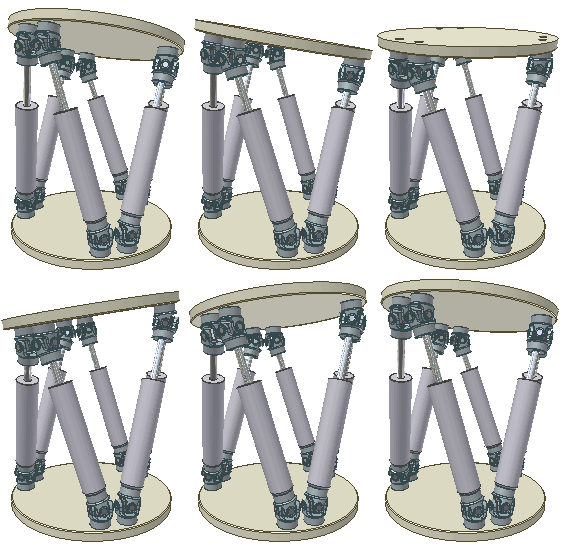
Aerotech’s Hexapod positioning system utilizes a Stewart platform for precise motion control. Image used courtesy of Wikimedia Commons
What Is a Stewart Platform?
A Stewart platform uses six linear actuators to move a platform relative to the base. Three of these control linear movements and the other three control roll, pitch, and yaw. Instead of thinking of positioning as movement along the x, y, and z axes, the Stewart Platform has a full six DoF, allowing for rotations and tilts. While the object still has an x, y, and z position in space, the ability of the Hexapod to move in multiple directions and tilt adds a whole new level of flexibility to positioning.
Stewart platforms are commonly used in flight simulators, virtual reality environments, CNC machining, and other robotics environments, so they are a tested and reliable technology. Using a Stewart platform, Aertoech’s Hexapod product line offers a unique way to position components precisely.
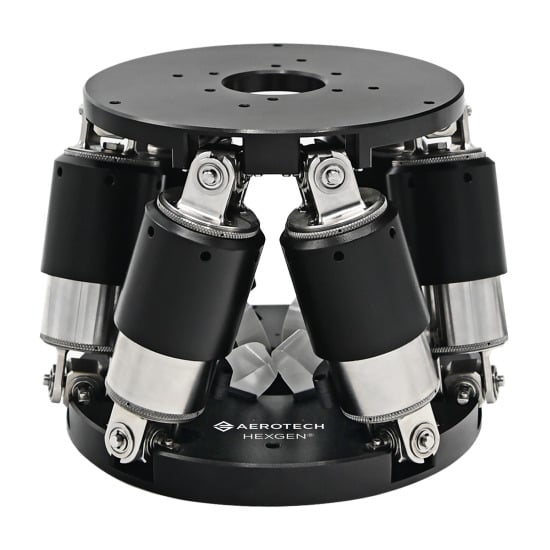
The HEX150-125HL miniature hexapod features a base diameter of 150 mm and a height of 125 mm. Image used courtesy of Aerotech
HEX150-125HL Miniature Hexapod
Even though it is small, it is mighty. With a 150 mm stage and 125 mm lift height, Aerotech’s HexGen HEX150-125HL Miniature Hexapod is a six-DoF positioning system capable of handling payloads of up to 12 kg. The stage has a large hole in the center for safely routing cabling to the stage. It also has several mounting holes to attach devices to the stage to hold them in place during quick motions and high angles.
Lifting capacity and a well-designed stage are only part of the features. One of the most impressive stats on the newest Hexapod is the movement resolution. Motion control is possible down to 15 nm, making it suitable for tasks such as moving a detector for X-ray diffraction characterization or other nanoscale operations.
Another key advantage of the miniature Hexapod is the speed at which it can perform movements. Just as a flight simulator has to move quickly to simulate the forces a pilot might experience during certain maneuvers, the Hexapod product line can also respond quickly, moving up to 30 mm/s or 30 °/s. This speed drastically increases throughput in a quality control or assembly production line, allowing for multiple measurements to be performed quickly.
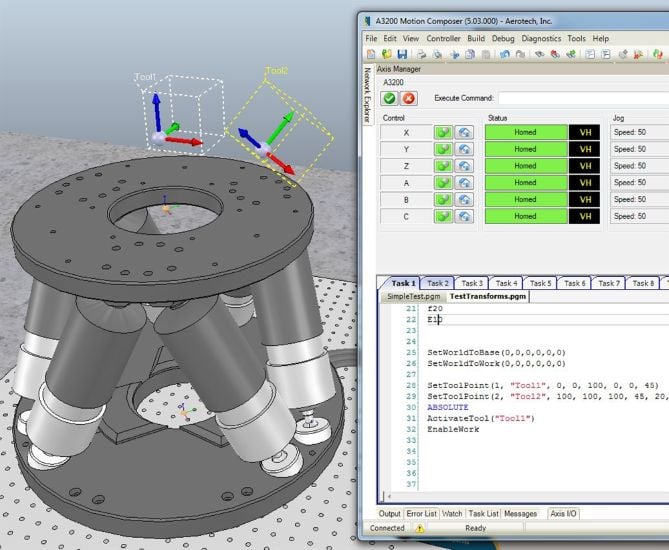
The HEX150-125HL features incremental motion down to 15 nm for nanoscale operations. Image used courtesy of Aerotech
One feature and drawback to the Stewart platform is the complexity of motion. While the design allows for greater flexibility and precision control of movement, it can also be more complicated to program than a standard x, y, z set of controls. This is another way the HEX150-125HL excels. The miniature Hexapod features an intuitive software interface designed to make coding motion significantly easier.
Precision Motion Control
The HEX150-125HL will serve markets similar to its bigger hexapod brother. Its compact size, however, enables it to be installed in smaller spaces. In particular, it will be deployed in the semiconductor and optical device markets for optical wafer probing, alignment of optical components in laser systems, photonic device manipulation, inspection, placement of fine objects for bonding, and other such applications.