Facebook
 Google
 GitHub
 Linkedin
AI Agents from Siemens Tackle Labor Gaps in Industry
Siemens expands its Industrial Copilot platform with autonomous AI agents to automate workflows and ease skilled labor shortages.
Manufacturers around the world are feeling the pressure. A growing skills gap, an aging workforce, and increasingly complex production systems are making it harder to meet demand. While automation has long been the go-to solution, many existing systems still require skilled professionals to manage them, limiting their potential to fully transform industrial productivity. Siemens is stepping in with a bold new solution. At Automate 2025, the company released an expansion of its Industrial Copilot platform, introducing AI agents capable of executing entire workflows on their own. These aren’t just virtual assistants, they’re autonomous digital workers, guided by a central orchestrator that assigns tasks to the right agent at the right time. Siemens estimates this shift could boost productivity by as much as 50%, offering an edge to manufacturers navigating ongoing labor challenges.

Siemens logo. Image used courtesy of Wikipedia
Smarter Interfaces, Deeper Intelligence
At the core of Siemens’ approach is a clear division of labor. Users interact with intuitive tools known as Industrial Copilots, while AI agents operate behind the scenes. These agents do the heavy lifting, such as interpreting instructions, pulling in data, coordinating with other agents, and completing tasks independently. Take the Design Copilot, for example. It works with Siemens’ NX CAD software to speed up product development, helping engineers explore design options and access technical insights without leaving their workflow. Siemens is also working on a Hydrogen Configurator that will help design hydrogen plants more efficiently, automating complex layout and planning processes.
Meanwhile, the Planning Copilot, currently in pre-release, uses generative AI to optimize production schedules and resource allocation. It helps companies plan smarter, cut waste, and stay agile in a volatile market. The Engineering Copilot that is integrated into Siemens’ TIA Portal also enables engineers to generate automation code through natural language prompts, reducing repetitive tasks and minimizing coding errors.
A Collaborative Web of AI Agents
What truly sets Siemens apart is how these agents interact with each other. They operate as part of a coordinated, multi-agent ecosystem. Each AI agent can access and communicate with others, both from Siemens and external providers, making the entire system smarter and more adaptable. These agents also extend into the physical world. Siemens is integrating mobile robots into its agent architecture, enabling a hybrid model where digital and physical agents collaborate in real time. A central orchestrator keeps everything running smoothly, ensuring the right agent is always on the job.
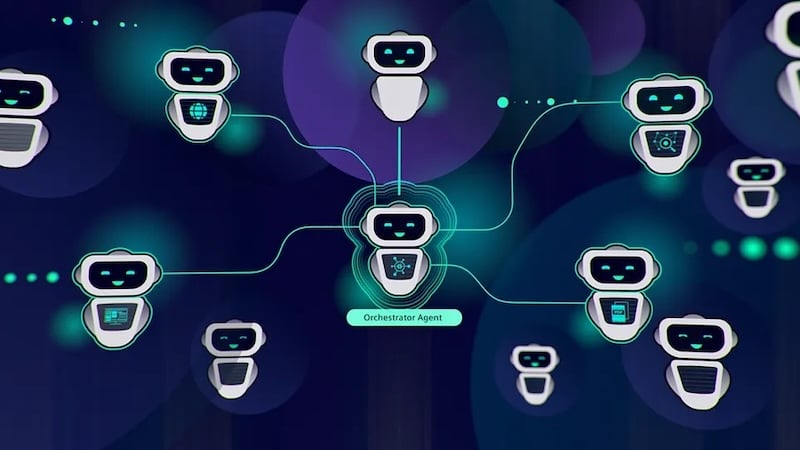
An image to represent AI agents collaborating. Image used courtesy of Siemens
One area of rapid development is operations. By the end of 2025, Siemens plans to release an Operations Copilot for frontline workers, enabling technicians to diagnose and fix machine issues by asking questions in plain language. In process industries, technicians already benefit from Simatic eaSie, which provides quick access to plant data through voice or text, improving both safety and efficiency.
Siemens is building an AI agent marketplace on its Xcelerator platform to accelerate adoption. This digital hub will offer a wide range of agents developed by Siemens and other third-party vendors. Manufacturers will be able to browse, adopt, and integrate AI agents tailored to their specific needs, unlocking new potential across all stages of production.
Tangible Results and a Path Forward
The impact is already being felt. At Thyssenkrupp Automation Engineering, developers using the Engineering Copilot have reported gains in both code quality and development speed. The Production Copilot has turned scattered data into useful insights at Siemens’ Bad Neustadt plant, enhancing daily operations. Just as importantly, these AI agents are helping close the industrial skills gap. With user-friendly interfaces and automation that doesn’t require deep technical know-how, Siemens is making industrial AI more accessible to teams across the board.
"In a factory environment, our Industrial AI agents connect different copilots and automate workflows across the entire value chain. This creates a unified approach that makes industrial AI accessible to everyone, regardless of their technical background or experience level," said Rainer Brehm, CEO of Factory Automation at Siemens.
Redefining Industrial Workflows Through Intelligence
Labor shortages and increasing production complexity continue to pose significant challenges to manufacturers worldwide. Siemens’ autonomous AI agents offer a practical solution. By freeing workers from routine operations, Siemens is paving the way for more resilient industrial systems.
Related Content