Facebook
 Google
 GitHub
 Linkedin
Siemens Unveils Digital Twin Composer for the Industrial Metaverse
Introduced at CES 2026, Siemens’ Digital Twin Composer connects digital twins, operations data, and industrial AI.
Siemens has introduced its Digital Twin Composer technology as part of the Siemens Xcelerator portfolio, aiming to accelerate the realization of the industrial metaverse. Unveiled at CES 2026, the platform unifies 2D and 3D digital twin data, real-world operational data, and NVIDIA Omniverse technologies to enable large-scale industrial simulation and AI-driven optimization. Early adopters such as PepsiCo report gains in throughput, faster design cycles, and reduced capital expenditure by validating factory designs virtually before physical implementation.
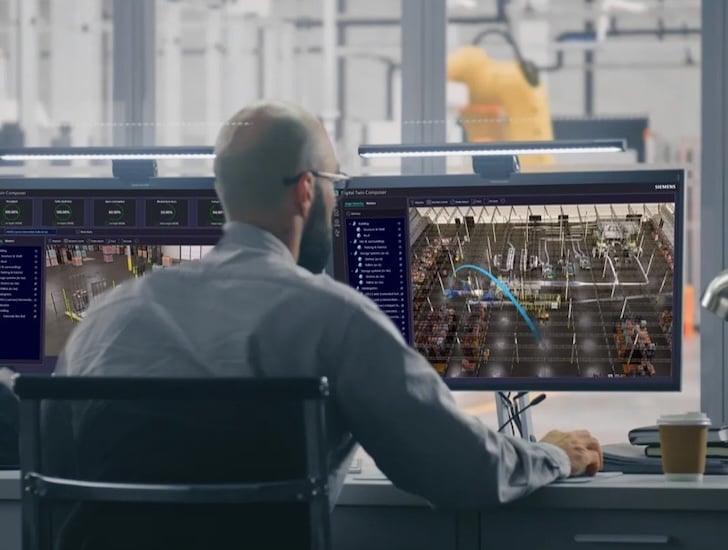
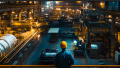
The Siemens Digital Twin Composer builds a virtual facility where users can test and run simulations to find the best way to scale operations. Image used courtesy of Siemens
How Does it Work?
The Digital Twin Composer serves as an integration layer, blending three key elements: 2D and 3D digital twin data, real-world (or physical twin) data, and specialised NVIDIA Omniverse libraries. This combination of elements allows users to design and build industrial metaverse factories (from product to machine to systems) at scale.
When we talk about 2D and 3D data (the “geometry”), we refer to true-life computer-aided design (CAD) models and complete 3D blueprints of industrial facilities (from tools such as Siemens NX within the Xcelerator portfolio), engineering simulation data, and automation logic (from TIA Portal). Other 2D and 3D data might include wiring setups and schematic diagrams.
The second pillar of real-world data feeds into the Digital Composer, which comes from PLC code running machines on the physical factory floor, manufacturing Execution software (MES), and industrial IoT sensors.
U.S. Manufacturing in the Digital Age
PepsiCo is leveraging the capabilities of the Digital Twin Composer to help facilitate digital transformation within its facilities. The OpenUSD (Universal Scene Description) framework, available through NVIDIA Omniverse, aggregates intricate data from many 2D and 3D engineering programs. The software utilises RTX Technology to generate photorealistic lighting and elements, which are essential for training AI-based computer-vision. PhysX integration lets simulated objects respond to physical gravity and friction.
This physically authentic environment enables corporations such as PepsiCo to deploy Industrial AI Agents that can run and test thousands of industrial design concepts, logistics solutions, and product configurations, detecting up to 90% of potential errors before physical construction. This foresight in industrial facility construction and long-term operational growth saves time that would otherwise be spent on rework, associated costs, and resources, thereby positively impacting enterprise sustainability goals.
Siemens is working alongside NVIDIA to deliver the future of industrial systems. Video used courtesy of NVIDIA
By implementing Siemens Digital Twin Composer, PepsiCo says it has achieved a 20% increase in throughput and sped up its design cycles. The company has also nearly achieved 100% design validation and has reduced its Capex (capital expenditure) by 10 to 25%.
From Concept to Reality
The Digital Twin Composer is a powerful tool essential to driving digital transformation across industries. Companies that are investing in their digital transformation journey can use the Digital Twin Composer to bring together siloed data from design, engineering, and operations teams to gain a systematic, bird's-eye view of their facilities from a virtual perspective. The ability to test ideas for feasibility from the level of thought and virtual projection, to implementing the best physical solution, will change manufacturing for good and lead to exponential growth and ingenuity.
Related Content