Facebook
 Google
 GitHub
 Linkedin
All-in-One Energy Monitoring for Smarter Industrial Power
A new energy monitoring system from Carlo Gavazzi brings power measurement, cloud connectivity, and local dashboards into a single industrial device.
Understanding when and where energy is consumed is a critical step toward improving industrial efficiency. Carlo Gavazzi’s EMS power monitor combines current measurement, data logging, edge gateway functionality, and an integrated web server into a single device. Designed for scalable deployments, the system supports multiple plug-and-play meters and modern IIoT communication protocols, enabling engineers to monitor power usage locally or in the cloud and make informed decisions to reduce energy waste.
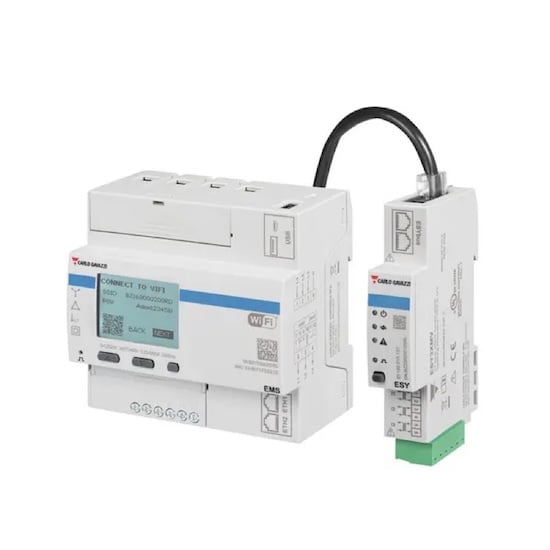
The EMS power monitor with an additional monitor attached. Image used courtesy of Gavazzi Automation
Energy Monitoring For Industrial Applications
An important step in reducing our carbon footprint is understanding where and when energy is consumed. Once we have this data, we can make changes to our processes and automation to reduce overall energy consumption and spikes. Recently, Carlo Gavazzi released a single- and three-phase current-monitoring device that is not just a current meter but also an edge gateway, data logger, and web server. Up to 10 additional meters can be added to the EMS meter to create a scalable current monitoring system.
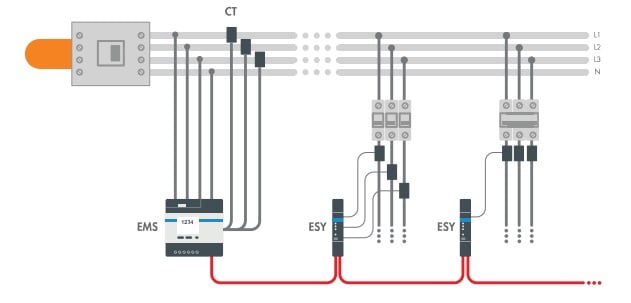
Typical connection of the EMS and two EYS monitors. Image used courtesy of Gavazzi Automation
The EMS Current Monitoring System
The EMS is a Linux-based power monitor capable of monitoring three single-phase or one three-phase power source. The data can be logged internally or exported via multiple supported communication channels. Configured via the integrated web server, the EMS can easily be set up and monitored in a matter of minutes.
To monitor multiple circuits, the EMS can be combined via a standard Ethernet cable to any one of the ESY plug-and-play meters from Carlo Gavazzi. Up to 10 meters can be daisy-chained to a single EMS, creating a complete power-monitoring solution.
Both the EMS and the optional monitors are DIN-mounted and designed to be installed near protection devices within the electrical cabinets. Connections are made with screw terminals and are compatible with stranded or solid copper wires up to 2.5 mm². An integrated LCD can be used to identify initial problems or configure WiFi settings.

Data represented on a dashboard. Image used courtesy of Unsplash
IIoT Compatibility
A power monitor wouldn’t be much without a way to view the data, so the EMS is fully equipped with the latest IIoT communication protocols. Analysis data can be transmitted via BACnet, MQTT, FTP, SFTP, FTPS, and REST API. The EMS has on-board WiFi capability and can connect directly to AWS or Microsoft Azure.
When remote access is required, additional hardware is not needed with the EMS. The MAIA Cloud SaaS web app enables remote connection and fleet management for energy monitoring and building automation devices. The app can be used for troubleshooting, commissioning, and firmware updates.
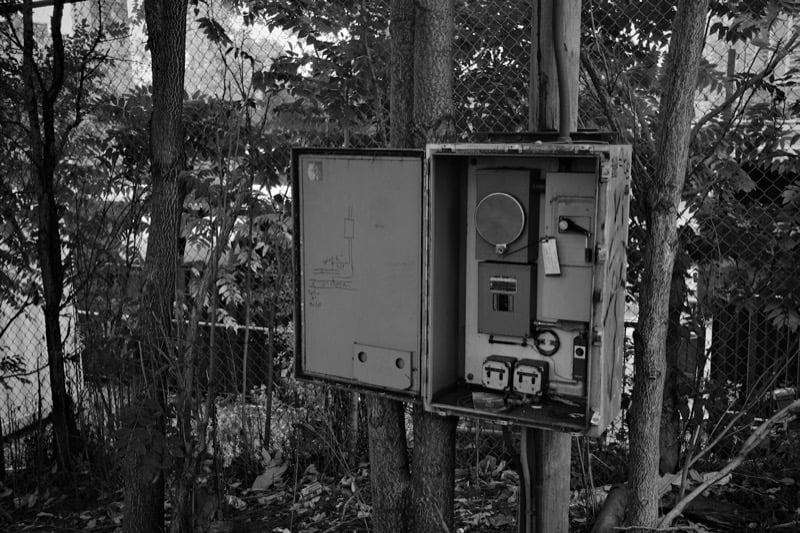
Archic method of monitoring power consumption. Image used courtesy of Unsplash
Viewing Data
Being able to view and analyze data allows engineers to make informed decisions about energy consumption. With the EMS running its own web server, the data can be viewed by simply entering the device's IP address into a web browser. Data such as voltage, current, frequency, and run hours can all be analyzed from the included dashboard. If you would like to create your own dashboard that combines a network of EMS monitors, the REST API can be used to gather data from every EMS device on the network and store it in a central database.
The First Steps To A Greener World
To fix a problem, we need to identify the root cause. The EMS from Carlo Gavazzi provides the information to find the root cause. Data collected from the EMS power monitor can be used to identify when and where power spikes occur. Technicians and engineers can then begin fixing the spikes, thereby making the power system more efficient.
Related Content