Facebook
 Google
 GitHub
 Linkedin
Acromag Releases I/O Modules With Dual-Band Wi-Fi Connectivity
The new NTW series wireless I/O modules include secure, dual-band Wi-Fi, making it easier to monitor and control systems remotely when running cables is not an option.
Acromag has released the BusWorks NTW series wireless I/O modules to address the problems of using wired Ethernet in remote or hard-to-reach places. With secure Wi-Fi connectivity added to the NT I/O platform, sensors and actuators can now connect to control systems without the need for cables.
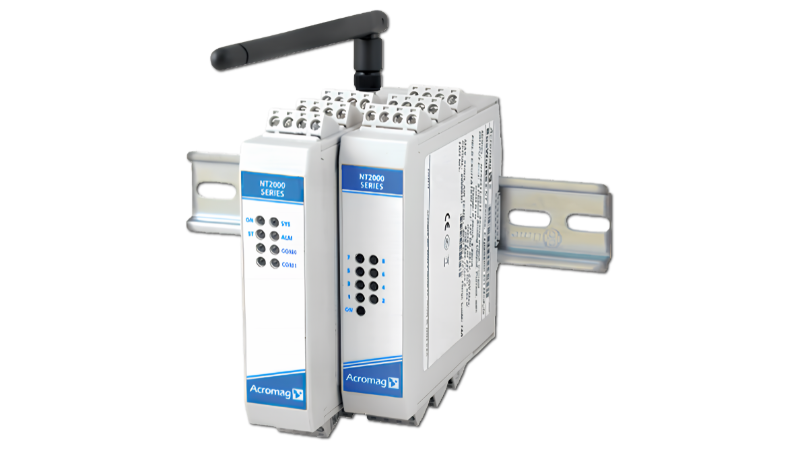
The new NTW series modules feature dual-band Wi-Fi connectivity. Image used courtesy of Acromag
BusWorks NTW Series Wireless I/O Modules
The NTW series wireless I/O module is based on Acromag's NT Ethernet I/O family. The series retains the modular design and is compatible with existing I/O setups and expansion modules. The NTW series includes built-in, dual-band Wi-Fi for 2.4 GHz and 5 GHz, meeting IEEE 802.11 a/b/g/n standards. This gives stable and flexible network connections for different needs.
In addition to built-in Wi-Fi, the NTW series features a standard RJ45 port, allowing each module to connect to wireless or wired networks. This makes it easier to connect older Ethernet systems with new wireless setups using the same hardware. The module also supports daisy chaining over Ethernet, which helps expand networks and reduce cabling.
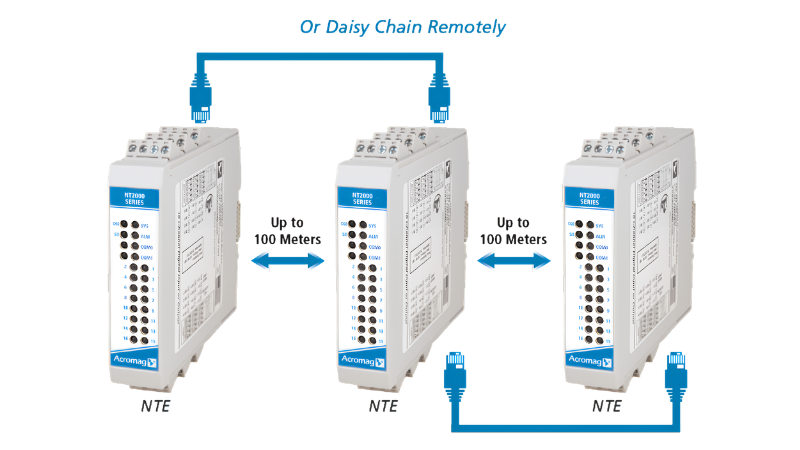
The NTW series modules feature an integrated RJ45 port that supports Ethernet daisy-chaining. Image used courtesy of Acromag
Modular and Scalable I/O Architecture
The NTW series works with all NTX expansion I/O modules, so users can add features as needed. Its modular design lets each setup be customized with the right mix of inputs and outputs, without needing new hardware. Each module supports up to 64 I/O points under a single IP address, simplifying network architecture while handling multiple channels in distributed systems. The platform supports different signal types, like discrete I/O, analog voltage, and RTDs, so one system can manage various sensing and control tasks in industrial settings.
The NTW modules are made to work reliably in tough industrial environments. They operate from -40°C to 70°C and resist vibration, shock, and electrical noise. Their compact 25 mm-wide housings fit easily into standard DIN rail control cabinets. Built with industrial-grade materials and designed to meet electromagnetic compatibility standards, these modules provide stable performance in many settings.
Industrial protocol and IIoT integration
Beyond physical connections, the NTW series supports Ethernet-based protocols like Modbus TCP/IP, EtherNet/IP, and PROFINET, making it easy to connect to existing control systems. For IIoT applications, the module can connect to cloud platforms and modern data systems using OPC UA, MQTT, and RESTful APIs. It also allows peer-to-peer communication, so modules can share data directly without a central controller.
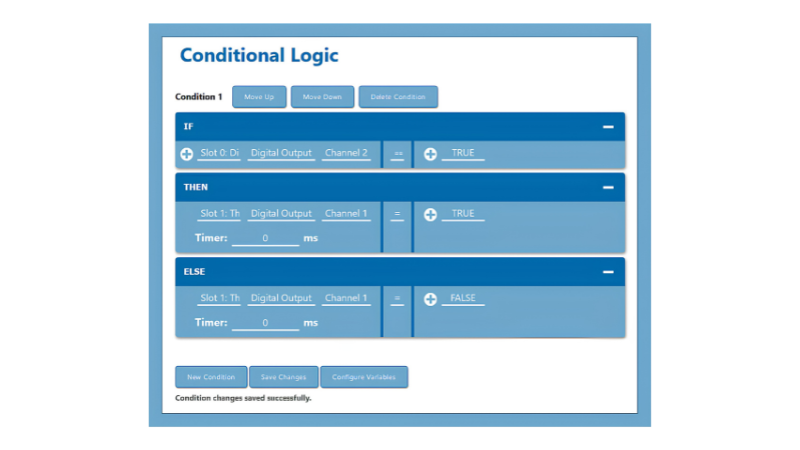
Acromag’s built-in conditional logic enables users to configure up to 64 complex IF/THEN/ELSE rules via a web interface without the need for traditional programming. Image used courtesy of Acromag
Secure Built-in Intelligence and Local Control
The NTW modules have built-in processing, so users can set up IF/THEN/ELSE rules directly on the device to trigger automatic responses to certain inputs. For example, a mix of temperature readings, thresholds, and digital inputs can turn on a relay without a PLC. With up to 64 configurable conditions, the module can handle complex decisions at the edge, reducing delays and the need for constant network connections.
The new NTW series addresses connectivity security risks with several layers of protection. Wi-Fi traffic uses WPA3 encryption, and data transmission is secured with TLS 1.2, PKI-based authentication, and X.509 certificates. AES 256-bit encryption also helps keep data safe, so the modules work securely even in industrial networks that may be exposed to outside access. By removing the need for a physical network, Acromag’s new solution enables engineers to deploy monitoring and control systems in areas that were previously impractical.